MCQ
major product $A$ and reaction $R$ are :
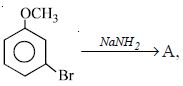
- ✓
 , elimination addition
 - B
 , elimination addition
 - C
 , cine substitution
 - D
 , addition elimination
, elimination addition, elimination addition, cine substitution, addition elimination, elimination additionGenerate a complete, print-ready paper with questions like this in minutes — across 16+ boards, with answer keys.
$(i)$ ${C_6}{H_5}{N^ + } \equiv NC{l^ - }$ $(ii)$ ${C_6}{H_5}{N^ + } \equiv N$
$(iii)$ ${{\overset{\centerdot }{\mathop{C}}\,}_{6}}{{H}_{5}}$ $(iv)$ $C_6H_5Cl$
Isomer $(P) \Rightarrow$ Can be prepared by Gabriel phthalimide synthesis
Isomer $(Q) \Rightarrow$ Reacts with Hinsberg's reagent to give solid insoluble in $NaOH$
Isomer (R) $\Rightarrow$ Reacts with $HONO$ followed by $\beta$-naphthol in $NaOH$ to give red dye.
Isomers $( P ),( Q )$ and $( R )$ respectively are
Here $A$ and $B$ on hydrolysis respectively gives
$A.$ The electron gain enthalpy of $F$ is more negative than that of $Cl$
$B.$ Ionization enthalpy decreases in a group of periodic table
$C.$ The electronegativity of an atom depends upon the atoms bonded to it.
$D.$ $Al _2 O _3$ and $NO$ are examples of amphoteric oxides.
Choose the most appropriate answer from the options given below: