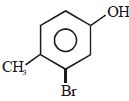
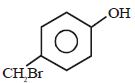
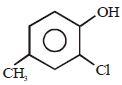
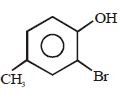
MCQ
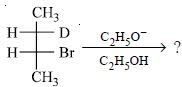
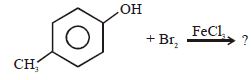
Major product of reaction :
  • A

  • B

  • C


Answer

Correct option: D.

d

Need a full question paper?

Generate a complete, print-ready paper with questions like this in minutes — across 16+ boards, with answer keys.

Start Generating Free

Similar questions

Product $(P)$ in the reaction is
In the given chemical reaction, colors of the $\mathrm{Fe}^{2+}$ and $\mathrm{Fe}^{3+}$ ions, are respectively :

$5 \mathrm{Fe}^{2+}+\mathrm{MnO}_{4}^{-}+8 \mathrm{H}^{+} \rightarrow \mathrm{Mn}^{2+}+4 \mathrm{H}_{2} \mathrm{O}+5 \mathrm{Fe}^{3+}$

$Pt(s)|Fe^{+2}(10^{-2}\ M, aq),\ $ $ Fe^{+3}(10^{-3}\ M, aq) || MnO_4^-(10^{-3}\ M, aq),\ $$Mn^{+2} (10^{-2}\ M, aq)$

$| Pt(s)$ At $298\ K$, $E^o_{cell}$ for cell is $- 2.31\ V$ , what will be the $E_{cell}$ at $pH = 1$ ? ........... $\mathrm{Volt}$

The chemical reaction: $Ba{O_{2(S)}}$ $\rightleftharpoons$ $Ba{O_{(s)}} $ $ + {O_{2(g)}}$’ $\Delta H = \,+ ve$. In equilibrium condition, pressure of $O_2$ depends upon
Consider the following reversible reaction at equilibrium, $2{H_2}{O_{(g)}}$ $\rightleftharpoons$ $2{H_{2(g)}} + {O_{2(g)}}$; $\Delta H = 241.7\,kJ$ Which one of the following changes in conditions will lead to maximum decomposition of ${H_2}{O_{(g)}}$
The number of moles of $K_2Cr_2O_7$ reduced by $1\,mol$ of $Sn^{+2}$
When initial concentration of a reactant is doubled in a reaction, its half-life period is not affected. The order of the reaction is
At $320\,K,$ a gas $A_2$ is $20\%$  dissociated to $A(g).$ The standard free energy change at  $320\,K$  and $1\,atm$   in $J\,mo1^{-1}$  is approximately

$(R= 8.314\,\,JK^{-1}\,\,mol^{-1};\,\,ln\,2 = 0.693;\,\,ln\,3 = 1.098)$

The ratio of number of oxygen atoms to bromine atoms in the product $\mathrm{Q}$ is  . . . .$\times 10^{-1}$.
Major product is :