MCQ
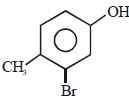
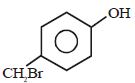
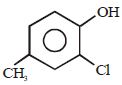
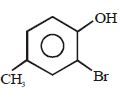
Major product of reaction :
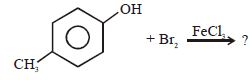
  • A

  • B

  • C


Answer

Correct option: D.

d

Need a full question paper?

Generate a complete, print-ready paper with questions like this in minutes — across 16+ boards, with answer keys.

Start Generating Free

Similar questions

Assertion : $NF_3$ is a weaker ligand than $N(CH_3)_3$

Reason : $NF_3$ ionizes to give $F^-$ ions in aqueous solution.

The freezing point of a $4\%$ by weight aq. solution of $A$ is equal to the freezing point of $10\%$ by weight aq. solution of $B$. If the molecular weight of $A$ is $60$ then the molecular weight of $B$ is
If $x$ is specific resistance (in $S^{-1}\,cm$) of the electrolyte solution and $y$ is the molarity of the solution, then ${\Lambda _m}$ (in $S \,cm^2\, mol^{-1}$) is given by
The mean values for the radial distance for different phosphorus orbitals are $3s:0.47\,\mathop A\limits^0 $,  $3p:0.55\,\mathop A\limits^0$ ,  $3d:2.4\,\mathop A\limits^0 $

When $P$ is going to form $PF_5$, then these radial distances are going to become arbitrarily ____,____and ____ respectively

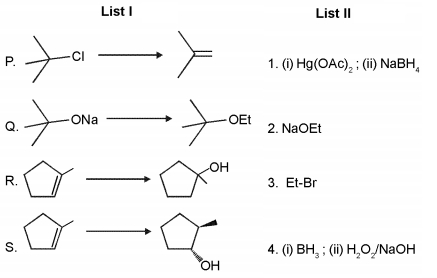
Match the chemical conversions in List $I$ with the appropriate reagents in List $II$ and select the correct answer using the code given below the lists :

Codes: $ \quad P \quad Q \quad R \quad S $
The osmotic pressure of a dilute solution of an ionic compound $XY$ in water is four times that of a solution of $0.01\,M\,BaCl_2$ in water. Assuming complete dissociation of the given ionic compounds in water, the concentration of $XY$ (in $mol\,L^{-1}$) in solution is
The standard reduction potentials at $298\,K$ for the following half reactions are given against each

$Z{n^{2 + }}\,(aq)\, + \,2e\, \rightleftharpoons \,Zn\,(s)\,;\, - \,0.762\,V$

$C{r^{3 + }}\,(aq)\, + \,3e\, \rightleftharpoons \,Cr(s)\,;\, - \,0.740\,\,V$

$2{H^ + }\,(aq)\, + \,2e\, \rightleftharpoons \,{H_2}(g)\,;\,\,\,0.00\,\,\,V$

$F{e^{3 + }}\,(aq)\, + \,e\, \rightleftharpoons \,F{e^{2 + }}(aq)\,;\,\,\,0.770\,\,\,V$

Which is the strongest reducing agent ?

Which of the following is not an element
For a very diluted solution preferred concentration unit is
When $AgNO_3$ is added to a solution of $Co(NH_3)_5Cl_3$, the precipitate of $AgCl$ shows two ionizable chloride ions. This means