Question
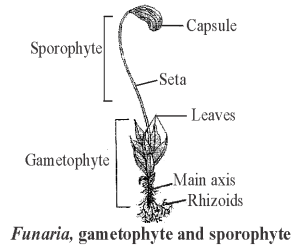
Make a labelled diagram of Funaria, Gametophyte and Sporophyte. Write any three differences between gymnosperms and angiosperms.
Need a full question paper?

Generate a complete, print-ready paper with questions like this in minutes — across 16+ boards, with answer keys.

Start Generating Free

Similar questions

Can you identify the correct sequence of taxonomical categories?
  1. Species → Order → Phylum → Kingdom
  2. Genus → Species → Order → Kingdom
  3. Species → Genus → Order → Phylum
What is the lymphatic system? Describe the functions of the lymph.
The conifer forests of the world cover huge areas of land and provide the largest terrestrial carbon sink. Conifers are also valued economically; their softwood is used for the production of timber, they are used to cultivate pine nuts, and the berries of the juniper bush are used to flavour gin. As in all other vascular plants, gymnosperms have a sporophyte dominant life cycle (the sporophyte is the diploid multicellular stage, which comprises the body of the plant, i.e., a leafy tree).The gametophyte phase is relatively short, and sees gametes produced on the reproductive organs.

(1) For a plant species to be 'dioecious', it must:
(a) Reproduce asexually
(b) Have both male and female organs
(c) Have separate male and female individuals
(d) Not reproduce

(2) Which division of the gymnosperms is most commonly used to create paper?
(a) Conifers  (b) Cycads  (c) Gnetophyta  (d) Gingkophyta(3) What role does the cone have in the gymnosperm life cycle?
(a) It is the seed
(b) It is the male gametophyte
(c) It is the reproductive body
(d) It feeds the embryo

(4) Conifers are adapted to tolerate extreme environmental conditions because of
(a) broad hardy leaves.
(b) superficial stomata.
(c) thick cuticle
(d) presence of vessel(5) Cycas and Adiantum resemble each other in having:
(a) seeds  (b) motile sperms  (c) cambium  (d) vessels
Define the following :
(i) Vasa Recta (ii) Homeostasis (iii) Podocytes (iv) Juxtamedullary Nephron.
Write the names of four groups of bacteria on the basis of shape. Name any four diseases caused by bacteria and draw any two picture of bacteria.
(i) The pelvic girdle forms part of our body. Write down four functions of the pelvic girdle.
(ii) Draw a labelled diagram of the right pelvic bone and the bones of the hind limb.
The fungi constitute a unique kingdom of heterotrophic organisms. They show a great diversity in morphology
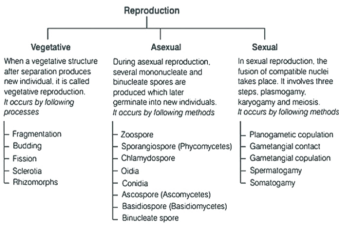
and habitat. Fungi are cosmopolitan and occur in air, water, soil, and on animals and plants. They prefer to grow in warm and humid places. Most fungi are heterotrophic and absorb soluble organic matter from dead substrates and hence are called saprophytes. When a fungus reproduces sexually, two haploid hyphae of compatible mating types come together and fuse. In some fungi, the fusion of two haploid cells immediately results in diploid cells (2n). The fungiform fruiting bodies in which reduction division occurs, leading to the formation of haploid spores. Symbionts - in association with algae as lichens and with roots of higher plants as mycorrhiza. Three types of reproduction occur in fungi

Image

i. Observe the given flow chart of reproduction and mention which steps involves in the sexual cycle of fungi.
(1)
ii. What is Rhizopus? Also, mention Rhizopus - wheat rush a correct match? (1)
iii. What is Mycorrhiza? And mention its function. (2)

OR

In which form Fungi Stores Food Material? Do fungi have food vacuoles? (2)
Name the respiratory organ of the following animals and draw a labelled diagram of the cross section of an air alveolus of a pulmonary vessel.
1. Hydra, 2. Earthworms, 3. Cockroaches, 4. Pelaemon, 5. Fishes, 6. Pigeons.