Question
Making use of the cube root table, find the cube root $1346$

Answer

By prime factorisation, we have:$1346 = 2 \times 673$
$\Rightarrow\sqrt[3]{1346}$ $=\sqrt[3]{2}\times\sqrt[3]{673}$ Also $670 < 673 < 680$
$\Rightarrow\sqrt[3]{670}<\sqrt[3]{673}<\sqrt[3]{680}$ For the difference $(680 - 670)$, i.e., $10$,
the difference in the values $= 8.794 - 8.750 = 0.044$
 $\therefore$ For the difference of $(673 - 670),$ i.e., $3$,
the difference in the values $=\frac{0.004}{10}\times3= 0.013$ (upto three decimal places)
$\therefore\sqrt[3]{673}$ $=8.750 +0.013$ $=8.763$ Now $\sqrt[3]{1346}$
$=\sqrt[3]{2}\times=\sqrt[3]{673}$ $=1.260\times8.763$
$=11.041$ (Up to three decimal places) Thus, the answer is $11.041$.

Need a full question paper?

Generate a complete, print-ready paper with questions like this in minutes — across 16+ boards, with answer keys.
Start Generating Free

Similar questions

Find the difference between the compound interest and simpal interest, On a sum of $Rs. 50,000$ at 10% per annum for $2$ years.
Construct a quadrilateral $ABCD$ given $AD = 3.5\ cm, BC = 2.5\ cm, CD = 4.1\ cm, AC = 7.3\ cm$ and $BD = 3.2\ cm$.
A cylindrical container with diameter of base $56\ cm$ contains sufficient water to submerge a rectangular solid of iron with dimensions $32\ cm \times 22\ cm \times 14\ cm$. Find the rise in the level of the water when the solid is completely submerged.
Verify whether the given statement is true or false: $\Big(\frac{-3}{5}\div\frac{-12}{35}\Big)\div\frac{1}{14}=\frac{-3}{5}\div\Big(\frac{-12}{35}\div\frac{1}{14}\Big)$
Construct a quadrilateral $ABCD$ in which $AB = 5.6\ cm, BC = 4\ cm,$ $\angle\text{A}=50^\circ,\angle\text{B}=80^\circ$ and $\angle\text{D}=80^\circ.$
$\frac{2\text{x}-1}{3}-\frac{6\text{x}-2}{5}=\frac{1}{3}$
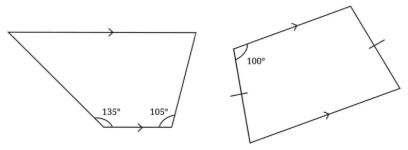
Find the remaining angles in the following trapeziums -
Image
Construct a quadrilateral $PQRS$ in which $QR = 7.5\ cm, PR = PS = 6\ cm, RS = 5\ cm$ and $QS = 10\ cm$. Measure the fourth side.
Express the number appearing in the following statements in standard form.
(i) 1 micron is equal to $\frac{1}{1000000} m$.
(ii) Charge of an electron is 0.00000000000000000016 coulomb.
(iii) Size of a bacteria is 0.0000005 m .
(iv) Size of a plant cell is 0.00001275 m .
(v) Thickness of a thick paper is 0.07 mm .
Represent the following data by a pie-diagram:
Items of expenditure
Expenditure
Family $A$
Family $B$
Food
$4000$
$6400$
Clothing
$2500$
$480$
Rent
$1500$
$3200$
Education
$400$
$1000$
Miscellaneous
$1600$
$600$
Total
$10000$
$16000$