Question
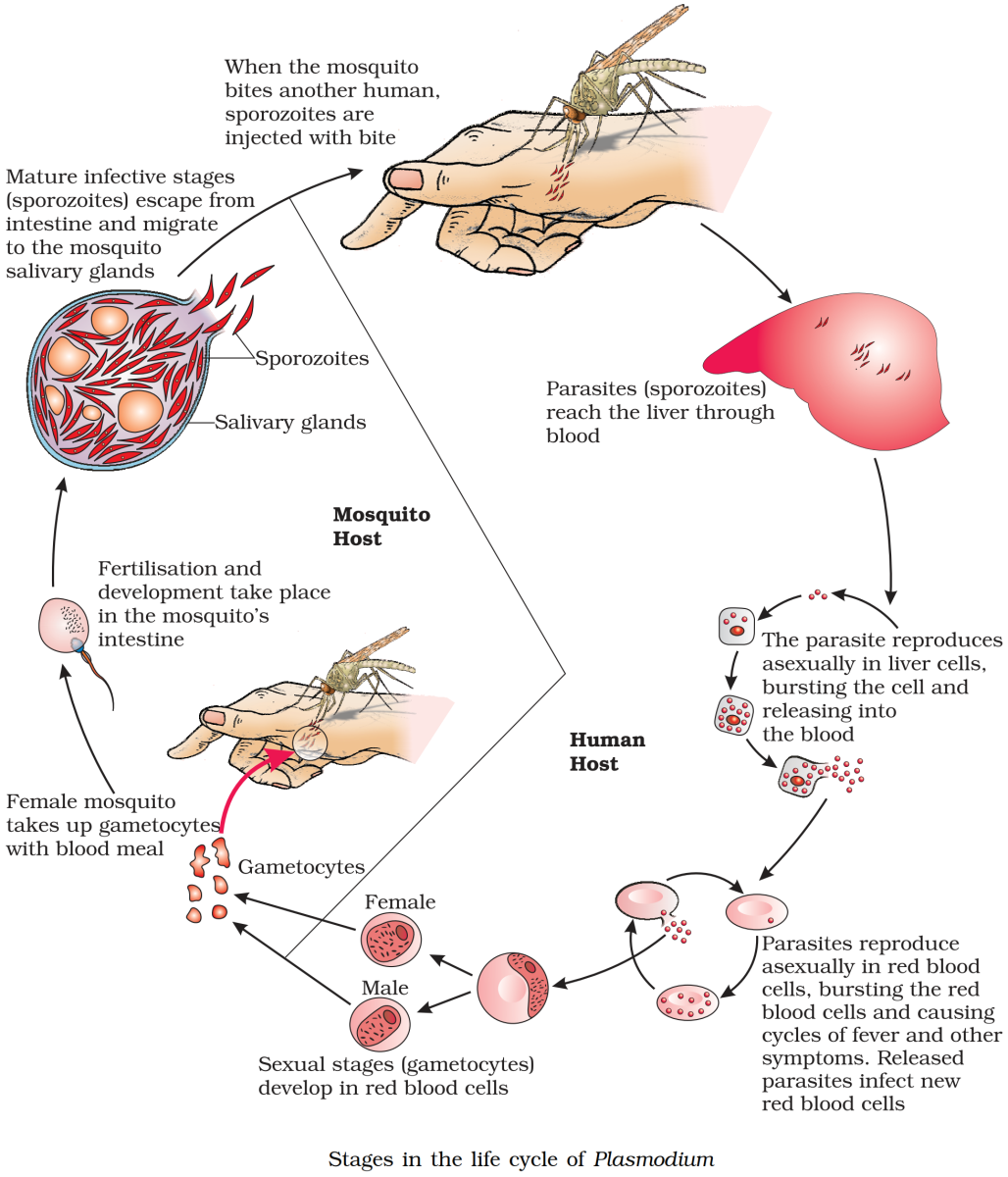
Malarial parasite ‘Plasmodium’ completes its life cycle in two hosts. Draw its complete life cycle and explain various stages it follows throughout its life.
Answer


Stages:

  1. The stage in which the parasite enters in the body of humans through saliva of mosquito-sporozoite stage.
  2. Asexual reproduction of sporozoites in liver cells, resulting into bursting of those cells and releasing outside into the blood.
  3. Sporozoites infect RBCs, cause them to get burst and represented by repeated cycles of fever. Released parasites also infect other RBCs.
  4. Parasites then follow sexual stage in RBCs which is called as ring signet stage and appears as a ring inside the RBCs under microscope. Usually presence of malarial parasite in humans is identified by pathologists by this stage.
  5. Female mosquito takes up gametocytes with the blood of host. Fertilisation and development takes place in the intestine of mosquito.
  6. From intestine, parasite comes to the salivary glands from where it reaches to human body and that is how the cycle continues.

Need a full question paper?

Generate a complete, print-ready paper with questions like this in minutes — across 16+ boards, with answer keys.

Start Generating Free

Similar questions

What is meant by the term bio-pesticide? Name and explain the mode of action of a popular bio-pesticide.
A flower of tomato plant following the process of sexual reproduction produce 240 viable seeds.
Answer the following questions giving reasons:
How many male gametes were involved in this case?
What evidence for biological evolution is obtained from, comparative anatomy? Describe in detail
Read the following and answer any four questions from (i) to (v) given below:

Crown gall is a neoplastic disease of most dicotyledonous plants and is caused by the soil bacterium Agrobacterium tumefaciens. A large extra chromosomal plasmid in these bacteria was found to be responsible for this disease. The plasmid is known as Ti plasmid. Bacteria free crown gall cells can be cultured in the absence of phytohormones. Ti plasmid is widely used in genetic engineering to deliver the desirable genes. The part of Ti plasmid transferred into plant cell DNA is called T-DNA. T-DNA with desired DNA segment is inserted into the chromosome of the host plant where it produces copies of itself.

  1. Which of the following is the full full of T-DNA?
  1. Transfer DNA.
  2. Tumour inducing DNA.
  3. Transgenic DNA.
  4. None of these.
  1. Ti plasmid cannot infect and develop crown gall in,
  1. Tomato.
  2. Maize.
  3. Soybean.
  4. sunflower.
  1. While making transgenic plant, T-DNA is inserted into the host cell, it is then:
  1. Integrated into the target host genome.
  2. Lie independent of the host genome.
  3. Rupture the host cell wall.
  4. Produce oncogenic factors in the host.
  1. Agrobacterium mediated gene transfer in plants:
  1. Allows relatively large segment of DNA.
  2. Transfer of DNA with defined ends and minimal rearrangement.
  3. High quality and fertility in transgenic plants.
  4. All of these.
  1. Assertion: In Agrobacterium mediated gene transfer in plants, transgenic plants do not develop tumors.

Reason: In T-DNA tumor producing genes are deleted during the process of gene transfer.

  1. Both assertion and reason are true and reason is the correct explanation of assertion.
  2. Both assertion and reason are true but reason is not the correct explanation of assertion.
  3. Assertion is true but reason is false.
  4. Both assertion and reason are false.
Explain the development of a secondary oocyte (ovum) in human female from the embryonic stage upto its ovulation. Name the hormones involved in this process.
Explain the surgical method of contraception with the help of a labelled diagram.###Write the name of a surgical contraceptive method and explain it which can be adopted by the male member of the couple.
What is placenta? Draw well labelled diagram of human embryo showing placenta in uterus and also write its four functions.
With the help of suitable diagram describe the logistic population growth curve.
Give a genetic explanation for the following cross. When a tall pea plant with round seeds was crossed with a dwarf pea plant with wrinkled seeds then all the individual of F1-population were tall with round seeds. However selfing among F1-population led to a 9:3:3:1 phenotypic ratio.
B. In the future, genetic therapies may be used to prevent, treat, or cure certain inherited disorders in humans. Justify the statement with a suitable example.