MCQ
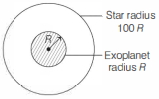
Many exoplanets have been discovered by the transit method, where in one monitors, a dip in the intensity of the parent star as the exoplanet moves in front of it. The exoplanet has a radius $R$ and the parent star has radius $100 \,R$. If $I_0$ is the intensity observed on earth due to the parent star, then as the exoplanet transits
  • A
    the minimum observed intensity of the parent star is $0.9 \,I_0$
  • B
    the minimum observed intensity of the parent star is $0.99 \,I_0$
  • C
    the minimum observed intensity of the parent star is $0.999 \,I_0$
  • the minimum observed intensity of the parent star is $0.9999 \,I_0$
Answer

Correct option: D.
the minimum observed intensity of the parent star is $0.9999 \,I_0$
d
(d)

Intensity of radiation (mainly visible light) emitted from surface of a star is proportional to its area.

So, $\quad I \propto A$ or $I=k A$

where, $k=$ constant.

Now, if $I_0=$ intensity of parent star.

Then, $I_0=k \pi(100 R)^2=k \pi R^2 \times 10000$

When exoplanet is in front of star,

observed intensity will be minimum. Let intensity minimum is $I_{\min }$, then

$I_{\min }=k\left[\pi(100 R)^2-\pi R^2\right]$

$\Rightarrow I_{\min } =k \pi R^2(10000-1)$

$=k \pi R^2 \times 9999$

$\text { So, } \frac{I_{min}}{I_0} =\frac{k \pi R^2 \times 9999}{k \pi R^2 \times 10000}$

$\Rightarrow I_{\min }=I_0 \times 0.9999$

Need a full question paper?

Generate a complete, print-ready paper with questions like this in minutes — across 16+ boards, with answer keys.

Start Generating Free

Similar questions

A negatively charged plate has charge density of $2 \times {10^{ - 6}}\,C/{m^2}$. The initial distance of an electron which is moving toward plate, cannot strike the plate, if it is having energy of $200\,eV$
Two waves are propagating to the point $P$ along a straight line produced by two sources $A$ and $B$ of simple harmonic and of equal frequency. The amplitude of every wave at $P$ is $‘a’$ and the phase of $A$ is ahead by $\frac{\pi }{3}$ than that of $B$ and the distance $AP$ is greater than $BP$ by $50 cm.$ Then the resultant amplitude at the point $P$ will be, if the wavelength is $1$ meter
A man in a car at location $Q$ on a straight highway is moving with speed $v$. He decides to reach a point $P$ in a field at a distance $d$ from highway (point $M$ ) as shown in the figure.Speed of the car in the field is half to that on the highway. What should be the distance $RM$, so that the time taken to reach $P$ is minimum?
The intensity level due to two waves of the same frequency in a given medium are $1\, bel$ and $5\, bel$. Then the ratio of amplitudes is
A projectile is thrown into space so as to have a maximum possible horizontal range of $400$ metres. Taking the point of projection as the origin, the co-ordinates of the point where the velocity of the projectile is minimum are
The largest distance between the interatomic planes of a crystal is $10^{-7}$ cm. The upper limit for the wavelength of $X-$ rays which can be usefully studied with this crystal is ............ $\mathop {\rm{A}}\limits^o $
A uniform electric field $E =(8\,m / e ) V / m$ is created between two parallel plates of length $1 m$ as shown in figure, (where $m =$ mass of electron and $e=$ charge of electron). An electron enters the field symmetrically between the plates with a speed of $2\,m / s$. The angle of the deviation $(\theta)$ of the path of the electron as it comes out of the field will be........
The equation $\lambda=\frac{1.227}{ x } nm$ can be used to find the de-Brogli wavelength of an electron. In this equation $x$ stands for :

Where,$m =$ mass of electron

$P =$ momentum of electron

$K =$ Kinetic energy of electron

$V =$ Accelerating potential in volts for electron

Image formed by a convex mirror is
Two capacitors $C_1$ and $C_2$ are connected in a circuit as shown in figure. The potential difference $(V_A -V_B)$ is....$V$