MCQ
Mapping $f:R \to R$ which is defined as $f(x) = \cos x,\;x \in R$ will be
  • Neither one-one nor onto
  • B
    One-one
  • C
    Onto
  • D
    One-one onto

Answer

Correct option: A.
Neither one-one nor onto
a
(a) Let ${x_1},\,{x_2} \in R,$ then $f({x_1}) = \cos {x_1}$, $f({x_2}) = \cos {x_2}$,

so $f({x_1}) = f({x_2})$

$⇒$ $\cos {x_1} = \cos {x_2}$ $⇒$ ${x_1} = 2n\pi \pm {x_2}$

$⇒$ ${x_1} \ne {x_2}$, so it is not one-one.

Again the value of $f$-image of $x$ lies in between $-1$ to $1$

$⇒$ $f[R] = \left\{ {f(x): - 1 \le f(x) \le 1)} \right\}$

So other numbers of co-domain (besides $-1$ and $1$) is not $f$ -image.

$f[R] \in R,$ so it is also not onto. 

So this mapping is neither one-one nor onto.

Need a full question paper?

Generate a complete, print-ready paper with questions like this in minutes — across 16+ boards, with answer keys.
Start Generating Free

Similar questions

The vectors $b$ and $c$ are in the direction of north-east and north-west respectively and $|b|=|c|= 4$. The magnitude and direction of the vector $d = c -b$, are
If $f: \mathrm{R} \rightarrow \mathrm{R}$ is a twice differentiable function such that $f^{\prime \prime}(x)>0$ for all $x \in \mathrm{R}$, and $f\left(\frac{1}{2}\right)=\frac{1}{2}, f(1)=1$, then
If $ab + bc + ca = 0$ and $\left| {\,\begin{array}{*{20}{c}}{a - x}&c&b\\c&{b - x}&a\\b&a&{c - x}\end{array}\,} \right| = 0$, then one of the value of $x$ is
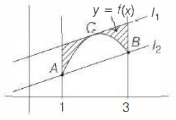
The following figure shows the graph of a continuous function $y=f(x)$ on the interval $[1,3]$. The points $A, B, C$ have coordinates $(1,1),(3,2),(2,3)$ respectively, and the lines $l_1$ and $l_2$ are parallel, with $l_1$ being tangent to the curve at $C$. If the area under the graph of $y=f(x)$ from $x=1$ to $x=3$ is $4$ sq units, then the area of the shaded region is
The triangle formed by the points $(0, 7, 10), (-1, 6, 6), (-4, 9, 6)$ is
Let ${\left( {1 + x} \right)^{10}} = \sum\limits_{r = 0}^{10} {{C_r}{x^r}} $ and ${\left( {1 + x} \right)^7} = \sum\limits_{r = 0}^7 {{d_r}{x^r}} $ . If $P = \sum\limits_{r = 0}^5 {{C_{2r}}} $ and $Q = \sum\limits_{r = 0}^3 {{d_{2r + 1}}} $ , then $\frac{P}{{2Q}}$ is equal to
Let $P_m$ stand for $^nP_m$ . Then the expression $1 . P_1 + 2 . P_2 + 3 . P_3 + ..... + n . P_n =$
If $f(x) = |x - 2|$, then
The vertices of a triangle are A(–1, 3), B(–2, 2) and C(3, –1). A new triangle is formed by shifting the sides of the triangle by one unit inwards. Then the equation of the side of the new triangle nearest to origin is :
Let $A=\left[\begin{array}{ccc}2 & 1 & 0 \\ 1 & 2 & -1 \\ 0 & -1 & 2\end{array}\right]$. If $|\operatorname{adj}(\operatorname{adj}(\operatorname{adj} 2 A))|=(16)^{ n }$, then $n$ is equal to