MCQ
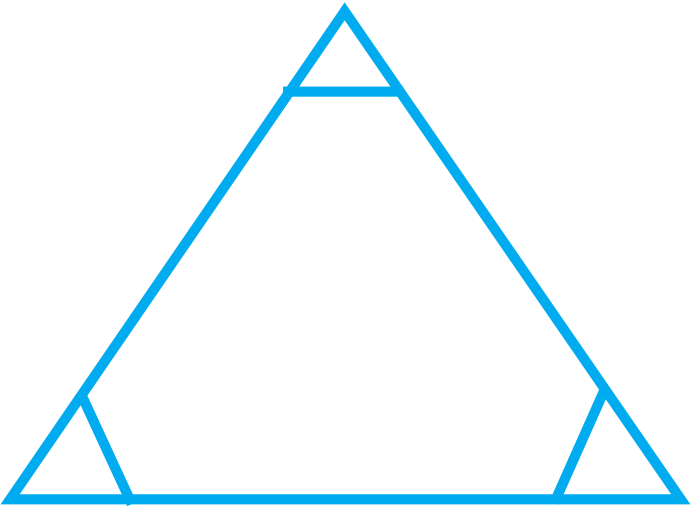
Mark $(\checkmark)$ against the correct answer.In $\triangle\text{ABC}$ if $\angle\text{A}=65^\circ$ and $\angle\text{C}=85^\circ$ then $\angle\text{B}={}?$
  • A
    $25^\circ$
  • $30^\circ$
  • C
    $35^\circ$
  • D
    $40^\circ$

Answer

Correct option: B.
$30^\circ$
In $\triangle\text{ABC}$
$\angle\text{A}=65^\circ,\angle\text{C}=85^\circ$
But $\angle\text{A}+\angle\text{B}+\angle\text{C}=180^\circ$ (Angles of a triangle)
$\Rightarrow65^\circ+\angle\text{B}+85^\circ=180^\circ$
$\Rightarrow150^\circ+\angle\text{B}=180^\circ$
$\Rightarrow\angle\text{B}=180^\circ-150^\circ=30^\circ$

Need a full question paper?

Generate a complete, print-ready paper with questions like this in minutes — across 16+ boards, with answer keys.
Start Generating Free

Similar questions

$x^4 + x^3- 1$ is an example of:
If $10$ is $10\%$ of a number, then the number is.
The sum of two integers is $-4.$ If one of them is $6,$ then the other is:
If $\frac{\text{x}-2}{3}=\frac{2\text{x}-1}{3}-1,$ then $x =$
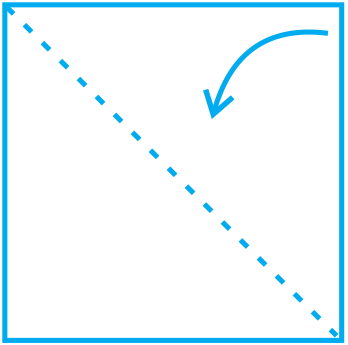
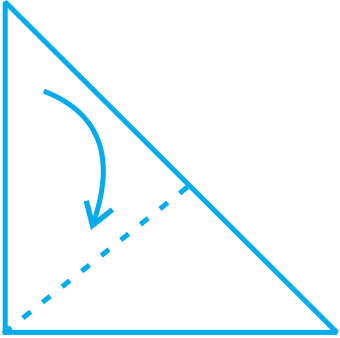
Take a square piece of paper as shown in figure $(1).$ Fold it along its diagonals as shown in figure $(2).$ Again fold it as shown in figure $(3).$ Imagine that you have cut off $3$ pieces of the form of congruent isosceles right$-$angled triangles out of it as shown in figure $4$.
$1.$

$2.$

$3.$

$4.$


On opening the piece of paper which of the following shapes will you get?

Which of the following does not represent an integer?
If the difference of an integer $a$ and $(-9)$ is $5$, then:
State $T$ for true and $F$ for false.
$(i).$ Every rational number can be expressed with a positive numerator.
$(ii). \frac{3}{11}$​ cannot be represented as a non$-$terminating repeating decimal.
$(iii).$ If $ \frac{\text{p}}{\text{q}}$ and $\frac{\text{r}}{\text{s}}$ are two terminating decimals, then $ \frac{\text{p}}{\text{q}}\times\frac{\text{r}}{\text{s}}$ is also a terminating decimal.
$(iv).$ If $\frac{\text{p}}{\text{q}}$ is non$-$terminating repeating decimal and $\frac{\text{r}}{\text{s}}$​ is a terminating decimal, then $\Big(\frac{\text{p}}{\text{q}}\div\frac{\text{r}}{\text{s}}\Big)$ is a terminating decimal.
The mean of $a, b, c, d$ and $e$ is $28.$ If the mean of $a, c$ and $e$ is $24,$ what is the mean of $b$ and $d?$
What must be subtracted from $-3$ to get $-9?$