Question
Mark ills a bottle completely with water.
The bottle has three same sized plugged holes on its wall.
Mark pulls out the plugs and checks the position of the stream of water coming out.Image
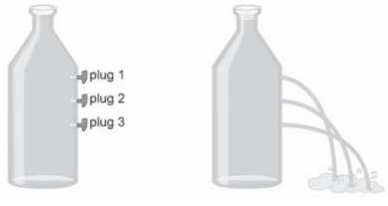
$7.$ What does Mark’s activity show$?$
$A.$ Liquids exert pressure.
$B.$ Liquids contract on cooling.
$C.$ Liquids cannot be compressed.
$D$. Liquids have no deinite shape.
$8.$ Which of these is an example of a contact force$?$
$A.$ A guava falling from the tree.
$B.$ A magnet attracting a hanging iron nail.
$C.$ A plastic comb attracting small pieces of hair.
$D.$ A boat moving on water by the action of wind on its sail.
$9.$ Which of these is true for force$?$
Circle ‘Yes’ or ‘No’ for the correct response.
Is this Correct? Yes or No
A force can change the state of motion of an object. Yes/No
A force can change the shape of an object. Yes/No
A force can act between two solid objects only. Yes/No
$7.$
Image

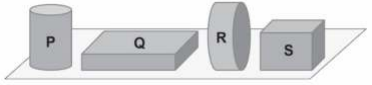
$P, Q, R$ and $S$ are four solid objects having the same mass.
Which object is exerting the least pressure on the table$?$
$A. P$
$B. Q$
$C. R$
$D. S$
Answer

$7. A.$ Liquids exert pressure
$8. D.$ A boat moving on water by the action of wind on its sail.
$9.$ Yes
Yes
No
$10. B. Q$

Need a full question paper?

Generate a complete, print-ready paper with questions like this in minutes — across 16+ boards, with answer keys.

Start Generating Free

Similar questions

Diabetes is a condition in which the blood sugar level of a person rises above the normal level.
The table below shows the average range of blood sugar levels at fasting.
  Low blood sugar level Normal blood sugar level High blood sugar level (diabetes)
Blood sugar level at fasting below $70$ mg/dL $70 – 120$ mg/dL above $120$ mg/dL
Doctors prescribe insulin injection for patients with high blood sugar levels. However, glucagon is injected in an emergency if the blood sugar level of a person drops too low.
$9.$ Which of these is true about the gland secreting insulin in the human body$?$
$A.$ It has no ducts.
$B.$ It is located on the skin.
$C.$ It controls the function of all other glands.
$D.$ It releases hormones that help in growth.
$10. $ Under what conditions of blood sugar level is glucagon likely to be injected$?$
$A.$ below $60$ mg/dL
$B. 80–100$ mg/dL
$C. 100–120$ mg/dL
$D.$ above $120$ mg/dL
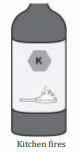
Fire extinguisher $K$ is suitable for kitchen fires.
Image
$5.$ Which ire extinguisher can perform most of the work of $K?$
$A. P$
$B. Q$
$C. R$
$D. S$
$6.$ How does dumping sand on ire extinguish the flame$?$
$7.$ Which of these materials is combustible$?$
$A.$ Steel
$B$. Wood
$D.$ Marble
$C.$ Glass
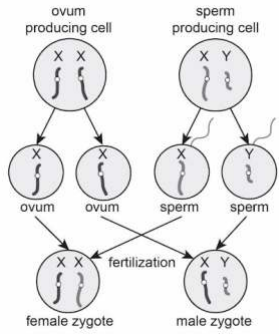
An ovum contains one $X$ chromosome.
A sperm contains an $X$ or a $Y$ chromosome.
A sperm can fertilize an ovum to produce two different zygotes.
Image
$1.$ Which chromosome does the female zygote receive from the mother and the father$?$
  Mother Father
$A.$ $X$ chromosome $Y$ chromosome
$B.$ $Y$ chromosome $X$ chromosome
$C.$ $X$ chromosome $X$ chromosome
$D.$ $Y$ chromosome $Y$ chromosome
$2.$ In which body part of a woman does a fertilized ovum get embedded$?$
$3.$ Which of these statements is supported by the picture$?$
Circle ‘Yes’ or ‘No’ for the correct response.
Is this Statement Supported by the Picture$?$ Yes or No
The father’s sperm decides the gender of the zygote. Yes/No
The $Y$ chromosome is shorter than the $X$ chromosome. Yes/No
An ovum unites with two sperms at a time Yes/No
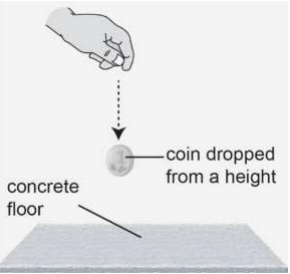
Mayank dropped four coins from the same height onto a concrete floor.
Image

The table below shows the type of sound that each coin produced after hitting the floor.
Coin Temperature of the ball when heated for a minute
Coin $1$ Ringing sound
Coin $2$ Damp sound
Coin $3$ Damp sound
Coin $4$ Ringing sound
$9.$ Which coins in Mayank’s activity are made of metal$?$
$A.$ Coin $1$ and Coin $2$
$B.$ Coin $2$ and Coin $3$
$C.$ Coin $3$ and Coin $4$
$D$. Coin $4$ and Coin $1$
$10.$ On which type of loor will Mayank’s activity produce the same results$?$
$A.$ Glass
$B.$ Sand
$C.$ Grass
$D.$ Carpet
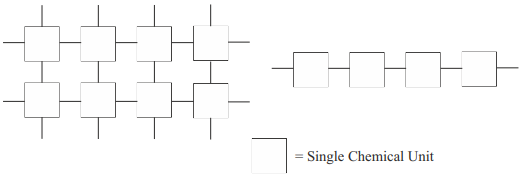
The pictures show the arrangement of chemical units in two types of plastics.Image
$7.$ What terms are used to describe the arrangement in Type $1$ and Type $2$ plastics$?$
$8.$ Which of these features is/are essential to classify a plastic as thermoplastic$?$
Circle ‘Yes’ or ‘No’ to mark your response.
Is this feature essential for classifying a plastic as thermoplastic? Yes or No
It bends easily on heating. Yes/No
It does not react with air and water Yes/No
It is a good conductor of heat. Yes/No
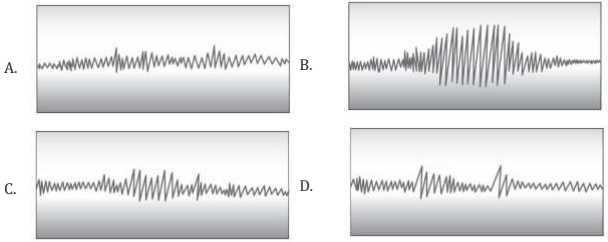
Earthquakes produce seismic waves that reach the Earth’s surface.
A seismograph is an instrument that records the seismic waves.
The strength of the earthquake is calculated from the graph recorded.
Image
$8.$ Which of these graphs shows the strongest earthquake?
Image
The table shows two groups of natural resources.
Group $1$ Group $2$
Air, Sunlight, Water Coal, Petroleum, Natural gas
$1.$ How is group $1$ different from group $2?$
  Group $1$ Group $2$
$A.$ Cannot be used as energy sources Can be used as energy sources
$B.$ Will not exhaust even if used continuously Will exhaust if used continuously
$C.$ Take thousands of years to form Take millions of years to form
$D.$ Contain high percentages of carbon Contain low percentages of carbon
$2.$ Which resource in group $2$ will cause the least amount of air pollution on burning$?$
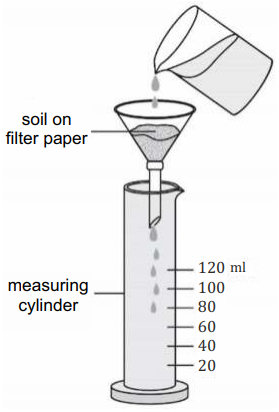
Soham investigates the water holding capacity of four different types of soils.
He sets up an experiment for each type of soil as shown in the diagram.
Soham records his observation in a table.
Image
  Soil type
Clay Loam Sand Silt
Amount of water added to the soil (ml) $150$ $150$ $150$ $150$
Amount of water collected in the measuring cylinder (ml) $30$ $60$ $105$ $50$
$8.$ Which type of soil absorbs the most water?
$A.$ Clay
$B.$ Loam
$C.$ Sand
$D.$ Silt
$9.$ Soham added the same amount of water to each type of soil.
State one more thing that Soham needs to keep the same in his experiment.
A scientist injected nitrogen dioxide gas in water.
He dropped a blue litmus paper in the water after the reaction was over.
The litmus paper turned red.
$7.$ What can be concluded from the experiment$?$
$A.$ A salt is produced by the reaction.
$B.$ An acid is produced by the reaction.
$C.$ Nitrogen gas is produced by the reaction.
$D.$ Hydrogen gas is produced by the reaction.
$8.$ The scientist heated the water after the reaction was over. Will there be any change in the colour of the litmus paper that turned red? Explain your answer.
What type of force is involved in each of the given conditions$?$
Put a tick mark (✔) for the response in terms of push or pull.
Condition Push Pull
Hitting a ball with a bat.    
Sucking milk shake with a plastic straw.    
Lifting a school bag from a desk.