Question
Mark out the incorrect statement:

Answer

  1. A free neutron can transform itself into photon
Explanation:
In beta minus decay, a neutron decays into a proton, an electron.
A free neutron is unstable, decaying to a proton, electron and antineutrino.
Inside a nucleus, a proton can transform into a neutron via inverse beta.

Need a full question paper?

Generate a complete, print-ready paper with questions like this in minutes — across 16+ boards, with answer keys.
Start Generating Free

Similar questions

A conducting loop is placed in a uniform magnetic field with its plane perpendicular to the field. An emf is induced in the loop if:
  1. It is translated.
  2. It is rotated about its axis.
  3. It is rotated about a diameter.
  4. It is deformed.
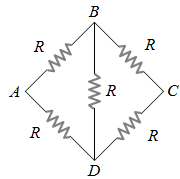
Five equal resistances each of value $R$ are connected in a form shown alongside. The equivalent resistance of the network
The time taken by a photo$-$electron to come out after the photon strikes is approximately:
The distance between an object and the screen is 100 cm. A lens produces an image on the screen when placed at either of the positions 40 cm apart. The power of the lens is(a) ≈ 3 dioptres(b) ≈ 5 dioptres(c) ≈ 7 diopters(d) ≈ 9 diopters
       
The same radioactive nucleus may emit?
A galvanometer of resistance 25 Ω  gives full scale deflection for a current of 10 milliampere, is to be changed into a voltmeter of range 100 V by connecting a resistance of ‘R’ in series with galvanometer. The value of resistance R in  Ω is(a) 10000(b) 10025(c) 975(d) 9975
       
Two thin lenses of $+2D$ and $-4D$ power are kept in contact. Focal length of the combination is :
The refractive indices of water and glass with respect to air are 1.2 and 1.5 respectively. The refractive index of glass with respect to water is(a) 0.6     (b) 0.8(c) 1.25   (d) 1.75
       
A torch battery consisting of two cells of 1.45 volts and an internal resistance 0.15Ω, each cell sending currents through the filament of the lamps having resistance 1.5ohms. The value of current will be(a) 16.11 amp(b) 1.611 amp(c) 0.1611 amp(d) 2.6 amp
       
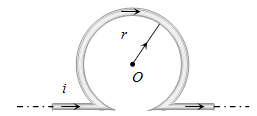
An infinitely long straight conductor is bent into the shape as shown in the figure. It carries a current of $i$ ampere and the radius of the circular loop is $r$ metre. Then the magnetic induction at its centre will be