Question
Mark the correct options.
  1. The luminous efficiency of a monochromatic source is always greater than that of a white light source of same power.
  2. The luminous efficiency of a monochromatic source of wavelength 555nm is always greater than that of a white light source of same power.
  3. The illuminating power of a monochromatic source of wavelength 555nm is always greater than that of a white light source of same power.
  4. The illuminating power of a monochromatic source is always greater than that of a white light source of same power.
Answer

  1. The luminous efficiency of a monochromatic source of wavelength 555nm is always greater than that of a white light source of same power.
  2. The illuminating power of a monochromatic source of wavelength 555nm is always greater than that of a white light source of same power. 
Explanation:
  1. The luminous efficiency of a monochromatic source may be less than that of the white light if the former emits wavelength far away from 555nm.
  2. Yes, it is true that our eyes mostly respond to colours close to the wavelength of 555nm and detect them bright. So, luminous efficiency is unity (highest).
  3. It is true because white light distributes its energy amongst certain colours that our eyes cannot detect as brightly as they detect a 555nm light.
  4. It is not necessarily true. If the monochromatic light radiates in a wavelength that is far away from 555nm, our eyes will not perceive it as bright. So, it will have lesser illuminating power.

Need a full question paper?

Generate a complete, print-ready paper with questions like this in minutes — across 16+ boards, with answer keys.

Start Generating Free

Similar questions

In photoelectric effect, what will be effect on velocity of emitted electrons, if the wavelength of the incident light is reduced?
Choose the correct alternative: The resistivity of a typical insulator $($e.g., amber$)$ is greater than that of a metal by a factor of the order of $(10^{22}/10^3).$
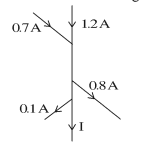
What is the value of I in the given figure?
Image
Two converging lenses of unequal focal lengths can be used to reduce the aperture of a parallel beam of light without losing the energy of the light. This increases the intensity. Describe how the converging lenses should be placed to do this.
Sometimes it is said that "heat is developed" in a resistance when there is an electric current in it. Recall that heat is defined as the energy being transferred due to temperature difference. Is the statement in quotes technically correct?
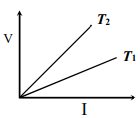
The voltage V and current I graph for a conductor at two different temperatures $T _1$ and $T _2$ are shown in the figure. Which of the highest value of temperature $T _1$ and $T _2$ is more and why?
Image
How does the value of capacitance depend on the condition of the dielectric material when the space between the plates of a parallel plate capacitor is partially filled with a dielectric material?
Can the electric field at any point be zero, while the electric potential at the same point may not be zero? Give examples.
Name the electromagnetic waves which :
(a) are useful in removing tension in musceles.
(b) are absorbed by ozone layer in atmosphere.
Calculate the volume of 1 mole of an ideal gas at STP.