MCQ
Mark the correct options:
  • A
    An atom with a vacancy has smaller energy that a neutral atom.
  • B
    K X-ray is emitted when a hole makes a jump from the K shell to some other shell.
  • C
    The wavelength of K X-ray is smaller than the wavelength of L X-ray of the same material.
  • D
    The wavelength of $\text{K}_\alpha$ X-ray is smaller than the wavelength of $\text{K}_\beta$ X-ray of the same material.

Answer

  1. K X-ray is emitted when a hole makes a jump from the K shell to some other shell.
  2. The wavelength of K X-ray is smaller than the wavelength of L X-ray of the same material.

Explanation:

Energy of a vacant atom is higher than that of a neutral atom.

Hence, option (a) is incorrect.

K X-ray is emitted when an electron makes a jump to the K shell from some other shell. As a result, a positive charge hole is created in the outer shell. As the electron continuously moves to the K shell, the hole moves from the K shell to some other shell.

Hence, option (b) is correct.

K X-ray is emitted due to the transition of an electron from the L or M shell to the K shell and L X-ray is emitted due to the transition of an electron from the M or N shell to the L shell. The energy involved in the transition from the L or M shell to the K shell is higher than the energy involved in the transition from the M or N shell to the L shell. Since the energy is inversely proportional to the wavelength, the wavelength of the K X-ray is smaller than the wavelength of the L X-ray of the same material. Hence, option (c) is correct.

If EK, EL and EM are the energies of K, L and M shells, respectively, then the wavelength of $\text{K}_\alpha$ X-ray $(\lambda_1)$ is given by

$\lambda_1=\frac{\text{hc}}{\text{E}_\text{K}-\text{E}_\text{L}}$

Here,

h = Planck's constant

c = Speed of light

Wavelength of the $\text{K}_\beta$ x-ray $(\lambda_2)$ is given by

$\lambda_2=\frac{\text{hc}}{\text{E}_\text{K}-\text{E}_\text{M}}$

As the difference of energies (EK - EM) is more than (E- EL), $\lambda_2$ is less than$\lambda_1$.

Hence, option (d) is not correct.

Need a full question paper?

Generate a complete, print-ready paper with questions like this in minutes — across 16+ boards, with answer keys.

Start Generating Free

Similar questions

AB  and CD are long straight conductor, distance d apart, carrying a current I. The magnetic field at the midpoint of BC is

(a)  

(b)

(c)    

(d)

During the nuclear fusion reaction

(a) A heavy nucleus breaks into two fragments by itself

(b) A light nucleus bombarded by thermal neutrons breaks up

(c) A heavy nucleus bombarded by thermal neutrons breaks up

(d) Two light nuclei combine to give a heavier nucleus and possibly other products

Given three equal resistors, how many different combination of all the three resistors can be made

(a) Six

(b) Five

(c) Four

(d) Three

The ratio of contributions made by the electric field and magnetic field components to the intensity of an EM wave is:
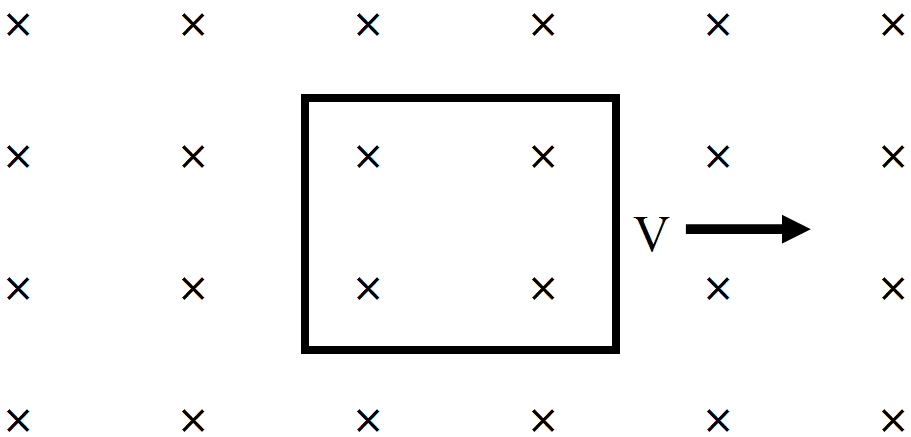
A conducting square loop of side l and resistance R moves in its plane with a uniform velocity u perpendicular to one of its sides. A uniform and constant magnetic field B exists along the perpendicular to the plane of the loop as shown in figure. The current induced in the loop is:
  1. $\frac{\text{Blv}}{\text{R}}$ clockwise.
  2. $\frac{\text{Blv}}{\text{R}}$ anticlockwise.
  3. $\frac{2\text{Blv}}{\text{R}}$ anticlockwise.
  4. $\text{Zero.}$

Which of the following statement is not true regarding Einsteins mass energy relation?
Electrical energy $U _0$ is stored in a charged parallel plate capacitor. On increasing the distance between the plates of a capacitor, double to initial distance the electrical energy will be :

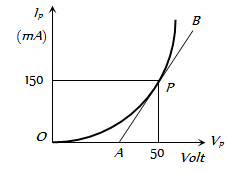
The plate characteristic curve of a diode in space charge limited region is as shown in the figure. The slope of curve at point P is 5.0 mA/V. The static plate resistance of diode will be

(a) 111.1W

(b) 222.2W

(c) 333.3W

(d) 444.4W

Two protons are kept at a separation of 10nm. Let Fn and Fe be the nuclear force and the electromagnetic force between them:

In the circuit shown below, the power developed in the 6W resistor is 6 watt. The power in watts developed in the 4W resistor is

(a) 16

(b) 9

(c) 6  

(d) 4