MCQ
Mark the correct statement :-
  • A
    $| \vec a + \vec b | \geq | \vec a | + | \vec b |$
  • $| \vec a + \vec b | \leq | \vec a | + | \vec b |$
  • C
    $| \vec a - \vec b | \geq | \vec a | + | \vec b |$
  • D
    All of the above

Answer

Correct option: B.
$| \vec a + \vec b | \leq | \vec a | + | \vec b |$
b

Need a full question paper?

Generate a complete, print-ready paper with questions like this in minutes — across 16+ boards, with answer keys.

Start Generating Free

Similar questions

The identical spheres each of mass $2 \mathrm{M}$ are placed at the corners of a right angled triangle with mutually perpendicular sides equal to $4 \mathrm{~m}$ each. Taking point of intersection of these two sides as origin, the magnitude of position vector of the centre of mass of the system is $\frac{4 \sqrt{2}}{x}$, where the value of $x$ is_____
$STATEMENT- 1$ The total translational kinetic energy of all the molecules of a given mass of an ideal gas is $1.5$ times the product of its pressure and its volume. because

$STATEMENT-2$ The molecules of a gas collide with each other and the velocities of the molecules change due to the collision.
A uniform rod $AB$ of length $l$ and mass $m$ is free to rotate about point $A$ . The rod is released from rest in the horizontal position. Given that the moment of inertia of the rod about $A$ is $\frac {ml^2}{3}$ , the initial angular acceleration of the rod will be 
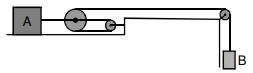
If block $A$ has a velocity of $0.6\,m / s$ to the right, determine the velocity of block $B$.
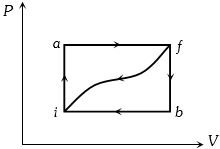
When a system is taken from state $i$ to a state $f$ along path $iaf, \,Q = 50\,J$ and $W = 20J.$ Along path $ibf, \,Q = 35J.$ If $W = - 13J$ for the curved return path $f i, Q$ for this path is ...... $J$
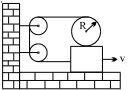
In the figure shown, the plank is being pulled to the right with a constant speed $v$. If the cylinder does not slip then:
There are two planets. The ratio of radius of the two planets is K but ratio of acceleration due to gravity of both planets is g. What will be the ratio of their escape velocity
Suppose the pressure at the surface of mercury in a barometer tube is P1 and the pressure at the surface of mercury in the cup is P2,
  1. P1 = 0, P2 = atmospheric pressure.
  2. P1 = atmospheric pressure P2 = 0
  3. P1 = P2 = atmospheric pressure.
  4. P1 = P2 = 0
Standing stationary waves can be obtained in an air column even if the interfering waves are
Consider a point $P$ on the circumference of a disc rolling along a horizontal surface. If $R$ is the radius of the disc, the distance through which $P$ moves in one full rotation of the disc  is: