MCQ
Mark the incorrect statement.
  • A
    The direction of the magnetic field is taken to be the direction in which a north pole of the compass needle moves inside it.
  • B
    The magnetic field lines are closed curves.
  • C
    No two field-lines are found to cross each other.
  • None

Answer

Correct option: D.
None

The direction of the magnetic field is taken to be the direction in which a north pole of the compass needle moves inside it. Therefore it is taken by convention that the field lines emerge from the north pole and merge at the south pole. Inside the magnet, the direction of field lines is from its south pole to its north pole. Thus the magnetic field lines are closed curves. The relative strength of the magnetic field is shown by the degree of closeness of the field lines. The field is stronger, that is, the force acting on the pole of another magnet placed is greater where the field lines are crowded. No two field-lines are found to cross each other. If they did, it would mean that at the point of intersection, the compass needle would point towards two directions, which is not possible.

Need a full question paper?

Generate a complete, print-ready paper with questions like this in minutes — across 16+ boards, with answer keys.

Start Generating Free

Similar questions

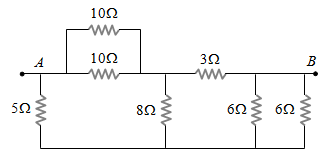
Seven resistances are connected as shown in the figure. The equivalent resistance between A and B is
A logic gate is an electronic circuit which
The first diffraction minimum due to the single slit diffraction is seen at $\theta  = {30^o}$ for a light of wavelength $5000\,\mathop A\limits^o $ falling perpendicularly on the slit. The width of the slit is
Energy released in fusion of $1\, kg$ of deuterium nuclei
A concave and convex lens have the same focal length of $20 cm$ and are put into contact to form a lens combination. The combination is used to view an object of $5 cm$ length kept at $20 cm $ from the lens combination. As compared to the object, the image will be
Magnets $A$ and $B$ are geometrically similar but the magnetic moment of $A$ is twice that of $B$. If $T_1 $ and $T_2$ be the time periods of the oscillation when their like poles and unlike poles are kept together respectively, then $\frac{{{T_1}}}{{{T_2}}}$will be
An electron and a proton have equal kinetic energies. They enter in a magnetic field perpendicularly, Then
When UV light of wavelength $300 \mathrm{~nm}$ is incident on the metal surface having work function $2.13 \mathrm{eV}$, electron emission takes place. The stopping potential is : (Given hc $=1240 \mathrm{eV} \mathrm{nm}$ )
The coil of the moving coil galvanometer is wound over an aluminium frame:
An observer looks at a distant tree of height $10\ m$ with a telescope of magnifying power of $20$. To the observer the tree appears :