MCQ
Mark what is incorrect regarding to the phylum-Arthropoda
- AOpen type of circulatory system
- BBilaterally symmetrical, coelomate animals
- ✓Diploblastic with head, thorax and abdomen
- DPresence of Malpighian tubules and antennae
Generate a complete, print-ready paper with questions like this in minutes — across 16+ boards, with answer keys.
($i$) It is made of a single thin layer of flattened cells with irregular boundaries.
($ii$) They are found in the walls of blood vessels and air sacs of lungs.
($iii$) They are involved in functions like forming a diffusion boundary. Which of the following characteristics of tissue is being described by the above statements?
$I.$ Each myosin is a polymerized protein
$II.$ Many meromyosin constitutes one thick filament (myosin)
$III.$ Each meromyosin's tail is called heavy meromyosin $(HMM)$ and head is called light meromyosin $(LMM)$
$IV.$ The globular head is an active $ATP$ ase enzyme and has binding sites for $ATP$ and active sites for actin
Choose the option with correct statements
|
Column $I$ $(Function)$ |
Column $II$ $(Part of Excretory System)$ |
|
$(a)$ Ultrafiltration |
$(i)$ Henle’s loop |
|
$(b)$ Concentration of urine |
$(ii)$ Ureter |
|
$(c)$ Transport of urine |
$(iii)$ Urinary bladder |
|
$(d)$Storage of urine |
$(iv)$ Malpighian corpuscle |
|
|
$(v)$Proximal convoluted tubule |
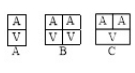
Identify the correct examples of figures $A, B$ and $C$