Question
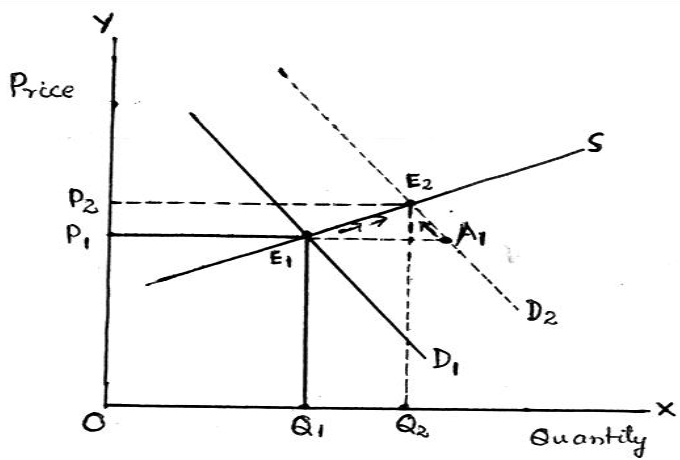
Market of a commodity is in equilibrium. Demand for the commodity ‘increases’. Explain the chain of effects of this change till the market again reaches equilibrium. Use diagram.
Generate a complete, print-ready paper with questions like this in minutes — across 16+ boards, with answer keys.
OR
Giving reasons, explain the law of variable proportion.OR
What are the different phases in the Law of Variable Proportions in terms of marginal product? Give reason behind each phase. Use diagram.| S. No | Particulars | (₹) In Crose |
| 1. | Private final consumption expenditure. | 450 |
| 2. | Rent. | 120 |
| 3. | Government final consumption expenditure. | 50 |
| 4. | Indirect taxes. | 60 |
| 5. | Interest. | 150 |
| 6. | Mixed income of self employed. | 20 |
| 7. | Consumption of fixed capital. | 30 |
| 8. | Opening stock. | 10 |
| 9. | Gross fixed capital formation. | 300 |
| 10. | Compensation of employees. | 200 |
| 11. | Net exports. | (-)10 |
| 12. | Net factor income from abroad. | (-)10 |
| 13. | Subsidies. | 10 |
| 14. | Profit. | 250 |
| (₹ in crores) | ||
| (i) | Compensation of employees | 2,000 |
| (ii) | Rent and interest | 800 |
| (iii) | Indirect taxes | 120 |
| (iv) | Corporation tax | 460 |
| (v) | Consumtion of fixed capital | 100 |
| (vi) | Subsidies | 20 |
| (vii) | Dividend | 940 |
| (viii) | Undistributed profits | 300 |
| (ix) | Net factor income to abroad | 150 |
| (x) | Mixed income | 200 |
| Output (units) | Average Fixed Cost ₹ | Marginal Cost ₹ | Average Variable Cost ₹ | Average Cost ₹ |
| 1 | 60 | 20 | .... | .... |
| 2 | .... | .... | 19 | .... |
| 3 | 20 | .... | 18 | .... |
| 4 | .... | 18 | .... | .... |
| 5 | 12 | .... | .... | 31 |