MCQ
Match List $I$ with List $II$ and select the correct answer using the code given below the lists :

List $I$ List $II$
$P$ $\quad\left(\frac{1}{y^2}\left(\frac{\cos \left(\tan ^{-1} y\right)+y \sin \left(\tan ^{-1} y\right)}{\cot \left(\sin ^{-1} y\right)+\tan \left(\sin ^{-1} y\right)}\right)^2+y^4\right)^{1 / 2}$ takes value $1.\quad$ $\frac{1}{2} \sqrt{\frac{5}{3}}$
$Q.\quad$ If $\cos x+\cos y+\cos z=0=\sin x+\sin y+\sin z$ then possible value of $\cos \frac{x-y}{2}$ is $2.\quad$ $\sqrt{2}$
$R.\quad$ If $\cos \left(\frac{\pi}{4}-x\right) \cos 2 x+\sin x \sin 2 x \sec x=\cos x \sin 2 x \sec x+$ $\cos \left(\frac{\pi}{4}+x\right) \cos 2 x$ then possible value of $\sec x$ is $3.\quad$ $\frac{1}{2}$
$S.\quad$ If $\cot \left(\sin ^{-1} \sqrt{1-x^2}\right)=\sin \left(\tan ^{-1}(x \sqrt{6})\right), x \neq 0$, then possible value of $x$ is $4.\quad$ $1$

Codes: $ \quad P \quad Q \quad R \quad S $ 

  • A
    $\quad 4 \quad 3 \quad 1 \quad 2 $
  • $\quad 4 \quad 3 \quad 2 \quad 1 $
  • C
    $\quad 3 \quad 4 \quad 2 \quad 1 $
  • D
    $\quad 3 \quad 4 \quad 1 \quad 2 $

Answer

Correct option: B.
$\quad 4 \quad 3 \quad 2 \quad 1 $
b
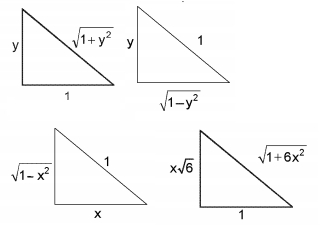
$(P)$ $\quad\left(\frac{1}{y^2}\left(\frac{\cos \left(\tan ^{-1} y\right)+y \sin \left(\tan ^{-1} y\right)}{\cot \left(\sin ^{-1} y\right)+\tan \left(\sin ^{-1} y\right)}\right)^2+y^4\right)^{1 / 2}$

$=\left[\frac{1}{y^2}\left[\frac{\left(\frac{1}{\sqrt{1+y^2}}+\frac{y \cdot y}{\sqrt{1+y^2}}\right)}{\left(\frac{\sqrt{1-y^2}}{y}+\frac{y}{\sqrt{1-y^2}}\right)}\right]^2+y^4\right]^{1 / 2}$

$=\left(\frac{1}{y^2} \cdot y^2\left(1-y^4\right)+y^4\right)^{1 / 2}=1$

$(Q)$ $\quad $$ \cos x+\cos y=-\cos z $

$ \sin x+\sin y=-\sin z $

$ 2+2 \cos (x-y)=1 $

$\Rightarrow \quad  \cos (x-y)=-1 / 2$

$(R)\quad$ $\cos 2 x\left(\cos \left(\frac{\pi}{4}-x\right)-\cos \left(\frac{\pi}{4}+x\right)\right)+2 \sin ^2 x=2 \sin x \cos x $

$\cos 2 x(\sqrt{2} \sin x)+2 \sin ^2 x=2 \sin x \cos x $

$\sqrt{2} \sin x[\cos 2 x+\sqrt{2} \sin x-\sqrt{2} \cos x]=0 $

$\text { Either } \sin x=0 \text { OR } \cos ^2 x-\sin ^2 x=\sqrt{2}(\cos x-\sin x) $

$\sec x=1 \quad \text { OR } \cos x=\sin x $

$\Rightarrow \quad \sec x=\sqrt{2}$

$(S)$ $\quad \cot \left(\sin ^{-1} \sqrt{1-x^2}\right)=\sin \left(\tan ^{-1}(x \sqrt{6})\right)$

$Image$

$\frac{x}{\sqrt{1-x^2}}  =\frac{x \sqrt{6}}{\sqrt{1+6 x^2}} $

$ \Rightarrow \quad 1+6 x^2=6-6 x^2 $

$ \Rightarrow \quad 12 x^2=5 $

$ x=\sqrt{\frac{5}{12}}==\frac{1}{2} \sqrt{\frac{5}{3}}$


Need a full question paper?

Generate a complete, print-ready paper with questions like this in minutes — across 16+ boards, with answer keys.

Start Generating Free

Similar questions

The value of $\int\frac{\cos\sqrt{\text{x}}}{\sqrt{\text{x}}}\text{ dx}$ is :
$\int_1^2 {\frac{1}{{{x^2}}}{e^{\frac{{ - 1}}{x}}}\,dx = } $
The area of the portion of the circle $x^2+y^2=1,$ which lies inside the parabola $y^2=1-x,$ is:
Apply linear programming to this problem. A firm wants to determine how many units of each of two products (products D and E) they should produce to make the most money. The profit in the manufacture of a unit of product D is 100 and the profit in the manufacture of a unit of product E is100 and the profit in the manufacture of aunit of product E is 87. The firm is limited by its total available labor hours and total available machine hours. The total labor hours per week are 4,000. Product D takes 5 hours per unit of labor and product E takes 7 hours per unit. The total machine hours are 5,000 per week. Product D takes 9 hours per unit of machine time and product E takes 3 hours per unit. Which of the following is one of the constraints for this linear program?
If matrix  $A\, = \,\left[ {\begin{array}{*{20}{c}}
  1&{3k + \frac{1}{3}} \\ 
  0&1 
\end{array}} \right]$, then the value of  $\mathop \Pi \limits_{k = 1}^{36} \,\left[ {\begin{array}{*{20}{c}}
  1&{3k + \frac{1}{3}} \\ 
  0&1 
\end{array}} \right]$ is equal to :-
A unit vector which is coplanar to vector and $i + 2j + k$ and $i + 2j + k$ and perpendicular to $i + j + k,$ is
If the value of $x$ satisfying the equation ${\sin ^{ - 1}}\sqrt {1 - {x^2}}  = {\tan ^{ - 1}}\sqrt {\frac{2}{x} - 1} $ is $\frac {a}{b}$ (where $a$ and $b$ are coprime), then the value of $a^2 + b^2$ is
The differention equation $\frac{\text{dy}}{\text{dx}}+\text{P}\text{y}=\text{Qy}^{\text{n}},\text{n}>2$ can be reduced to linear from by substituting:
Two persons $A$ and $B$ take turns in throwing a pair of dice.The first person to throw $9$ from both dice will be awarded the prize. If $A$ throws first, then the probability that $B$ wins the game is.
$\left| {\,\begin{array}{*{20}{c}}1&1&1\\1&{1 + x}&1\\1&1&{1 + y}\end{array}\,} \right| = $