MCQ
 Match List $– I$ with List $–II. $
Image
Choose the correct answer from options given below: 
  • A
    A-(III), (B)-(IV), (C)-(I), (D)-(II)
  • B
    A-(IV), (B)-(II), (C)-(I), (D)-(III)
  • C
    A-(IV), (B)-(II), (C)-(III), (D)-(I)
  • D
    A-(III), (B)-(IV), (C)-(II), (D)-(I)

Answer

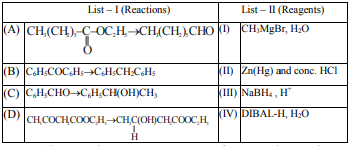
$ CH_3\left(CH_2\right)_5 COOC_2 H_5 \xrightarrow{\text { DIBAL- }-H_3 H, O} CH_3\left(CH_2\right)_5 CHO$
$C_6 H_5 COC_6 H_5 \xrightarrow{Zn(Hg) \ \text { conc. } HCl} C_6 H_5 CH_2 C_6 H_5$
$C_6 H_5 CHO \xrightarrow[H_2 O]{CH_2 MBr} C_6 H_5 CH(OH) CH_3$
$CH_3 COCH_2 COOC_2 H_5 \xrightarrow{NanH_4, H} CH_3 CH(OH) CH_2 COOC_2 H_5 $

Need a full question paper?

Generate a complete, print-ready paper with questions like this in minutes — across 16+ boards, with answer keys.

Start Generating Free

Similar questions

Are which type of isomers
On electrolysis of aqueous solution of $KI$ in presence of platinum electrodes 
$(a)$ Hydrogen gas is released at cathode
$(b)$ Oxygen gas is released at anode
$(c)$ $pOH$ of solution decreases
$(d)$ There is deposition of potassium at cathode
Choose the correct option from following
In the following reaction, $3B{r_2} + 6CO_3^{2 - } + 3{H_2}O \rightarrow 5B{r^ - } + BrO_3^ - + 6HC{O_3}$
A Substance undergoes first order decomposition. The decomposition follows two parallel first order reactions asThe percentage distribution of $B$ and $C$  are

$A\,\xrightarrow{{{k_1}}}B$        ${k_1}\, = \,1.26\, \times \,{10^{ - 4}}\,{S^{ - 1}}$

$A\,\xrightarrow{{{k_2}}}C$       ${k_2}\, = \,3.8\, \times \,{10^{ - 5}}\,{S^{ - 1}}$

The ionic radii of $\mathrm{F}^{-}$ and $O^{2-}$ respectively are $1.33\, A^o$ and $1.4\, A^o$, while the covalent radius of $\mathrm{N}$ is $0.74\,A^o$ 

The correct statement for the ionic radius of $\mathrm{N}^{3-}$ from the following is :

Consider the following pairs of electrons

$(A)$ $(a)$ $n=3,1=1, m_{l}=1, m_{s}=+\frac{1}{2}$

$\quad (b)$ $n =3,1=2, m _{l}=1, m _{s}=+\frac{1}{2}$

$(B)$ $(a)$ $n =3,1=2, m _{l}=-2, m _{s}=-\frac{1}{2}$

$\quad (b)$ $n =3,1=2, m _{l}=-1, m _{s}=-\frac{1}{2}$

$(C)$ $(a)$ $n=4,1=2, m_{l}=2, m_{s}=+\frac{1}{2}$

$\quad (b)$ $n =3,1=2, m _{l}=2, m _{s}=+\frac{1}{2}$

The pairs of electron present in degenerate orbitals is/are...... .

Assertion : It is impossible to determine the exact position and exact momentum of an electron simultaneously.
Reason : The path of an electron in an atom is clearly defined.
Several blocks of magnesium are fixed to the bottom of a ship to
Which of the following sets of elements have the strongest tendency to form anions
Moles of $K_2Cr_2O_7$ used to oxidise $1$  $mole$  $Fe_{0.92}O$ to $Fe^{3+}$ are -