MCQ
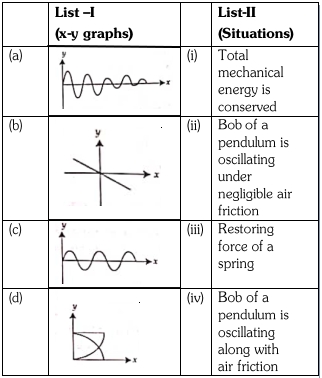
Match $List - I$ with $List - II$

Choose the correct answer from the options given below
  • A
    $(a) - (iv), (b) - (ii), (c) - (iii), (d) - (i)$
  • $(a) - (iv), (b) - (iii), (c) - (ii), (d) - (i)$
  • C
    $(a) - (i), (b) - (iv), (c) - (iii), (d) - (ii)$
  • D
    $(a) - (iii), (b) - (ii), (c) - (i), (d) - (iv)$
Answer

Correct option: B.
$(a) - (iv), (b) - (iii), (c) - (ii), (d) - (i)$
b
$(a) \rightarrow (iv)$ Amplitude is continuously decreasing

$(b) \rightarrow (iii)$ $\quad F \propto- x$

$(c) \rightarrow (ii)$ Amplitude is constant

$(d) \rightarrow (i)$ $\quad$ K.E. $+$ P.E. $=$ M.E. $=$ constant

Need a full question paper?

Generate a complete, print-ready paper with questions like this in minutes — across 16+ boards, with answer keys.

Start Generating Free

Similar questions

An electric dipole of moment $\vec p$ is lying along a uniform electric field $\vec E.$ The work done in rotating the dipole by $90^o $ is
Two nucleons are at a separation of $1 \times {10^{ - 15}}m$. The net force between them is ${F_1}$, if both are neutrons, ${F_2}$ if both are protons and ${F_3}$ if one is a proton and other is a neutron. In such a case
Three identical spheres each of mass $M$ are placed at the corners of a right angled triangle with mutually perpendicular sides equal to $3\,m$ each. Taking point of intersection of mutually perpendicular sides as origin, the magnitude of position vector of centre of mass of the system will be $\sqrt{x} m$. The value of $x$ is
Two wires each carrying a steady current $I$ are shown in four configurations in Column $I$. Some of the resulting effects are described in Column $II$. Match the statements in Column $I$ with the statements in Column $II$ and indicate your answer by darkening appropriate bubbles in the $4 \times 4$ matrix given in the $ORS$.

Column $I$ Column $II$
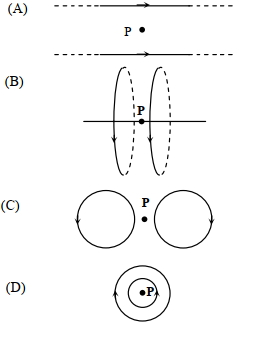
$(A)$ Point $P$ is situated midway between the wires. $Image$ $(p)$ The magnetic fields $(B)$ at $P$ due to the currents in the wires are in the same direction.
$(B)$ Point $P$ is situated at the mid-point of the line joining the centers of the circular wires, which have same radii. $Image$ $(q)$ The magnetic fields $(B)$ at $P$ due to the currents in the wires are in opposite directions.
$(C)$ Point $P$ is situated at the mid-point of the line joining the centers of the circular wires, which have same radii. $Image$ $(r)$ There is no magnetic field at $P$.
$(D)$ Point $P$ is situated at the common center of the wires. $Image$ $(s)$ The wires repel each other.


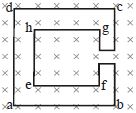
Two square wire frames $abcd$ and $efgh$ are placed in uniformly decreasing magnetic field as shown in figure. The direction of induced current in both the loops is
Two blocks of masses $2 \,kg$ and $4 \,kg$ are hanging with the help of massless string passing over an ideal pulley inside an elevator. The elevator is moving upward with an acceleration $\frac{g}{2}$. The tension in the string connected between the blocks will be .......... $N$ (Take $g=10 \,m / s ^2$ ).
$A$ brass disc and a carbon disc of same radius are assembled alternatively to make a cylindrical conductor. The resistance of the cylinder is independent of the temperature. The ratio of thickness of the brass disc to that of the carbon disc is [$\alpha$ is temperature coefficient of resistance and Neglect linear expansion ]
$Assertion$ : A body with constant acceleration always moves along a straight line.

$Reason$ : A body with constant acceleration may not speed up.

The length of a simple pendulum is increased by $1\%$. Its time period will
The muon has the same charge as an electron but a mass that is $207$ times greater. The negatively charged muon can bind to a proton to form a new type of hydrogen atom. How does the binding energy $E_{Bμ}$ of the muon in the ground state of a muonic hydrogen atom  compare with the binding energy $E_{Be}$ of an electron in the ground state of a conventional hydrogen atom ?