Question
Match structures given in Column $I$ with functions given in Column $II.$
  Column $I$   Column $II$
$(i)$ Stomata $(a)$ Absorption of water
$(ii)$ Xylem $(b)$ Transpiration
$(iii)$ Root hairs $(c)$ Transport of food
$(iv)$ Phloem $(d)$ Transport of water
    $(e)$ Synthesis of carbohydrates

Answer

  Column I   Column II
$(i)$ Stomata $(b)$ Transpiration
$(ii)$ Xylem $(d)$ Transport of water
$(iii)$ Root hairs $(a)$ Absorption of water
$(iv)$ Phloem $(c)$ Transport of food

Need a full question paper?

Generate a complete, print-ready paper with questions like this in minutes — across 16+ boards, with answer keys.

Start Generating Free

Similar questions

Water is very precious for all the living beings. What will happen in future if we do not save water now?
Name some effective safety measures against cyclone?
How does weathering lead to the formation of soil? Explain the physical and chemical changes involved.
The distances travelled by a car at various time intervals are given as follow
Distance (m)0510152025
Time (s)0246810
(a) Draw the distance-time graph for the car.
(b) What conclusion do you get from this graph about the nature of motion of the car?
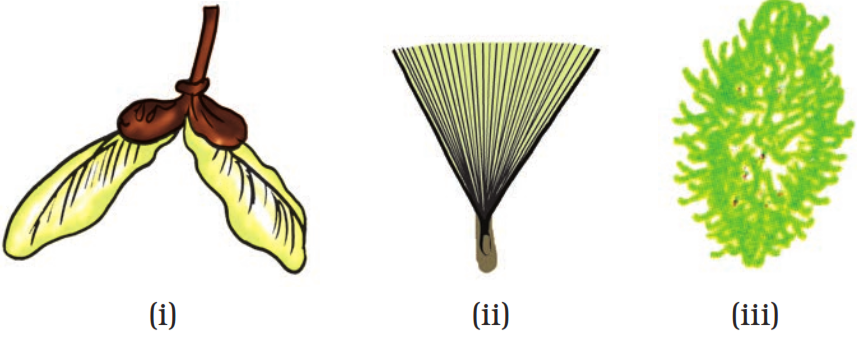
Group the seeds given in Figure $(i)$ to $(iii)$ according to their means of dispersion.
  1. Seed dispersed by wind.
  2. Seed dispersed by water.
  3. Seed dispersed by animal.
Rohan went to the desert of Rajasthan with his freinds. He saw an animal. It had a hump. Its feet had large soles. He wondered about this animal. He found that these were adaptations of that animal which helped it to survive in very hot and dry climate of the desert.
Answer the following Questions on the basis of the observations seen by Rohan.
  1. Name the animal Rohan observed in the desert of Rajasthan?
  2. What role does this hump has in this animal?
  3. Why do it has large soles?
  4. Can you give same more adaptations of this animal which help it to survive in desert?
  5. What values do you observe in Rohan?
Describe the different methods of asexual reproduction. Give examples.
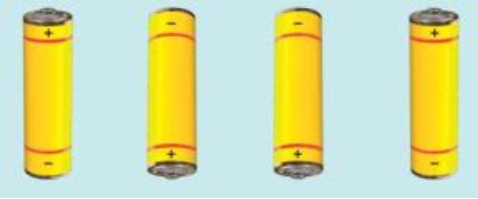
Figure shows four cells fixed on a board. Draw lines to indicate how you will connect their terminals with wires to make a battery of four cells.

Image

Describe an activity to show convection in gases.
Draw a labelled diagram of human digestive system.