Question
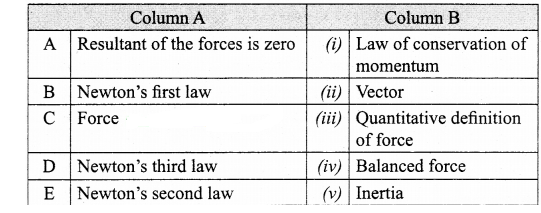
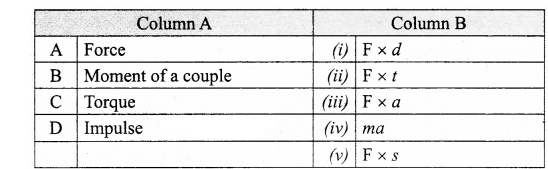
Match the column A with column B.
Generate a complete, print-ready paper with questions like this in minutes — across 16+ boards, with answer keys.
| Sample | pH |
| (i) Oranges | (a) 8 |
| (ii) Grapes | (b) 7 |
| (iii) Pure water | (c) 3.5 |
| (iv) Egg white | (d) 4 |
| i. Solubility of $KNO _3$ | (a) decreases with increase in temperature |
| ii. The solubility of CaO | (b) increases with increase in pressure |
| iii. The solubility of oxygen | (c) increases with increase in temperature |
| iv. Solubility of $CO _2$ | (d) more in cold water |
| 1. Psychotropic drugs | (a) Nicotine |
| 2. Chronic metabolic disorder | (b) Emphysema |
| 3. Addiction to Tobacco | (c) Polyphagia |
| 4. Excess hunger | (d) Polydipsia |
| 5. Inflammation of lung alveoli | (e) Mood Altering drugs |
| 6. Loss of water leads to thirst | (f) Diabetes Mellitus |
| i. $NH _3, CH _4$ | (a) Polyatomic molecule |
| ii. $O _2, N_2$ | (b) Monoatomic molecule |
| iii. He, Ne | (c) Heteroatomic molecule |
| iv. Sulphur | (d) Diatomic molecule |
| i. Group 18 | (a) Main group elements |
| ii. Group 3 – 12 | (b) Noble gases |
| iii. Group 13 – 18 | (c) Halogens |
| iv. Group 17 | (d) Transition elements |
| i. 22 g of $CO _2$ | (a) 2 moles |
| ii. 18 g of $H _2 O$ | (b) 4 moles |
| iii. 360 g of Glucose | (c) 0.5 mole |
| iv. 64 g of $CH _4$ | (d) 1 mole |
| Alloy | Metals present | Uses |
| 1. Brass | Fe, C, Ni | Statues, Coins |
| 2. Bronze | Al, Mg, Mn, Cu | Aircraft, Pressure cookers |
| 3. Duralumin | Fe, C, Ni, Cr | Cables, Propeller |
| 4. Magnalium | Cu, Sn | Automobile parts, Utensils |
| 5. Stainless steel | Cu, Zn | Scientific instruments, Air craft |
| 6. Nickel steel | Al, Mg | Medals, decorative items |
| 1. Natural radioactivity | (a) $3.7 \times 10^{10}$ decay $/$ second |
| 2. Artificial radioactivity | (b) spontaneous process |
| 3. 1 curie | (c) $10^6$ decay/second |
| 4. 1 Rd (Rutherford) | (d) induced process |
| 1. Oparin and Haldane | (a) use and disuse theory |
| 2. Ernest Haeckel | (b) Mutation theory |
| 3. Leonardo da Vinci | (c) Father of Indian palaeobotany |
| 4. Jean Baptiste Lamarck | (d) Life from the chemical reaction |
| 5. Darwin | (e) Father of palaeontology |
| 6. De Vries | (f) Radioactive carbon |
| 7. Birbal Sahni | (g) Ethnobotany |
| 8. W.F. Libby | (h) Origin of species |
| 9. J.W. Harshberger | (i) Biogenetic law |