Question
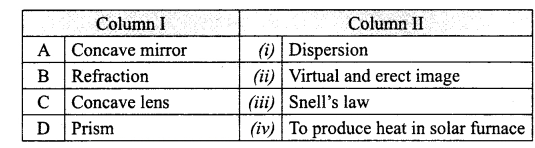
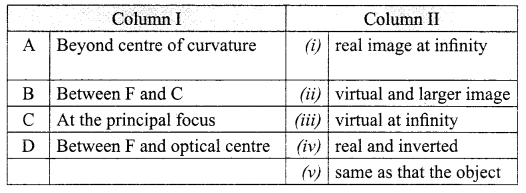
Match the Column I with Column II.
Generate a complete, print-ready paper with questions like this in minutes — across 16+ boards, with answer keys.
| 1. Cowpea | (a) Joining the DNA fragments |
| 2. UV rays | (b) New breed of sheep |
| 3. Lady’s finger | (c) Bacterial blight |
| 4. DNA ligase | (d) Flat bean |
| 5. Pusasem 3 | (e) Pusa Sawani |
| 6. Hissardale | (f) Induce mutation |
| i. Cuprite | (a) Halide ore |
| ii. Marble | (b) Oxide ore |
| iii. Fluorspar | (c) Sulphide ore |
| iv. Galena | (d) Carbonate ore |
| 1. ρ=RAl | (a) watt |
| 2. σ=1ρ | (b) Ωm |
| 3. E = P × t | (c) coulomb |
| 4. P = VI | (d) $m ^{-1} \Omega^{-1}$ |
| 5. q = It | (e) Kilowatt-hour |
| i. Solubility of $KNO _3$ | (a) decreases with increase in temperature |
| ii. The solubility of CaO | (b) increases with increase in pressure |
| iii. The solubility of oxygen | (c) increases with increase in temperature |
| iv. Solubility of $CO _2$ | (d) more in cold water |
| Metal | Ore | Chemical formula |
| 1. Copper | Bauxite | $ZnCO _3$ |
| 2. Aluminium | Haematite | $CuFeS _2$ |
| 3. Iron | Copper pyrite | $Fe _2 O _3$ |
| 4. Zinc | Calamine | $Al _2 O _3 \cdot 2 H _2 O$ |
| 1. Homozygous | (a) polynucleotide |
| 2. Genes | (b) human male |
| 3. DNA | (c) occurs in pairs and alike |
| 4. Heterozygous | (d) segments of DNA |
| 5. Heterogametic | (e) bind DNA to the origin of replication site |
| 6. Autosome | (f) occurs in pairs and unlike |
| 7. Helicase | (g) somatic characters |
| Process | Ores |
| i. Hydraulic process | (a) $ZnS$ |
| ii. Magnetic separation | (b) $Fe _2 O _3$ |
| iii. Froth floatation process | (c) $SnO _2$ |
| iv. Leaching process | (d) $Al _2 O _3 \cdot 2 H _2 O$ |
| 1. Neuroglia | (a) Conduct nerve impulses |
| 2. Electrical impulse | (b) Connects the lobe of the cerebellum |
| 3. Pons | (c) Cerebrospinal fluid |
| 4. Brain | (d) Do not conduct nerve impulses |
| 5. Dendrites | (e) Information from the receptor |