MCQ
Match the complexes in Column-$I$ with their properties listed in Column-$II$. Indicate your answer by darkening the appropriate bubbles of the $4 \times 4$ matrix given in the $ORS$.
Column-$I$ Column-$II$
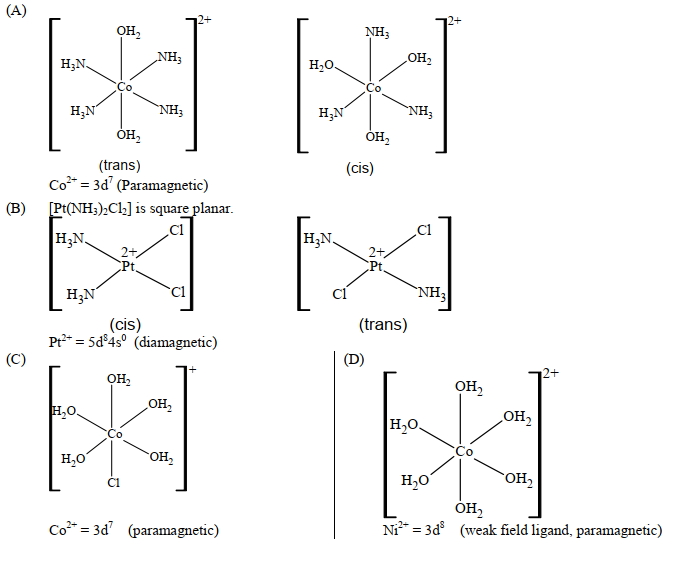
$(A)$ $\left[\mathrm{Co}\left(\mathrm{NH}_3\right)_4\left(\mathrm{H}_2 \mathrm{O}\right)_2\right] \mathrm{Cl}_2$ $(p)$ geometrical isomers
$(B)$ $\left[\mathrm{Pt}\left(\mathrm{NH}_3\right)_2 \mathrm{Cl}_2\right]$ $(q)$ paramagnetic
$(C)$ $\left[\mathrm{Co}\left(\mathrm{H}_2 \mathrm{O}\right)_5 \mathrm{Cl}\right] \mathrm{Cl}$ $(r)$ diamagnetic
$(D)$ $\left[\mathrm{Ni}\left(\mathrm{H}_2 \mathrm{O}\right)_6\right] \mathrm{Cl}_2$ $(s)$ metal ion with $+2$ oxidation state
  • $A \rightarrow p, q, s \quad B \rightarrow p, r, s \quad C \rightarrow q, s \quad D \rightarrow q, s$
  • B
    $A \rightarrow s, q, r \quad B \rightarrow q, r, p \quad C \rightarrow r, s \quad D \rightarrow q, s$
  • C
    $A \rightarrow q, s, s \quad B \rightarrow r, q, s \quad C \rightarrow q, s \quad D \rightarrow r, s$
  • D
    $A \rightarrow p, r, s \quad B \rightarrow q, r, s \quad C \rightarrow p, s \quad D \rightarrow q, s$
Answer

Correct option: A.
$A \rightarrow p, q, s \quad B \rightarrow p, r, s \quad C \rightarrow q, s \quad D \rightarrow q, s$
a

Need a full question paper?

Generate a complete, print-ready paper with questions like this in minutes — across 16+ boards, with answer keys.

Start Generating Free

Similar questions

Products obtained in the given reactions are shown below.

The number of poss ible products for $x$ and $y$ are

Aqueous solutions of hydrogen sulphide and sulphur dioxide when mixed together, yield
The pair that has similar atomic radii is
$H_2S$ is more acidic than $H_2O,$ due to
$\begin{array}{*{20}{c}}
  {O\,\,\,\,\,\,\,\,\,\,\,\,\,\,\,\,\,\,\,\,\,\,\,\,\,\,\,\,\,\,\,\,\,\,\,\,\,\,\,\,\,\,\,\,\,\,\,\,\,\,\,\,\,\,\,\,\,\,} \\ 
  {||\,\,\,\,\,\,\,\,\,\,\,\,\,\,\,\,\,\,\,\,\,\,\,\,\,\,\,\,\,\,\,\,\,\,\,\,\,\,\,\,\,\,\,\,\,\,\,\,\,\,\,\,\,\,\,\,\,\,\,} \\ 
  {Et - {\text{ }}O - {\text{ }}C - {\text{ }}O - {\text{ }}Et\xrightarrow[{(2){H_3}{O^ \oplus }}]{{\left( 1 \right){\text{ }}C{H_3}MgBr\,\,\left( {excess} \right)}}(A),} 
\end{array}$

 Product $(A)$ is 

The specific conductivity of a saturated solution of silver chloride is $2 \times 10^{-6}\, S\,cm^{-1}$ at $25\,^oC.$ What will be the solubility of silver chloride at $25\,^oC$ if molar conductivities at infinite dilution of $Ag^+$ and $Cl^-$ ions are $60$ and $80\,S\,cm^2\,mol^{-1}$ respectively -
$0.3\,g$ of an organic compound gave $50\,ml$. of nitrogen collected at $300\,K$ and $715 \,mm$ pressure in Dumas method. Calculate the percentage......$\%$ of nitrogen in the  compound (aqueous tension of water at $300\, K$ is $15\, mm$)
In aqueous solution, strong electrolytes
Standard electrode potential of $NHE$ at $298\,K$ is  .............. $\mathrm{V}$
Consider following molecules

Glucose, Mannose, Galactose, $\alpha -$ Glucose, $\beta -$ Glucose

$(K)\,\, (L)\,\, (M)\,\, (N)\,\, (O)$

Correct set of epimer and anomer is respectivley

Epimer    -     Anomer