Question
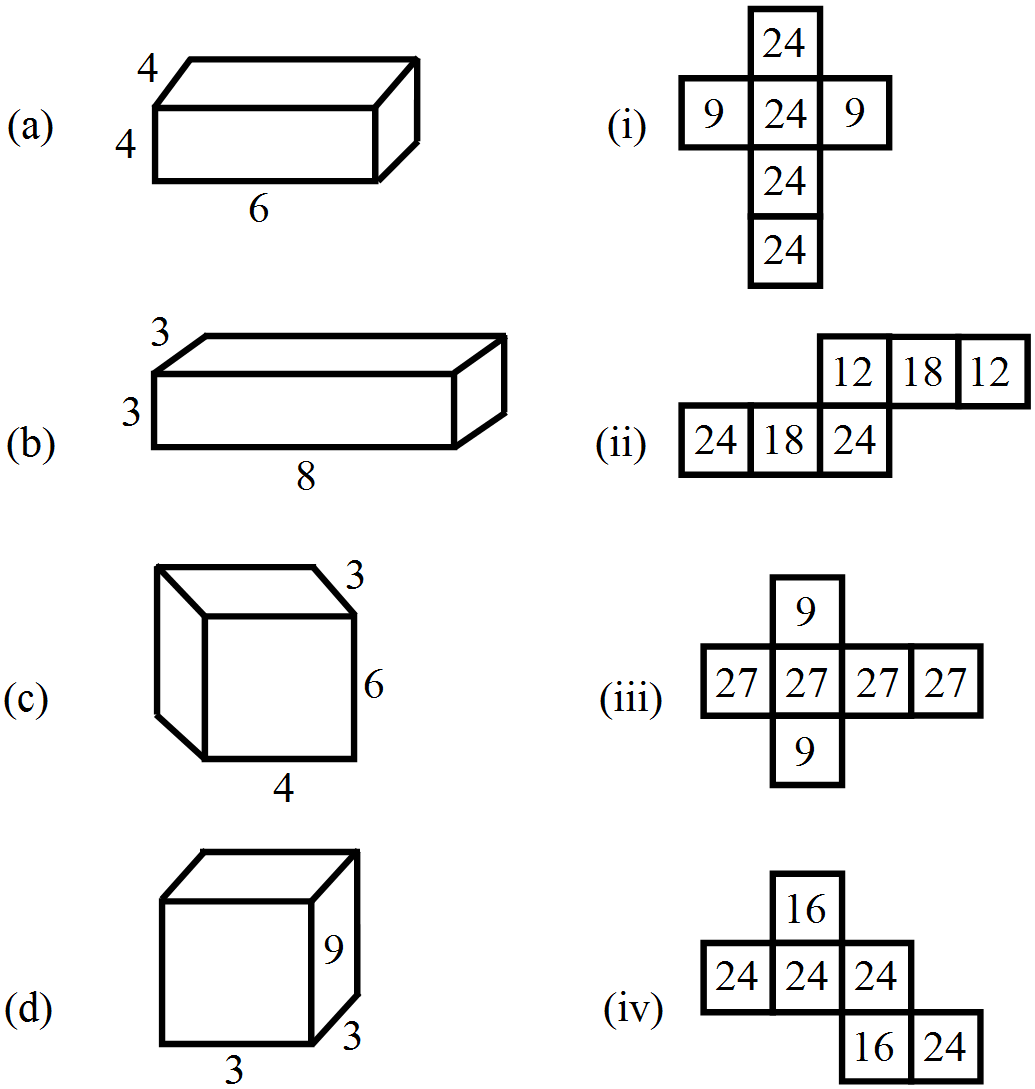
Match the following figures:
Answer

$i.$ The given figure is a cuboid with sides $4, 4$ and $6$ units.
Area of a rectangle $=$ length $\times $ width
$\therefore$ Area of the rectangular face sith sides $4$.

$ii.$ The given figure is a cuboid with sides $3, 3$ and $8$.Area of a rectangle $=$ length $\times$ width
$\therefore$ Area of the rectangular face sith sides $3$ and $3 = 3 \times 3 = 9$ And the area of the other face with sides $3$ and $8 = 3 \times 8 = 24$
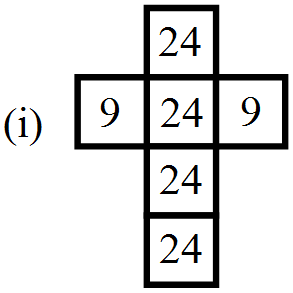
Thus, the net for given figure will have four faces with area $24$ and two faces with area $9$.
Observe that net $(i)$ satisfies this.
Thus, the net of figure $(b)$ is net $(i)$.

$iii.$ The given figure is a cuboid with sides $3, 4$ and $6$.
Area of a rectangle = length $\times $  width
$\therefore$ Area of the rectangular face sith sides $3$ and $4 = 3 \times 4 = 12$,
Area of the rectangular face with sides $4$ and $6 = 4 \times 6 = 24$
And, area of the other face with sides $3$ and $6 = 3 \times 6 = 18$
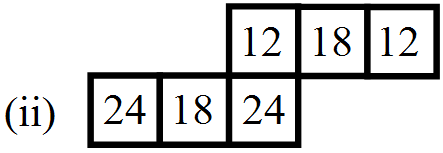
Thus, the net for given figure will have two faces with area $24$, two faces wit area $18$ and two faces with area $12$.
Observe that net $(ii)$ satisfies this.
Thus, the net of figure $(c)$ is net $(ii)$.

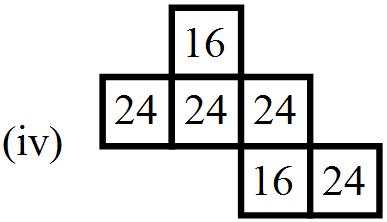
$iv.$ The given figure is a cuboid with sides $3, 3$ and $9$.
Area of a rectangle $=$ length $\times$ width
$\therefore$ Area of the rectangular face with sides $3$ and $3 = 3 \times 3 = 9$, And
area of the other face with sides $3$ and $9 = 3 \times 9 = 27$
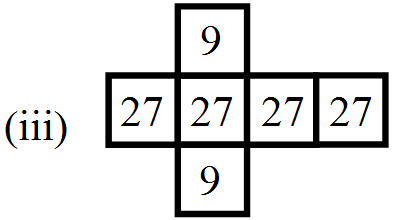
Thus, the net for given figure will have four faces with area $27$ and two faces with area $9$.
Observe that net $(iii)$ satisfies this.
Thus, the net of figure $(d)$ is net $(iii)$.

Need a full question paper?

Generate a complete, print-ready paper with questions like this in minutes — across 16+ boards, with answer keys.

Start Generating Free

Similar questions

Draw a pie-diagram representing the relative frequencies (expressed as percentage) of the eight classes as given below: $12.6, 18.2, 17.5, 20.3, 2.8, 4.2, 9.8, 14.7$
Multiply the monomial by the binomial and find the value of$ x = -1, y = 0.25$ and $z = 0.05$:
$ x z\left(x^2+y^2\right) $
The sum of the digits of a two-digit number is $15$. The number obtained by interchanging its digits exceeds the given number by $9$. Find the original number.
Two circular cylinders of equal volumes have their heights in the ratio $1 : 2$. Find the ratio of their radii.
Find, without dividing, whether the following numbers are divisible by 9.
(i) 123 (ii) 405 (iii) 8888 (iv) 93547 (v) 358095
Solve the following equation and verify your answer: $\frac{2}{3\text{x}}-\frac{3}{2\text{x}}=\frac{1}{12}$
Predicting the ones digit, copy and complete this table and answer the questions that follow.
$x$
$1^x$
$2^x$
$3^x$
$4^x$
$5^x$
$6^x$
$7^x$
$8^x$
$9^x$
$10^x$
$1$
$1$
$2$


$2$
$1$
$4$


$3$
$1$
$8$


$4$
$1$
$16$


$5$
$1$
$32$


$6$
$1$
$64$


$7$
$1$
$128$


$8$
$1$
$256$


Ones Digit of the Powers
$1$
$2, 4, 8, 6$


$a.$ Describe patterns you see in the ones digits of the powers.
$b.$ Predict the ones digit in the following:
$i. 4^{12}$
$ii. 9^{20}$
$iii. 3^{17}$
$iv. 5^{100}$
$v. 10^{500}$
$c.$ Predict the ones digit in the following:
$i. 31^{10}$
$ii. 12^{10}$
$iii.17^{21}$
$iv. 29^{10}$
The area of a trapezium with equal non-parallel sides is $168m^2$. If the lengths of the parallel sides are $36\ m$ and $20\ m$, find the length of the non-parallel sides.
Construct a quadrilateral $ABCD$, where $AB = 5.5\ cm, BC = 3.7\ cm,$$\angle\text{A}=60^\circ,$ $\angle\text{B}=105^\circ$ and $\angle\text{D}=90^\circ$
Represent the following data by a pie-diagram:
Items of expenditure
Expenditure
Family $A$
Family $B$
Food
$4000$
$6400$
Clothing
$2500$
$480$
Rent
$1500$
$3200$
Education
$400$
$1000$
Miscellaneous
$1600$
$600$
Total
$10000$
$16000$