Question
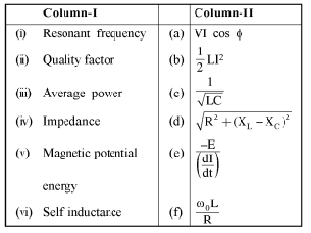
Match the following
Image

Answer

(i) $\frac{1}{\sqrt{ LC }}$
(ii) $\frac{\omega_0 L}{ R }$
(iii)$VI \cos \phi$
(iv)$\sqrt{ R ^2+\left( X _{ L }- X _{ C }\right)^2}$
(v) $\frac{1}{2} LI ^2$
(vi) $\frac{- E }{\left(\frac{ dI }{ dt }\right)}$

Need a full question paper?

Generate a complete, print-ready paper with questions like this in minutes — across 16+ boards, with answer keys.

Start Generating Free

Similar questions

The current−voltage characteristic of an ideal p-n junction diode is given by $\text{i}=\text{i}_0\Big(\text{e}^{\frac{\text{eV}}{\text{kT}}}-1\Big)$ where, the drift current i0 equals $10\mu\text{A}.$ Take the temperature T to be 300K.
  1. Find the voltage V0 for which $\text{e}^{\frac{\text{eV}}{\text{KT}}}=100.$ One can neglect the term 1 for voltages greater than this value.
  2. Find an expression for the dynamic resistance of the diode as a function of V for V > V0.
  3. Find the voltage for which the dynamic resistance is $0.2\Omega.$
A parallel plate capacitor is to be designed with a voltage rating 1kV, using a material of dielectric constant 3 and dielectric strength about 107Vm–1. (Dielectric strength is the maximum electric field a material can tolerate without breakdown, i.e., without starting to conduct electricity through partial ionisation.) For safety, we should like the field never to exceed, say 10% of the dielectric strength. What minimum area of the plates is required to have a capacitance of 50pF?
When the sun is directly overhead, the surface of the earth receives 1.4 × 10³ W m-2 of sunlight. Assume that the light is monochromatic with average wavelength 500nm and that no light is absorbed in between the sun and the earth's surface. The distance between the sun and the earth is 1.5 × 10¹¹m.
  1. Calculate the number of photons falling per second on each square metre of earth's surface directly below the sun.
  2. How many photons are there in each cubic metre near the earth's surface at any instant?
  3. How many photons does the sun emit per second?
When the sun is directly overhead, the surface of the earth receives 1.4 × 10³ W m-2 of sunlight. Assume that the light is monochromatic with average wavelength 500nm and that no light is absorbed in between the sun and the earth's surface. The distance between the sun and the earth is 1.5 × 10¹¹m.
  1. Calculate the number of photons falling per second on each square metre of earth's surface directly below the sun.
  2. How many photons are there in each cubic metre near the earth's surface at any instant?
  3. How many photons does the sun emit per second?
A voltmeter coil has resistance $50.0\Omega$ and a resistor of $1.15\text{k}\Omega$ is connected in series. It can read potential differences up to 12 volts. If this same coil is used to construct an ammeter that can measure currents up to 2.0A, what should be the resistance of the shunt used?
Prove that due to a charged layer of infinite expansion, the value of the electric field at any point near it does not depend on the area of the surface and the distance from the layer . i.e., the electric field remains uniform at points near the layer.###Write Gauss'law.By applying this rule,find the value of the electric field due to a uniformly charged infinite plane sheet at any point near the sheet.
A car moving at a speed of 36 km/hr is taking a turn on a circular road of radius 50m. A small wooden plate is kept on the seat with its plane perpendicular to the radius of the circular road (figure In). A small block of mass 100g is kept on the seat which rests against the plate. The friction coefficient between the block and the plate is $\mu=0.58.$
  1. Find the normal contact force exerted by the plate on the block.
  2. The plate is slowly turned so that the angle between the normal to the plate and the radius of the road slowly increases. Find the angle at which the block will just start sliding on the plate.

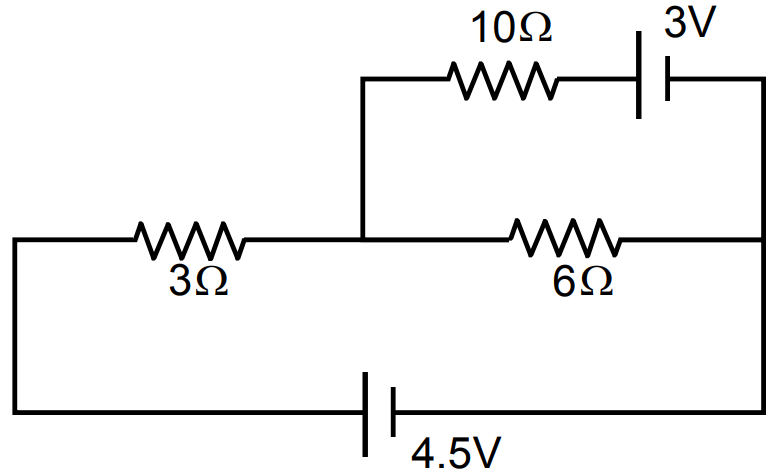
Find the current through the $10\Omega$ resistor shown in figure.

Derive Snell's law for refraction of light by Huygen's wave theory.
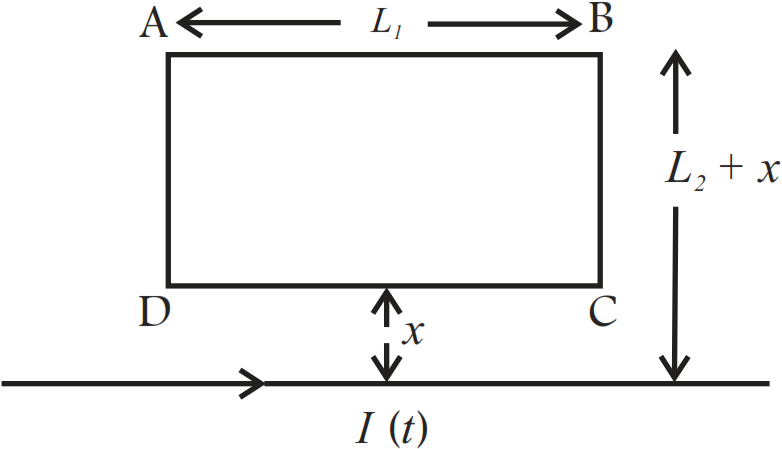
A rectangular loop of wire ABCD is kept close to an infinitely long wire carrying a current $\text{I}(\text{t})=\text{I}_0\Big(1-\frac{\text{t}}{\text{T}}\Big)$ for 0 and I(0) = 0 for t > T (Fig). Find the total charge passing through a given point in the loop, in time T. The resistance of the loop is R.