Question
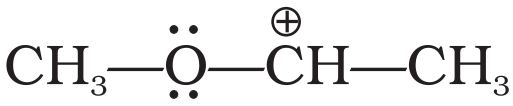
Match the ions given in Column I with their nature given in Column II.
 
Column I
 
Column II
(i)
(a)
Stable due to resonance.
(ii)
$\text{F}_3-\text{C}^\oplus$
(b)
Destabilised due to inductive effect.
(iii)
$\ \ \ \ \ \ \ \ \ \ \ \ \text{CH}_3\\\ \ \ \ \ \ \ \ \ \ \ \ \ |\\\text{CH}_3-\text{C}^\ominus\\\ \ \ \ \ \ \ \ \ \ \ \ \ \ |\\\ \ \ \ \ \ \ \ \ \ \ \ \ \text{CH}_3$
(c)
Stabilised by hyperconjugation.
(iv)
$\ \ \ \ \ \ \ \ \ \ \ \ \ _\oplus\\\text{CH}_3-\text{CH}-\text{CH}_3$
(d)
A secondary carbocation.

Answer

 
Column I
 
Column II
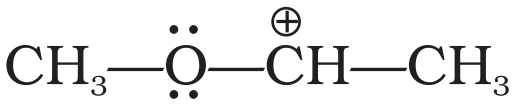
(i)
(a)
Stable due to resonance.
(ii)
$\text{F}_3-\text{C}^\oplus$
(b)
Destabilised due to inductive effect.
(iii)
$\ \ \ \ \ \ \ \ \ \ \ \ \text{CH}_3\\\ \ \ \ \ \ \ \ \ \ \ \ \ |\\\text{CH}_3-\text{C}^\ominus\\\ \ \ \ \ \ \ \ \ \ \ \ \ \ |\\\ \ \ \ \ \ \ \ \ \ \ \ \ \text{CH}_3$
(b)
Destabilised due to inductive effect.
(iv)
$\ \ \ \ \ \ \ \ \ \ \ \ \ _\oplus\\\text{CH}_3-\text{CH}-\text{CH}_3$
(c)
Stabilised by hyperconjugation.
(d)
A secondary carbocation.

Need a full question paper?

Generate a complete, print-ready paper with questions like this in minutes — across 16+ boards, with answer keys.

Start Generating Free