Question
Match the items given in Column I and Column II.
 
Column I
 
Column II
i.
Saturated solution
a.
Solution having same osmotic pressure at a given temperature as that of given solution.
ii.
Binary solution
b.
A solution whose osmotic pressure is less than that of another.
iii.
Isotonic solution
c.
Solution with two components.
iv.
Hypotonic solution
d.
A solution which contains maximum amount of solute that can be dissolved in a given amount of solvent at a given temperature.
v.
Solid solution
e.
A solution whose osmotic pressure is more than that of another.
vi
Hypertonic solution
f.
A solution in solid phase.

Answer

 
Column I
 
Column II
i.
Saturated solution
d.
A solution which contains maximum amount of solute that can be dissolved in a given amount of solvent at a given temperature.
ii.
Binary solution
c.
Solution with two components.
iii.
Isotonic solution
a.
Solution having same osmotic pressure at a given temperature as that of given solution.
iv.
Hypotonic solution
b.
A solution whose osmotic pressure is less than that of another.
v.
Solid solution
f.
A solution in solid phase.
vi.
Hypertonic solution
e.
A solution whose osmotic pressure is more than that of another.
Explanation:
  1. Saturated solution: A solution which contains maximum amounts of solute that can be dissolved in a given amounts of solute that can be dissolved in a given amount of solvent at a given temperature.
  2. Binary solution: A solution with two components is known as binary solution.
  3. Isotonic solution: A solution having same osmotic pressure at a given temperature as that of given solution is known as isotonic solution.
  4. Hypotonic solution: A solution whose osmotic pressure is less than another is known as hypotonic solution.
  5. Solid solution: A solution in solid phase is known as solid solution.
  6. Hypertonic solution: A solution whose osmotic pressure is greater than that of another is known as hypertonic solution.

Need a full question paper?

Generate a complete, print-ready paper with questions like this in minutes — across 16+ boards, with answer keys.

Start Generating Free

Similar questions

The reaction between A and B is first order with respect to A and zero order with respect to B. Fill in the blanks in the following table :
Experiment$[ A ] / mol L ^{-1}$$[ B ] / mol L ^{-1}$Initial rate
$/ mol$ $L ^{-1} min^{-1}$
I0.10.1$2.0 \times 10^{-2}$
II-0.2$4.0 \times 10^{-2}$
III0.40.4-
IV-0.2$2.0 \times 10^{-2}$
Explain the following reaction:
$ n-BuBr + KCN \xrightarrow{EtOH-H_2O} n-BuCN $
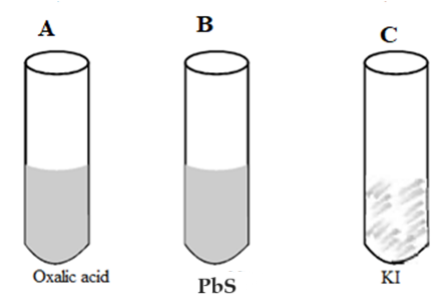
$(a).$ A purple colour compound $A,$ which is a strong oxidising agent and used for bleaching of wool, cotton, silk and other textile fibres was added to each of the three test tubes along with $H_2SO_4.$ It was followed by strong heating.
Image
In which of the above test tubes; $A, B$ or $C:$
$(i)$ Violet vapours will be formed
$(ii)$ The bubbles of gas evolved will extinguish a burning matchstick. Write an equation for each of the above observations.
$b. A$ metal ion $M^{n+}$ of the first transition series having $d^5$ configuration combines with three didentate ligands. Assuming $\Delta_0 < P:$
$(i)$ Draw the crystal field energy level diagram for the $3d$ orbital of this complex.
$(ii)$ What is the hybridisation of Mnt in this complex and why?
$(iii)$ Name the type of isomerism exhibited by this complex.
Describe the reactions of carboxylic acids in which C-OH bond is broken.
Explain the collision principle of any chemical reaction.
Answer the following questions:
Assign reasons for the following:
  1. In the series $\ce{Sc (Z = 21) to Zn (Z = 30)}$, the enthalpy of atomisation of $Zn$ is the lowest.
  2. $Zr$ and Hf have almost identical radii.
  3. Transition metals show variable oxidation states.
  4. The $E^\circ M^{2+}/M$ value for copper is positive $(+0.34 V).$
Assign reasons for the following:
  1. The enthalpies of atomisation of transition elements are high.
  2. The transition metals and many of their compounds act as good catalyst.
  3. From element to element the actinoid contraction is greater than the lanthanoid contraction.
  4. The $E^0$ value for the $Mn^{3+}/Mn^{2+}$ couple is much more positive than that for $Cr^{3+}/Cr^{2+}.$
  5. Scandium $(Z = 21)$ does not exhibit variable oxidation states and yet it is regarded as a transition element.
Which of the following compounds would undergo aldol condensation, which the Cannizzaro reaction and which neither? Write the structures of the expected products of aldol condensation and Cannizzaro reaction.
  1. Methanal
  2. 2-Methylpentanal
  3. Benzaldehyde
  4. Benzophenone
  5. Cyclohexanone
  6. 1-Phenylpropanone
  7. Phenylacetaldehyde
  8. Butan-1-ol
  9. 2,2-Dimethylbutanal.
(i) Define molecularity of a reaction.
(ii) Explain the effect of presence of catalyst on the rate of reaction.
(iii) In a first order reaction at 300 K , the initial concentration of the reactant was $1.0 \times 10^{-2} mol L ^{-1}$, which decreased to $0.5 \times 10^{-2} molL ^{-1}$ after 30 minutes at 300 K . Calculate the rate constant of the reactant at 300 K. $[\log 2=0.3010] \quad$
Describe how does the enthalpy of reaction remain unchanged when a catalyst is used in the reaction.