Question
Match the items of Column I and Column II.
  Column I   Column II
(i) Mathematical expression for rate of reaction. (a) Rate constant.
(ii) Rate of reaction for zero order reaction is equal to. (b) Rate law.
(iii) Units of rate constant for zero order reaction is same as that of. (c) Oder of slowest step.
(iv) Order of a complex reaction is determined by. (d) Rate of a reaction.

Answer

  Column I   Column II
(i) Mathematical expression for rate of reaction. (b) Rate law.
(ii) Rate of reaction for zero order reaction is equal to. (a) Rate constant.
(iii) Units of rate constant for zero order reaction is same as that of. (d) Rate of a reaction.
(iv) Order of a complex reaction is determined by. (c) Oder of slowest step.
Explanation:
  1. Mathematical expression for rate of reaction is known as rate law.
  2. Rate of reaction for zero order reaction is equal to rate constant r = k[A].
  3. Unit of rate of reaction is same as that or rate of reaction.
  4. Order of complex reaction is determined by rate of a reaction, which is slowest.

Need a full question paper?

Generate a complete, print-ready paper with questions like this in minutes — across 16+ boards, with answer keys.

Start Generating Free

Similar questions

$\ce{COSO_4Cl._5NH_3}$ exists in two isomeric forms $'A\ '$ and $'B\ '.$ Isomer $'A\ '$ reacts with $AgNO_3$ to give white precipitate but does not react with $BaCl_2.$ Isomer $'B\ '$ gives a white precipitate with $BaCl_2$ but does not react with $AgNO_3.$ Answer the following questions.
i. Identify $'A\ '$ and $'B\ '$ and write their structural formulas.
ii. Name the type of isomerism involved.
iii. Give the $\text{IUPAC}$ name of $'A\ '$ and $'B\ '.$
  1. Answer the following questions briefly:
  1. What are any two good sources of vitamin A?
  2. What are nucleotides?
  3. Give an example of simple lipids.
  1. How are carbohydrates classified?
Match the complex ions given in Column $I$ with the colours given in Column $II$ and assign the correct code:
 
Column $I ($Complex ion$)$
 
Column $II ($Colour$)$
$a.$ $[Co(NH_3)_6]^{3+}$ $1.$
Violet
$b.$ $[Ti(H_2O)_6]^{3+}$ $2.$
Green
$c.$ $[Ni(H_2O)_6]^{2+}$ $3.$
Pale blue
$d.$ $[Ni(H_2O)_4(en)]^{2+} (aq)$ $4.$
Yellowish orange
 
 
$5.$
Blue
Code:
Explain the following :
(i) Fermentation
(ii) Dehydration
(iii) Hydrogen bonding in alcohols.
  1. Give reasons for the following:
  1. $Mn^{3+ }$ is a good oxidizing agent.
  2. $ E^0 m^{2+} / M $ values are not regular for first row transition metals. $(3d$ series$)$
  3. Although $‘F’$ is more electronegative then $‘O’$, the highest Mn fluoride is $Mnf_4$, whereas the highest oxide is $Mn_2O_7$.
  1. Complete the following equations:
$\text{2CrO}_{4}^{2}+\text{2H}^{+}\rightarrow$
$\text{KMnO}_{4}\xrightarrow{heat}$ 
The rate constant for the first order decomposition of $\ce{H_2O_2}$ is given by the following equation:
$\log k = 14.34 – 1.25 \times 10^4K/T$
Calculate $E_a$ for this reaction and at what temperature will its half$-$period be $256$ minutes?
Explain relationship between $E _{\text {cell }}^{\circ}$ and equilibrium constant with the help of Nernst equation.
Answer the following question:
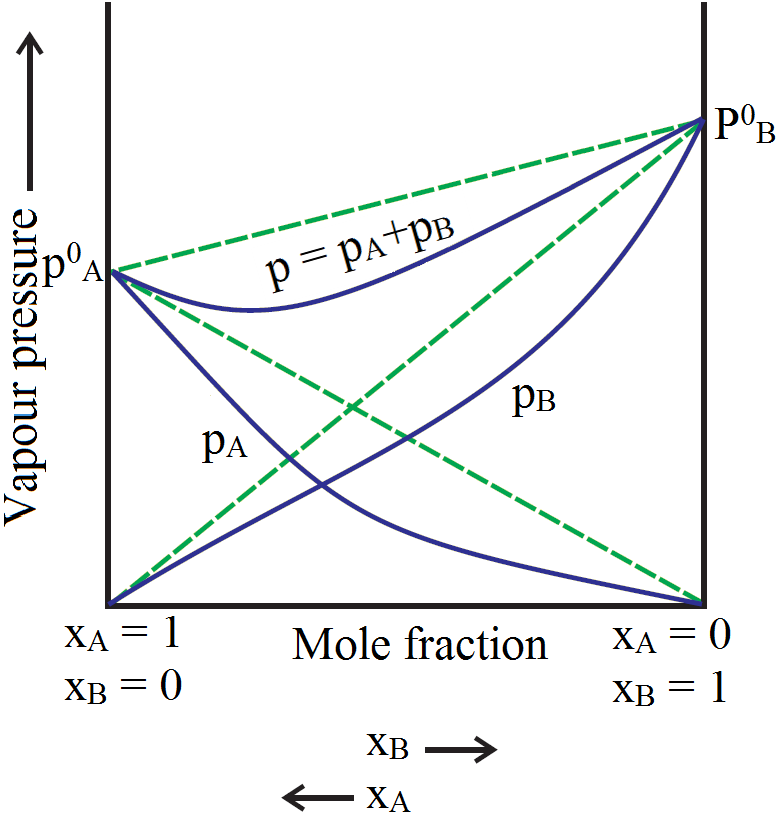
The graphical representation of vapour pressures of two component system as a function of composition is given alongside. By graphic inspection, answer the following questions:
  1. Are the A-B interactions weaker, stronger or of the same magnitude as A-A and B-B?
  2. Name the type of deviation shown by this system from Raoult’s law.
  3. Predict the sign of $\Delta_\text{mix}\text{H}$ for this system.
  4. Predict the sign of $\Delta_\text{mix}\text{H}$ for this system.
  5. Give an example of such a system.
  6. What type of azeotrope will this system form, if possible?
  1. Define the following terms:
  1. Mole fraction.
  2. Ideal solution.
  1. $15.0\ g$ of an unknown molecular material is dissolved in $450\ g$ of water. The resulting solution freezes at $- 0.34^\circ C.$ What is the molar mass of the material?
$(K_f$ for water $= 1.86\ K \ kg\ mol^{–1}).$
Match the terms given in Column $I$ with the units given in Column $II.$
 
Column $I$
 
Column $II$
$i.$ $∧_m$ $a.$ $\ce{S cm^{-1}}$
$ii.$ $\ce{E}_{\ce{Cell}}$ $b.$ $m^-$
$iii.$ $K$ $c.$ $\ce{S cm^2 mol^{-1}}$
$iv.$ $G^*$ $d.$ $V$