Question
Match the items of Column I with items of Column II and assign the correct code:
 
Column I
 
Column II
(A)
Coloured bands
(1)
Zone refining
(B)
LImpure matal to volatie complex
(2)
Fractional distillation
(C)
Purification of Ge and Si
(3)
Mond process
(D)
Purification of mercury
(4)
Chromatophy
 
 
(5)
Liquation
  1. A (1) B (2) C (4) D (5)
  2. A (4) B (3) C (1) D (2)
  3. A (3) B (4) C (2) D (1)
  4. A (5) B (4) C (3) D (2)

Answer

 
Column I
 
Column II
(A)
Coloured bands
(4)
Chromatophy
(B)
LImpure matal to volatie complex
(3)
Mond process
(C)
Purification of Ge and Si
(1)
Zone refining
(D)
Purification of mercury
(2)
Fractional distillation
  1. A (4) B (3) C (1) D (2)
Explanation:
  1. Coloured bands are observed in chromatography.
  2. Impure metal is converted to volatile complex by using Mond’s process.
  3. Ge and Si are purified by zone refining method.
  4. Purification of mercury is done by fractional distillation.

Need a full question paper?

Generate a complete, print-ready paper with questions like this in minutes — across 16+ boards, with answer keys.

Start Generating Free

Similar questions

Prove that the relative depression of vapour pressure is equal to the mole fraction of solute.
An element ‘A’ exists as a yellow solid in standard state. It forms a volatile hydride ‘B’ which is a foul smelling gas and is extensively used in qualitative analysis of salts. When treated with oxygen, ‘B’ forms an oxide ‘C’ which is a colourless, pungent smelling gas. This gas when passed through acidified $KMnO_4$ solution, decolourises it. ‘C’ gets oxidised to another oxide ‘D’ in the presence of a heterogeneous catalyst. Identify ‘A’, ‘B’, ‘C’, ‘D’ and also give the chemical equation of reaction of ‘C’ with acidified $KMnO_4​​​​​​​$​​​​​​​ solution and for conversion of ‘C’ to ‘D’.
Describe the nucleophilic addition- elimination reactions of carbonyl compounds with reference to their reaction with the following compounds:
(i) Alcohol and thio alcohol
(ii) Ammonia and its derivatives
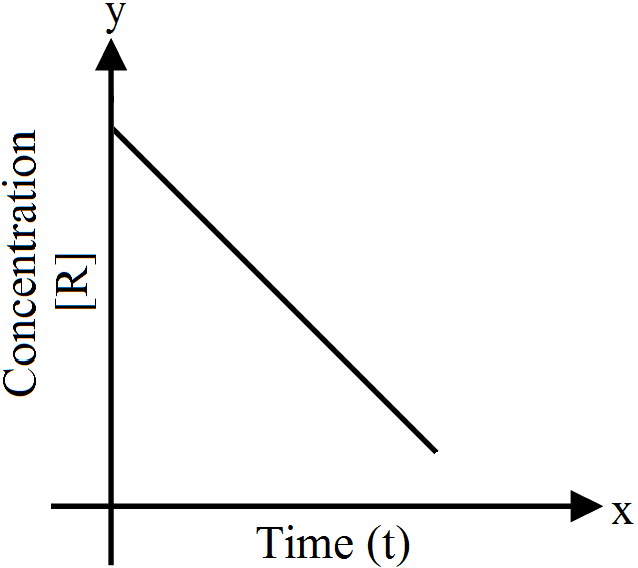
Consider the reaction $\text{R}\xrightarrow{\ \ \text{k}\ \ } \text{P}.$ The change in concentration of $R$ with time is shown in the following plot:
  1. Predict the order of the reaction.
  2. Derive the expression for the time required for the completion of the reaction.
  3. What does the slope of the above line indicate?
Why the reactivity of chlorobenzene towards nucleophilic substitution increase when electron withdrawing group ( $- NO _2$ ) is attached to the ortho and para positions? Explain.
Explain the open chain structure of glucose.
Give reasons for the following:
On electrolysis in acidic solution amino acids migrate towards cathode, while in alkaline solution these migrate towards anode.
Give the oxidation state, d-orbital occupation and coordination number of the central metal ion in the following complexes:
$i. K_3\left[ Co \left( C _2 O _4\right)_3\right]$
$ii.$ cis- $\left[ Cr (e n)_2 Cl _2\right] Cl$
$iii. \left( NH _4\right)_2\left[ CoF _4\right]$
$iv. \left[ Mn \left( H _2 O \right)_6\right] SO _4$
Derive the Nernst equation and explain how $E_{\text {cell }}^{\circ}$ depends on concentration of ions.
$(i).$ Illustrate the following reactions giving suitable example in each case:
$a.$ Ammonolysis
$b.$ Coupling reaction
$c.$ Acetylation of amines
$(ii).$ Describe Hinsberg method for the identification of primary, secondary and tertiary amines. Also, write the chemical equations of the reactions involved.