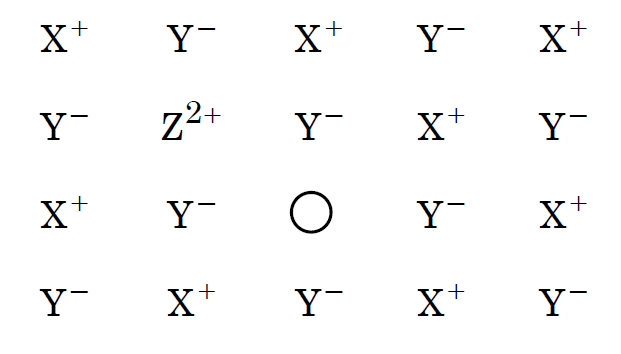
Question
Match the properties given in Column I with the metals given in Column II.
 
Column I (Property)
 
Column II (Metal)
(i)
An element which can show +8 oxidation state
(a)
Mn
(ii)
3d block element that can show upto +7 oxidation state
(b)
Cr
(iii)
3d block element with highest melting point
(c)
Os
   
(d)
Fe

Answer

 
Column I (Property)
 
Column II (Metal)
(i)
An element which can show +8 oxidation state
(c)
Os
(ii)
3d block element that can show upto +7 oxidation state
(a)
Mn
(iii)
3d block element with highest melting point
(b)
Cr
Explanation:
  1. Osmium is an element which show +8 oxidation state.
  2. 3d block element that can show up to +7 oxidation state is manganese.
  3. 3d block element with highest melting point is chromium.

Need a full question paper?

Generate a complete, print-ready paper with questions like this in minutes — across 16+ boards, with answer keys.

Start Generating Free

Similar questions

Write the conditions to maximise the yield of $H_2SO_4$ by Contact process.
Calculate the standard cell potentials of galvanic cell in which the following reactions take place:
$Fe^{2+}(aq) + Ag^+ (aq) \rightarrow Fe^{3+}(aq) + Ag(s)$
Calculate the $\triangle_\text{r}\text{G}^\ominus$ and equilibrium constant of the reactions.
Ionisation enthalpies of Ce, Pr and Nd are higher than Th, Pa and U.
  1. What is the radius of sodium atom if it crystallises in bcc structure with the cell edge of $400$ pm?
  2. Examine the given defective crystal:
  1. Write the term used for this type of defect.
  2. What is the result when $XY$ crystal is doped with divalent $(Z^{2+})$ impurity$?$
Silver crystallises in an fcc lattice. The edge length of its unit cell is $4.077 \times 10^{–8}\ cm$ and its density is $10.5\ g\ cm^{–3}.$ Calculate on this basis the atomic mass of silver. $(N_A = 6.02 \times 10^{23}\ mol^{–1}).$
Account for the following:
  1. Electrophilic substitution in case of aromatic amines takes place more readily than benzene.
  2. $CH_3CONH_2$ is a weaker base than $CH_3CH_2NH_2$.
  3. Nitro compounds have higher boiling points than hydrocarbons having almost same molecular mass.
What happens when,
  1. A freshly prepared precipitate of $Fe(OH)_3$ is shaken with a small amount of $FeCl_3$ solution?
  2. Persistent dialysis of a colloidal solution is carried out?
  3. An emulsion is centrifuged?
Boiling point of water at $750$ mm Hg is $99.63^\circ C.$ How much sucrose is to be added to $500$ g of water such that it boils at $100^\circ C.$
Define the following:
  1. Anionic detergents.
  2. Narrow spectrum antibiotics.
  3. Antacids.
Explain measurement and calculation of resistance and conductivity of electrolytic solution.