Question
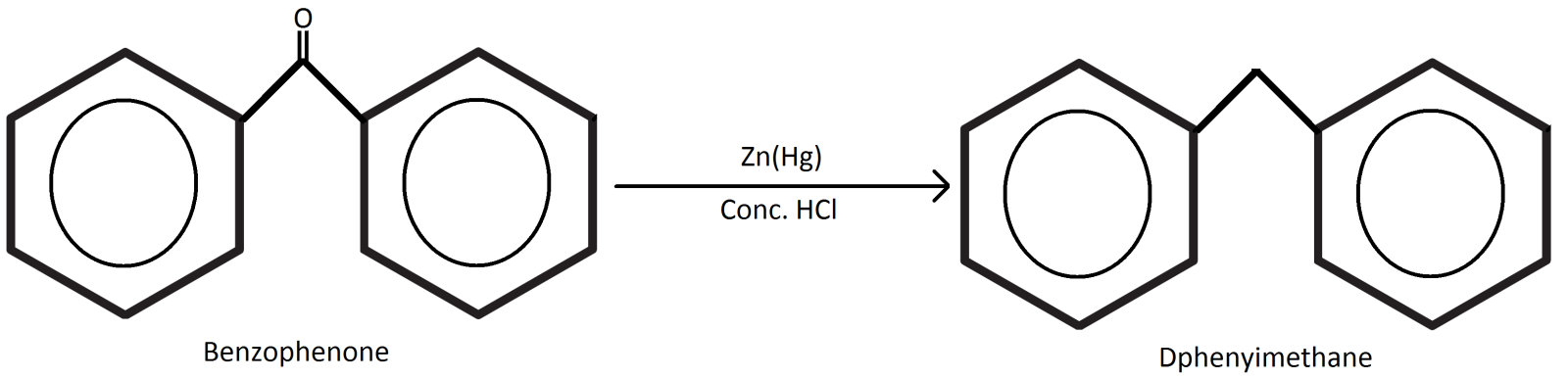
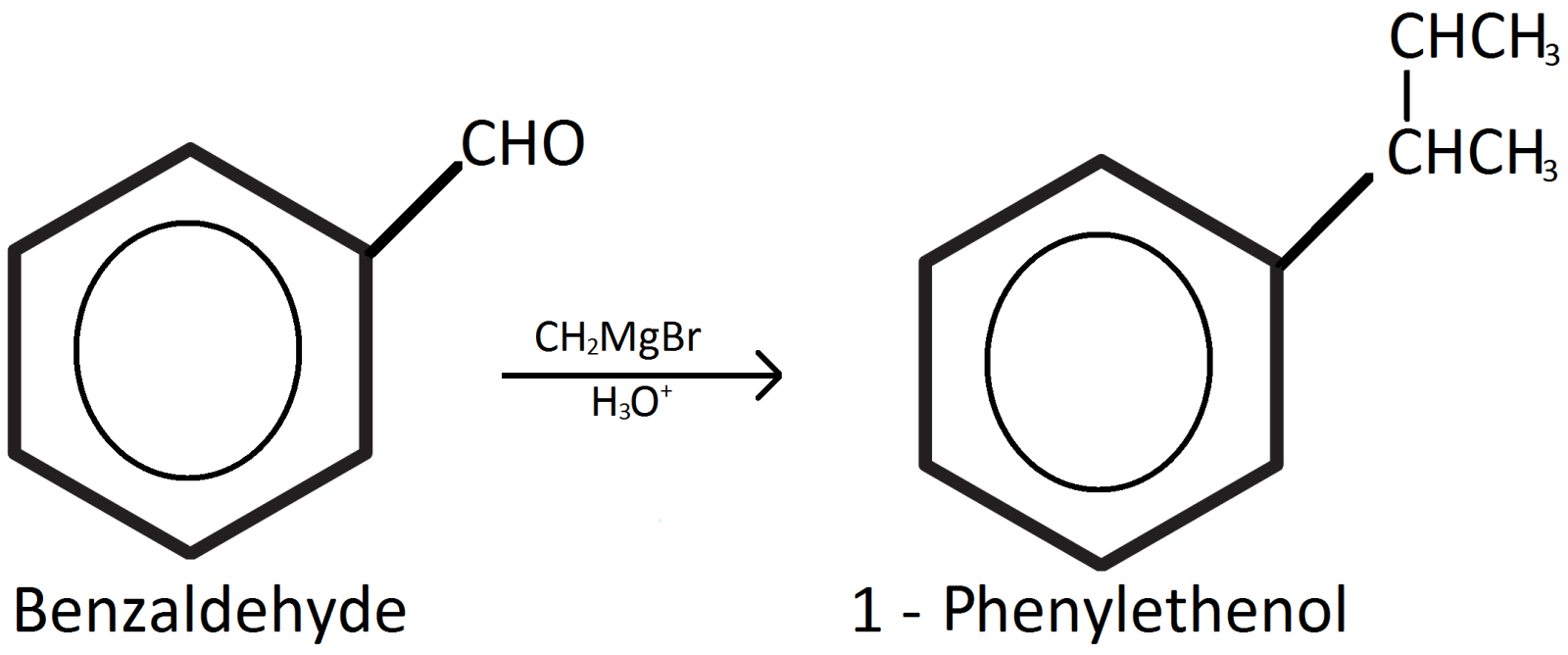
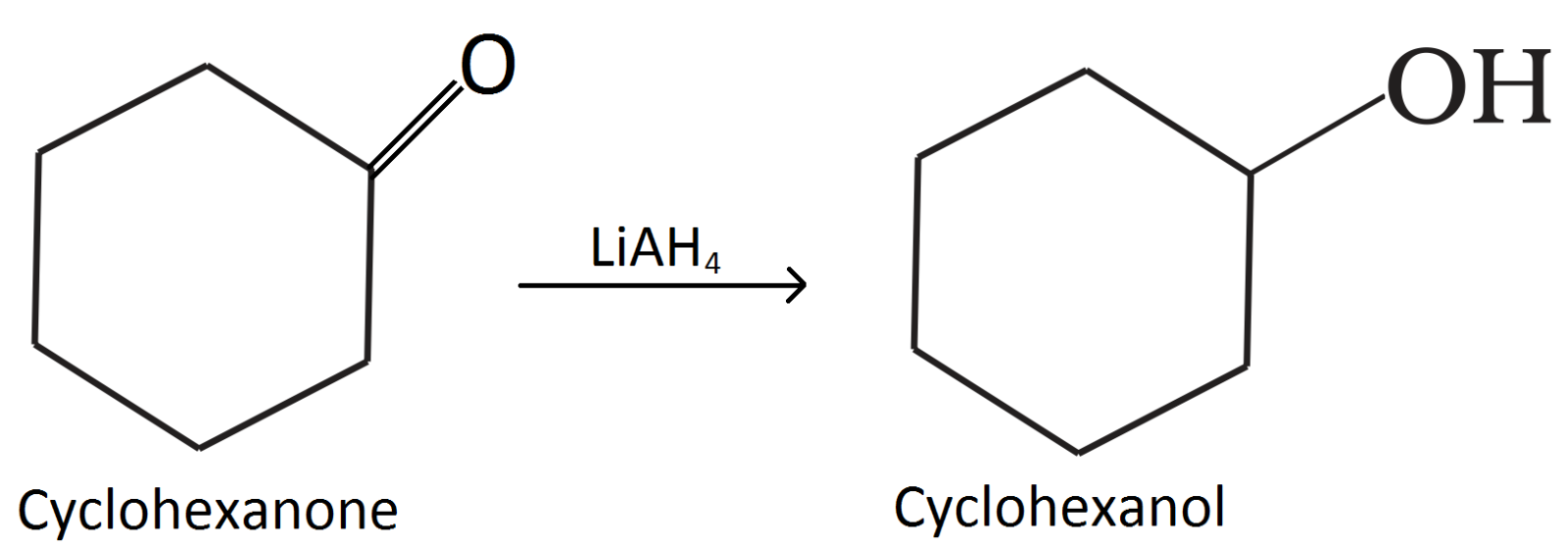
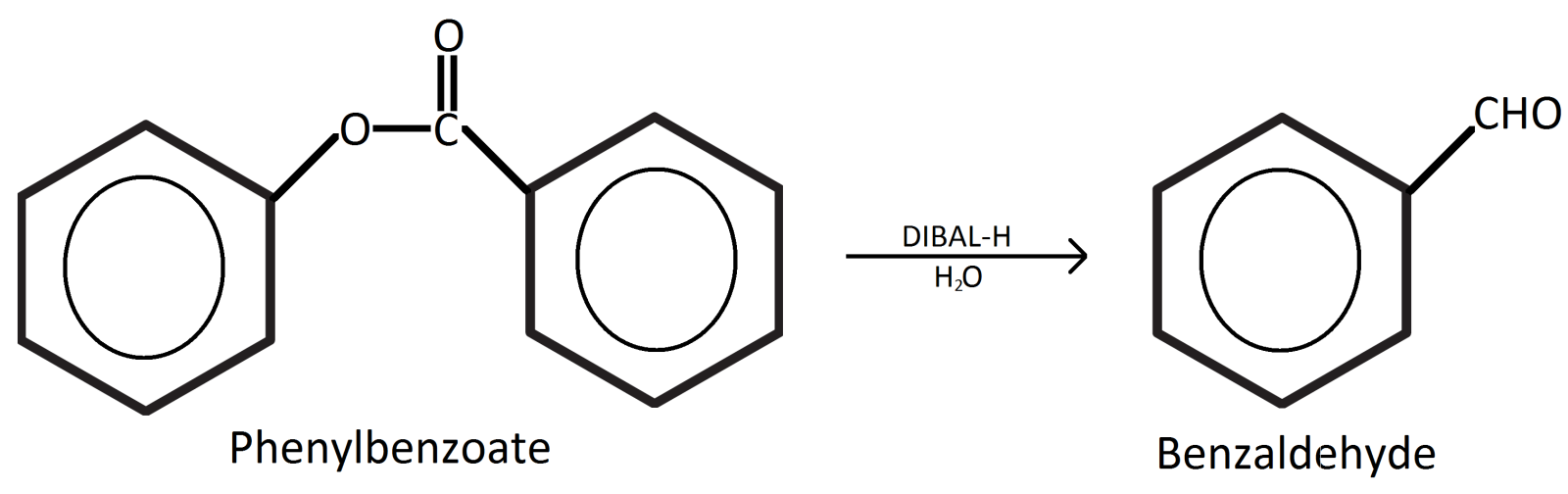
Match the reactions given in Column I with the suitable reagents given in Column II. 
 
Column I
(Reactions)
 
Column II
(Reagents)
(i)
Benzophenone → Diphenylmethane
(a)
LiAlH4
(ii)
enzaldehyde → 1-Phenylethanol
(b)
DIBAL—H
(iii)
Cyclohexanone → Cyclohexanol
(c)
Zn(Hg)/Conc. HCl
(iv)
Phenyl benzoate → Benzaldehyde
(d)
CH3MgBr

Need a full question paper?

Generate a complete, print-ready paper with questions like this in minutes — across 16+ boards, with answer keys.

Start Generating Free

Similar questions

(i) Name the product obtained when excess of ethanol is treated with ammonia in the presence of Alumina?
(ii) How is methyl amine prepared from the following compounds? Give the equation.
(a) $CH _3- MgCl$
(b) $CH _3 COCl$
Why Hunsdiecker reaction is not suitable for making alkyl iodide?
Visha took two aqueous solutions - one containing 7.5g of urea (Molar mass = 60g/ mol) and the other containing 42.75g of substance Z in 100g of water, respectively. It was observed that both the solutions froze at the same temperature. Calculate the molar mass of Z.
Write the name of the cell which is generally used in transistors. Write the reactions taking place at the anode and the cathode of this cell.
When 3-methylbutan-2-ol is treated with HBr, the following reaction takes place:

$\ \ \ \ \ \ \ \ \ \ \ \ \ \ \ \ \ \ \ \ \ \ \ \ \ \ \ \ \ \ \ \ \ \ \ \ \ \ \ \ \ \ \ \ \ \ \ \ \ \ \ \ \ \ \ \ \ \ \ \ \ \ \ \ \ \ \ \ \text{Br}\\\ \ \ \ \ \ \ \ \ \ \ \ \ \ \ \ \ \ \ \ \ \ \ \ \ \ \ \ \ \ \ \ \ \ \ \ \ \ \ \ \ \ \ \ \ \ \ \ \ \ \ \ \ \ \ \ \ \ \ \ \ \ \ \ \ \ \ \ \ |\\\text{CH}_3-\text{CH}-\text{CH}-\text{CH}_3\xrightarrow{\ \ \ \text{HBr} \ \ }\text{CH}_3-\text{C}-\text{CH}_2-\text{CH}_3\\\ \ \ \ \ \ \ \ \ \ \ \ \ \ |\ \ \ \ \ \ \ \ \ \ |\ \ \ \ \ \ \ \ \ \ \ \ \ \ \ \ \ \ \ \ \ \ \ \ \ \ \ \ \ \ \ \ \ \ \ \ \ \ \ \ \ \ \ |\\\ \ \ \ \ \ \ \ \ \ \ \ \ \text{CH}_3\ \ \ \ \text{OH}\ \ \ \ \ \ \ \ \ \ \ \ \ \ \ \ \ \ \ \ \ \ \ \ \ \ \ \ \ \ \ \ \ \ \ \ \ \ \text{CH}_3$

Give a mechanism for this reaction.

(Hint: The secondary carbocation formed in step II rearranges to a more stable tertiary carbocation by a hydride ion shift from 3rd carbon atom.)

Calculate the mass of compound (molar mass= 256 g mol-1) to be dissolved in 75 g of benzene to lower its freezing point by 0.48 K (Kf= 5.12 K kg mol-1).
Write the reactions of D-glucose which can’t be explained by its open-chain structure. How can cyclic structure of glucose explain these reactions?
A compound ‘A’ is optically active. On mild oxidation, it gives a compound ‘B’ but on vigorous oxidation gives another compound ‘C’. C along with D is also formed from B by reaction with iodine and alkali. Deduce the structures of A, B, C, D.
Calculate the value of EMF for the cell reaction :
$
\begin{array}{l}
Cu_{(s)}+2 Ag_{(aq)}^{+} \rightarrow Cu_{(aq)}^{2+}+2 Ag_{(s)} \\
E_{Cu^{+2} / Cu}^{o}=0.34 V \text { and } E_{Ag^{+} / Ag}^{o}=0.80 V
\end{array}
$
Phenols do not undergo substitution of the -OH group like alcohols.