MCQ
Match the reactions in Column $I$ with appropriate options in Column $II$.
Column $I$ Column $II$
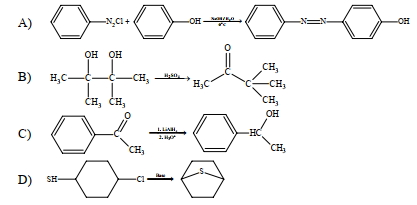
$(A)$ $Image$ $(p)$ Racemic mixture
$(B)$ $Image$ $(q)$ Addition reaction
$(C)$ $Image$ $(r)$ Substitution reaction
$(D)$ $Image$ $(s)$ Coupling reaction
  $(t)$ Carbocation intermediate

  • A
    $(A-r, p, t) ;(B-t) ;(C-p, t) ;(D-s)$
  • B
    $(A-q, s, t) ;(B-p) ;(C-p, r) ;(D-p)$
  • $(A-r, s, t) ;(B-t) ;(C-p, q) ;(D-r)$
  • D
    $(A-p, q, r) ;(B-t) ;(C-s, t) ;(D-q)$

Answer

Correct option: C.
$(A-r, s, t) ;(B-t) ;(C-p, q) ;(D-r)$
c
$(A)$ It is an example of electrophilic substitution reaction which results in coupled product hence it is coupling reaction also.

$(B)$ Pinacole-pinacolone rearrangement. In this reaction intermediate is carbocation.

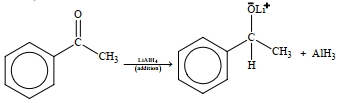
$(C)$ It is an example of addition reaction by carbonyl compounds and both enantiomers will be formed. Hence, racemic mixture will be obtained. $Image$

$(D)$ It is an example of nucleophilic substitution.

Need a full question paper?

Generate a complete, print-ready paper with questions like this in minutes — across 16+ boards, with answer keys.

Start Generating Free

Similar questions

Which of the following halides is the most stable?
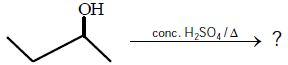
Number of possible product $(s)$ formed in above reaction :-
Rate of reaction is given by following rate law $ - \frac{{d\left[ c \right]}}{{dt}} = \frac{{{k_1}\,\left[ c \right]}}{{1 + {k_2}\,\left[ c \right]}}$ order of reaction when concentration is verh high
If the concentration is expressed in moles per litre, the unit of the rate constant for a first order reaction is
Which will have the maximum value of electron affinity $O^x,\, O^y$ and $O^z \,(x,\, y$ and $z$ are $0,\, -1$ and $-2$ respectively $)$
From the following statements regarding $H_2O_2,$ choose the incorrect statement :
$\underset{(a)}{\mathop{\begin{matrix}
   \,\,\,\,\,\,C{{H}_{3}}  \\
   |  \\
   C{{H}_{3}}-C-C{{H}_{3}}  \\
   |  \\
   \,\,Br  \\
\end{matrix},}}\,\,\,\,\underset{(b)}{\mathop{\begin{matrix}
   C{{H}_{3}}-CH-C{{H}_{3}},  \\
   |\,\,\,\,  \\
   Br\,\,  \\
\end{matrix}}}\,\underset{(c)}{\mathop{C{{H}_{3}}-CH-Br}}\,$

Compare rate of $E_2$ reaction

Which of the following reaction will not give ether as a major product?
The compounds that will give an isomer of  $2; 2-$ dimethyl propane on catalytic hydrogenation are

$(1)$ $\begin{array}{*{20}{c}}
  {C{H_3}CH = C - C{H_3}} \\ 
  {\,\,\,\,\,\,\,\,\,\,|} \\ 
  {\,\,\,\,\,\,\,\,\,\,\,\,\,\,\,\,C{H_3}} 
\end{array}$

$(2)$ $C{H_3}CH = CHC{H_3}$

$(3)$ $\mathop {C{H_3}C}\limits^{\begin{subarray}{l} 
  \,\,\,\,\,\,\,\,{\begin{array}{*{20}{c}}
  {}&H 
\end{array}} \\ 
  \,\,\,\,\,\,\,\,\,\,\,\,\,\,| 
\end{subarray} }  = CHC{H_2}C{H_3}$

$(4)$ $\begin{array}{*{20}{c}}
  {C{H_3}C = C - C{H_3}} \\ 
  {\,\,\,\,\,\,\,|\,\,\,\,\,\,\,\,\,\,\,\,|\,\,\,\,\,\,\,\,\,\,\,\,\,} \\ 
  {\,\,\,\,\,\,\,\,\,\,\,\,\,C{H_{3\,\,}}\,\,C{H_3}\,\,\,\,\,\,\,\,\,\,\,\,\,\,\,\,} 
\end{array}$

The element with which of the following outer electron configuration may exhibit the largest number of oxidation states in its compounds