MCQ
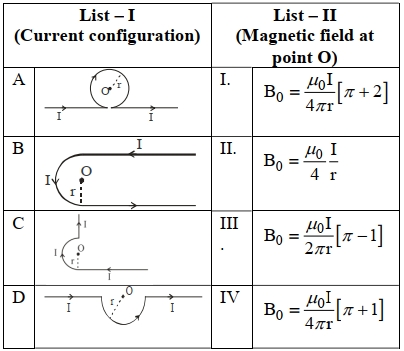
Math List $I$ with List $II$

Choose the correct answer from the option given below:

  • A
    $A-III, B-IV, C-I, D-II$
  • B
    $A-I, B-III, C-IV, D-II$
  • $A-III, B-I, C-IV, D-II$
  • D
    $A-II, B-I, C-IV, D-III$

Answer

Correct option: C.
$A-III, B-I, C-IV, D-II$
c
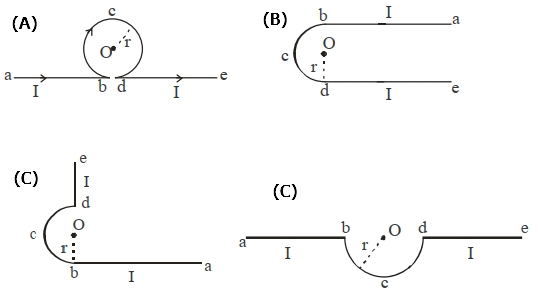
(A)

$B _{ ab }=\frac{\mu_0}{4 \pi} \frac{ I }{ r } \text { (out of the plane) }$

$B _{ bcd }=\frac{\mu_0}{4 \pi} \frac{ I }{ r }(2 \pi) \text { (in the plane) }$

$B _{ de }=\frac{\mu_0}{4 \pi} \frac{ I }{ r } \text { (out of the plane) }$

Hence magnetic field at $O$ is

$B _0=-\frac{\mu_0}{4 \pi} \frac{ I }{ r }+\frac{\mu_0}{4 \pi} \frac{ I }{ r }(2 \pi)-\frac{\mu_0}{4 \pi} \frac{ I }{ r }$

$B _0=\frac{\mu_0}{2 \pi} \frac{ I }{ r }(\pi-1) \ldots \ldots . . \text { (III) }$

(B)

$B _{ ab }=\frac{\mu_0}{4 \pi} \frac{ I }{ r } \text { (out of the plane) }$

$B _{ bcd }=\frac{\mu_0}{4 \pi} \frac{ I }{ r }(\pi) \text { (out of the plane) }$

$B _{ de }=\frac{\mu_0}{4 \pi} \frac{ I }{ r } \text { (out of the plane) }$

Hence magnetic field at $O$ is

$B _0=\frac{\mu_0}{4 \pi} \frac{ I }{ r }+\frac{\mu_0}{4 \pi} \frac{ I }{ r }(\pi)+\frac{\mu_0}{4 \pi} \frac{ I }{ r }$

$B _0=\frac{\mu_0}{4 \pi} \frac{ I }{ r }(\pi+2) \ldots .( I )$

(C)

$B _{ ab }=\frac{\mu_0}{4 \pi} \frac{ I }{ r } \text { (in the plane) }$

$B _{ bcd }=\frac{\mu_0}{4 \pi} \frac{ I }{ r }(\pi) \text { (in the plane) }$

$B _{ de }=0 \text { (at the axis) }$

Hence magnetic field at $O$ is

$B _0=\frac{\mu_0}{4 \pi} \frac{ I }{ r }(1+\pi) \ldots(IV)$

$B _{ ab }=0 \text { (at the axis) }$

$B _{ bcd }=\frac{\mu_0}{4 \pi} \frac{ I }{ r }(\pi) \text { (out of the plane) }$

$B _{ de }=0 \text { (at the axis) }$

Hence magnetic field at $O$ is

$B _0=\frac{\mu_0 I }{4 r } \ldots \text { (II) }$
Need a full question paper?

Generate a complete, print-ready paper with questions like this in minutes — across 16+ boards, with answer keys.

Start Generating Free

Similar questions

In Young’s double-slit experiment the fringe width is $\beta$. If entire arrangement is placed in a liquid of refractive index $n,$  the fringe width becomes
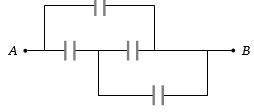
In the circuit shown in figure, each capacitor has a capacity of $3\,\mu F$. The equivalent capacity between $A$ and $B$ is.......$\mu F$
As a body performs $S.H.M.$, its potential energy $U.$ varies with time as indicated in
The most penetrating radiation out of the following is
Which of the following is electromagnetic wave
If $10^{22}$ gas molecules each of mass $10^{-26}\, kg$ collide with a surface (perpendicular to it)elastically per second over an area $1\, m^2$ with a speed $10^4\,m/s$, the pressure exerted by the gas molecules will be of the order of
$\begin{array}{*{20}{c}}
  {2C{H_3} - C - C{H_3}} \\ 
  {\,\,||} \\ 
  {\,\,\,O} 
\end{array}$ $\xrightarrow[{^{{H^ + }}}]{{Mg/Hg}}$ Product, product in the reaction is
A straight steel wire of length $‘\ell ’$ has a magnetic moment $‘M’$. It is bent in $L-$ shape. The new magnetic moment is
An observer looks at a distant tree of height $10\ m$ with a telescope of magnifying power of $20$. To the observer the tree appears :
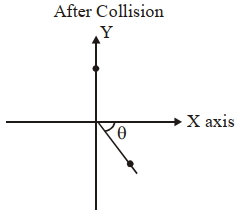
A ball of mass $10\, kg$ moving with a velocity $10 \sqrt{3}\, ms ^{-1}$ along $X-$axis, hits another ball of mass $20\, kg$ which is at rest. After collision, the first ball comes to rest and the second one disintegrates into two equal pieces. One of the pieces starts moving along $Y-$ axis at a speed of $10\, m / s$. The second piece starts moving at a speed of $20\, m / s$ at an angle $\theta$ (degree) with respect to the $X-$axis. The configuration of pieces after collision is shown in the figure. The value of $\theta$ to the nearest integer is