MCQ
$\mathop {\lim }\limits_{x \to 0} \frac{{5\sin x + x\cos x}}{{2\tan x - {x^2}}}$ is
  • A
    $\frac{5}{2}$
  • $3$
  • C
    $0$
  • D
    does not exist

Answer

Correct option: B.
$3$
b
$\mathop {\lim }\limits_{x \to 0} \frac{{5\sin x + x\cos x}}{{2\tan x - {x^2}}}$

$\mathop {\lim }\limits_{x \to 0} \frac{{5\frac{{\sin x}}{x} + \cos x}}{{\frac{{2\tan x}}{x} - x}} = \frac{{5 + 1}}{{2 - 0}} = 3$

Need a full question paper?

Generate a complete, print-ready paper with questions like this in minutes — across 16+ boards, with answer keys.

Start Generating Free

Similar questions

If $x = A\cos 4t + B\sin 4t$, then ${{{d^2}x} \over {d{t^2}}} = $
If ${C_r}$ stands for $^n{C_r}$, the sum of the given series $\frac{{2(n/2)!(n/2)!}}{{n!}}[C_0^2 - 2C_1^2 + 3C_2^2 - ..... + {( - 1)^n}(n + 1)C_n^2]$, Where $n$ is an even positive integer, is
Let $V_{\mathrm{r}}$ denote the sum of the first $\mathrm{r}$ terms of an arithmetic progression $(A.P.)$ whose first term is $\mathrm{r}$ and the common difference is $(2 \mathrm{r}-1)$. Let

$T_{\mathrm{I}}=V_{\mathrm{r}+1}-V_{\mathrm{I}}-2 \text { and } \mathrm{Q}_{\mathrm{I}}=T_{\mathrm{r}+1}-\mathrm{T}_{\mathrm{r}} \text { for } \mathrm{r}=1,2, \ldots$

$1.$  The sum $V_1+V_2+\ldots+V_n$ is

$(A)$ $\frac{1}{12} n(n+1)\left(3 n^2-n+1\right)$

$(B)$ $\frac{1}{12} n(n+1)\left(3 n^2+n+2\right)$

$(C)$ $\frac{1}{2} n\left(2 n^2-n+1\right)$

$(D)$ $\frac{1}{3}\left(2 n^3-2 n+3\right)$

$2.$  $\mathrm{T}_{\mathrm{T}}$ is always

$(A)$ an odd number $(B)$ an even number

$(C)$ a prime number $(D)$ a composite number

$3.$  Which one of the following is a correct statement?

$(A)$ $Q_1, Q_2, Q_3, \ldots$ are in $A.P.$ with common difference $5$

$(B)$ $\mathrm{Q}_1, \mathrm{Q}_2, \mathrm{Q}_3, \ldots$ are in $A.P.$ with common difference $6$

$(C)$ $\mathrm{Q}_1, \mathrm{Q}_2, \mathrm{Q}_3, \ldots$ are in $A.P.$ with common difference $11$

$(D)$ $Q_1=Q_2=Q_3=\ldots$

Give the answer question $1,2$ and $3.$
The circumcentre of a triangle formed by the line $xy + 2x + 2y + 4 = 0$ and $x + y + 2 = 0$ is
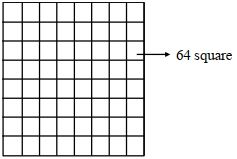
Two squares are chosen at random on a chessboard (see figure). The probability that they have a side in common is :
$C$ the centre of the hyperbola $\frac{{{x^2}}}{{{a^2}}} - \frac{{{y^2}}}{{{b^2}}} = 1$. The tangents at any point $P$ on this hyperbola meets the straight lines $bx - ay = 0$ and $bx + ay = 0$ in the points $Q$ and $R$ respectively. Then $CQ\;.\;CR = $
Let ${R_1}$ be a relation defined by ${R_1} = \{ (a,\,b)|a \ge b,\,a,\,b \in R\} $. Then ${R_1}$ is
$\mathop \smallint \limits_0^1 \frac{{8{\rm{log}}\left( {1 + x} \right)}}{{1 + {x^2}}}dx = $
If for $z=\alpha+i \beta,|z+2|=z+4(1+i)$, then $\alpha+\beta$ and $\alpha \beta$ are the roots of the equation
If the sum of three terms of $G.P.$ is $19$ and product is $216$, then the common ratio of the series is