MCQ
$\mathop \smallint \limits_0^1 \frac{{8{\rm{log}}\left( {1 + x} \right)}}{{1 + {x^2}}}dx = $
  • A
    $\frac{\pi }{8}log2$
  • B
    $\;\frac{\pi }{2}log2$
  • C
    $\;log2$
  • $\;\pi log2$

Answer

Correct option: D.
$\;\pi log2$
d
$I = \int\limits_0^1 {\frac{{8\log (1 + x)}}{{1 + {x^2}}}dx} $

put $x=\tan \theta$

$\therefore \frac{d x}{d \theta}=\sec ^{2} \theta \Rightarrow d x=\sec ^{2} \theta d \theta$

$\therefore I = 8\int\limits_0^{\pi /4} {\frac{{\log (1 + \tan \theta )}}{{1 + {{\tan }^2}\theta }}.} {\sec ^2}\theta d\theta $

$I = 8\int\limits_0^{\pi /4} {\log (1 + \tan \theta )} d\theta .....\left( i \right)$

$ = 8\int\limits_0^{\pi /4} {\log \left[ {1 + \tan \left( {\frac{\pi }{4} - \theta } \right)} \right]} d\theta $

$ = 8\int\limits_0^{\pi /4} {\log \left[ {1 + \frac{{1 - \tan \theta }}{{1 + \tan \theta }}} \right]} d\theta $

$ = 8\int\limits_0^{\pi /4} {\log \left[ {\frac{2}{{1 + \tan \theta }}} \right]} d\theta $

$ = 8\int\limits_0^{\pi /4} {\left[ {\log 2 - \log \left( {1 + \tan \theta } \right)} \right]} d\theta $

$I=8 .(\log 2)[x]_{0}^{\pi / 4}-8$

$ = \int\limits_0^{\pi /4} {\log \left( {1 + \tan \theta } \right)} d\theta $

$I=8 . \frac{\pi}{4} \cdot \log 2-I[\text { From equation }(i)]$

$\Rightarrow 2 I=2 \pi \log 2$

Need a full question paper?

Generate a complete, print-ready paper with questions like this in minutes — across 16+ boards, with answer keys.
Start Generating Free

Similar questions

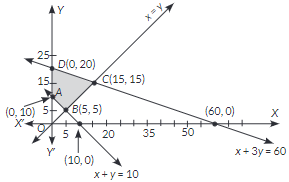
Based on the given shaded region as the feasible region in the graph, at which point(s) is the objective function $Z=3 x+9 y$ maximum?
Image
Choose the correct answer from the given four options:
The area of the region bounded by the curve x = 2y + 3 and the y lines. y = 1 and y = -1 is:
  1. $4\text{ sq. units}$
  2. $\frac{3}{2}\text{ sq. units}$
  3. $6\text{ sq. units}$
  4. $8\text{ sq. units}$
Let $e^{f(x)} = ln x .$ If $g(x)$ is the inverse function of $f(x)$ then $g ‘ (x)$ equals to :
Choose the correct answer from the given four options.
The sine of the angle between the straight line $\frac{\text{x}-2}{3}=\frac{\text{y}-2}{3}=\frac{\text{z}-2}{3}$ and the plane $2\text{x}-2\text{y}+\text{z}=5$ is:
$\int_0^{\frac{\pi}{6}} \sec ^2\left(x-\frac{\pi}{6}\right) d x$ is equal to :
The value of $\left( {\vec a + 2\vec b - \vec c} \right).\left\{ {\left( {\vec a - \vec b} \right) \times \left( {\vec a - \vec b - \vec c} \right)} \right\}$ is equal to
The differential equation for the line $y = mx + c$ is (where $m$ and $c$ is arbitrary constant)
If $a$ , $b$ , $c$ are $p^{th}$ , $q^{th}$ , $r^{th}$ terms of an $H.P.$ and $\vec u = \left( {q-r} \right)\hat i + \left( {r - p} \right)\hat j + \left( {p - q} \right)\hat k$ ,$\vec \upsilon  = \frac{{\hat i}}{a} + \frac{{\hat j}}{b} + \frac{{\hat k}}{c}$ then
A line makes the same angle $\theta$ with each of thex and z axis. If the angle $\beta$ which it makes with y-axis is such that $\sin^2\beta=3\sin^2\theta$ then $\cos^2\theta$ equals:

  1. $\frac{3}{5}$

  2. $\frac{1}{5}$

  3. $\frac{2}{3}$

  4. $\frac{2}{5}$

For a polynomial $g ( x )$ with real coefficient, let $m _{ g }$ denote the number of distinct real roots of $g ( x )$. Suppose $S$ is the set of polynomials with real coefficient defined by

$S=\left\{\left(x^2-1\right)^2\left(a_0+a_1 x+a_2 x^2+a_3 x^3\right): a_0, a_1, a_2, a_3 \in R\right\} \text {. }$

For a polynomial $f$, let $f^{\prime}$ and $f^{\prime \prime}$ denote its first and second order derivatives, respectively. Then the minimum possible value of $\left(m_f+m_{f^{\prime}}\right)$, where $f \in S$, is. . . . . . . .