MCQ
$\mathop \smallint \limits_0^{1.5} x\left[ {{x^2}} \right]dx = $
  • A
    $0$
  • B
    $\frac{3}{2}$
  • $\frac{3}{4}$
  • D
    $\frac{5}{4}$

Answer

Correct option: C.
$\frac{3}{4}$
c
$\int \limits_0^{1.5} x\left[x^2\right] d x=\int \limits_0^1 x\left[x^2\right] d x+\int \limits_1^{\sqrt{2}} x\left[x^2\right] d x+\int \limits_{\sqrt{2}}^{1.5} x\left[x^2\right] d x$

$=\int \limits_0^1(x \times 0) d x+\int \limits_1^{\frac{3}{2}} x\left[x^2\right] d x$

$=\int \limits_1^{\frac{3}{2}} x\left[x^2\right] d x$

Let $x^2=t$ then $2 x d x=d t$. So,

$\int \limits_1^{\frac{3}{2}} x\left[x^2\right] d x=\frac{1}{2} \int \limits_1^{\frac{9}{4}}[t] d t$

$=\frac{1}{2} \int \limits_1^2[t] d t+\frac{1}{2} \int \limits_2^{\frac{9}{4}}[t] d t$

$=\frac{1}{2} \int \limits_1^2 1 d t+\frac{1}{2} \int \limits_2^{\frac{9}{4}} 2 d t$

$=\frac{1}{2}[t]_1^2+\frac{1}{2}[2 t]_2^{\frac{9}{4}}$

$=\frac{1}{2}(2-1)+\frac{1}{2}\left[2\left(\frac{9}{4}\right)-2(2)\right]$

$=\frac{1}{2}+\frac{1}{2}\left(\frac{9-8}{2}\right)$

$=\frac{3}{4}$

Need a full question paper?

Generate a complete, print-ready paper with questions like this in minutes — across 16+ boards, with answer keys.
Start Generating Free

Similar questions

The equation of the curve that passes through the point $(1,\,2)$ and satisfies the differential equation $\frac{{dy}}{{dx}} = \frac{{ - 2xy}}{{({x^2} + 1)}}$ is
${d \over {dx}}\log (\sqrt {x - a} + \sqrt {x - b} ) = $
The area bounded by the curve $y = x^2 + 4x + 5,$ the axes of co-ordinates & the minimum ordinate is:
If $x\in (0,\frac{\pi}{4})$ then the expression $ \frac{cos x}{sin^2 x(cos x-sin x)}$ can not take the value
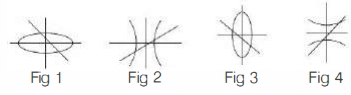
Suppose $a, b$ are real numbers such that $a b \neq 0$. Which of the following four figures represent the curve $(y-a x-b)\left(b x^2+a y^2-a b\right)=0$ ?
The value of $cot\, 7\frac{{{1^0}}}{2}$ $+ tan\, 67 \frac{{{1^0}}}{2} - cot 67 \frac{{{1^0}}}{2} - tan7 \frac{{{1^0}}}{2}$ is :
Let circle $C$ be the image of $x^{2}+y^{2}-2 x+4 y-4=0$ in the line $2 x-3 y+5=0$ and $A$ be the point on $C$ such that OA is parallel to $x$-axis and $A$ lies on the right hand side of the centre $O$ of $C$. If $B(\alpha, \beta)$, with $\beta<4$, lies on $C$ such that the length of the arc AB is $(1 / 6)^{\text {th }}$ of the perimeter of C , then $\beta-\sqrt{3} \alpha$ is equal to
If the position vectors of the vertices $A, B$ and $C$ of a $ \Delta ABC$ are respectively $4\hat i + 7\hat j + 8\hat k\,,\,2\hat i + 3\hat j + 4\hat k$ and $2\hat i + 5\hat j + 7\hat k$ then the position vector of the point, where the bisector of $\angle A$ meets $BC$ is
${( - 1 + i\sqrt 3 )^{20}}$ is equal to
$\int_{}^{} {\frac{{\log x}}{{{{(1 + \log x)}^2}}}dx = } $