MCQ
$\mathop \smallint \limits_0^\pi \left[ {\cot x} \right]dx = $
  • A
    $1$
  • B
    $-1$
  • $ - \frac{\pi }{2}$
  • D
    $\;\frac{\pi }{2}$

Answer

Correct option: C.
$ - \frac{\pi }{2}$
c
$I = \int\limits_0^\pi  {\left[ {\cot x} \right]} dx$

$I = \int\limits_0^\pi  {\left[ {\cot \left( {\pi  - x} \right)} \right]} dx$

$ = \int\limits_0^\pi  {\left[ { - \cot x} \right]} dx$

Adding we have

$2I = \int\limits_0^\pi  {\left\{ {\left[ {\cot x} \right] + \left[ { - \cot x} \right]} \right\}} dx$

$2I = \int\limits_0^\pi  {\left( { - 1} \right)} dx =  - \pi $

$\therefore I =  - \pi /2$

Need a full question paper?

Generate a complete, print-ready paper with questions like this in minutes — across 16+ boards, with answer keys.
Start Generating Free

Similar questions

$\int_0^\pi {x\sin x\,dx = } $
$\int\limits^\frac{\pi}{2}_0\frac{1}{1+\tan\text{x}}\text{dx}$ is equal to:
If the Rolle's theorem holds for the function $f(x) = 2x^3 + ax^2 + bx$ in the interval $[-1, 1 ]$ for the point $c = \frac{1}{2}$ , then the value of $2a + b$ is
The direction ratios of the line joining the points $A(4, −3, 7)$ and $B(1, 3, 5)$ are:
$S$ denote the set of all real values of $\lambda$ such that the system of equations  $\lambda x + y + z =1$ ; $x +\lambda y + z =1$ ; $x + y +\lambda z =1$ is inconsistent, then $\sum_{\lambda \in S}\left(|\lambda|^2+|\lambda|\right)$ is equal to
The value of $\sin\big(2\big(\tan^{-1}0.75\big)\big)$ is equal to:
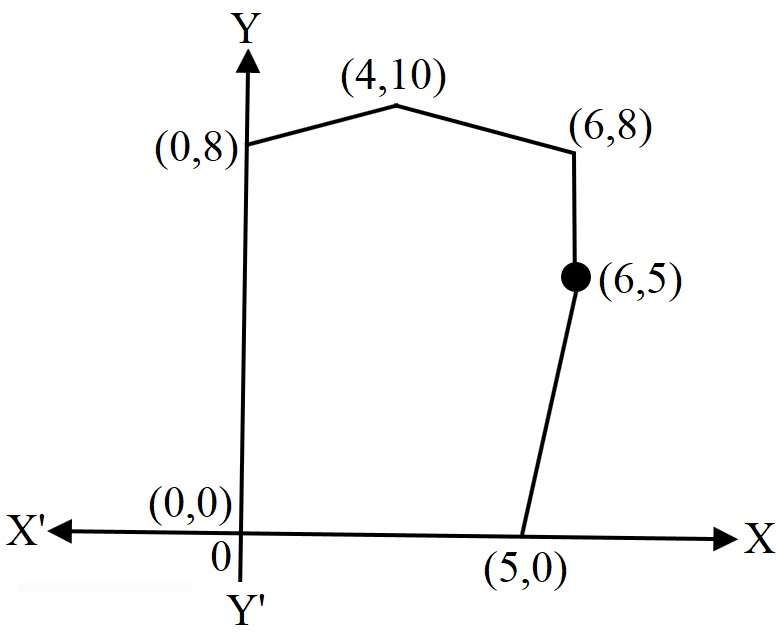
The feasible solution for a LPP is shown in the following figure. Let Z = 3x - 4y be the objective function.

Minimum of Z occurs at:


The objective function Z = 4x + 3y can be maximised subjected to the constraints 3x + 4y ≤ 24, 8x + 6y ≤ 48, x ≤ 5, y ≤ 6, x, y ≥ 0
Let $y = y\left( x \right)$ be the solutions of the differential equation, $\left( {{x^2} + 1} \right)^2\,\frac{{dy}}{{dx}} + 2x\left( {{x^2} + 1} \right)\,y = 1$ such that $y\left( 0 \right) = 0$. If $\sqrt a y\left( 1 \right) = \frac{\pi }{{32}}$, then the value of $‘a’$ is
The probabilities of Virat become man of the match in $1^{st}, 2^{nd}$ and $3^{rd}$ match of India in world cup $2015$ are $\frac{3}{7},\frac{2}{7}$&$\frac{1}{7}$ respecitvely. If Virat got a man of the match in exactly one match, then what is the probability that he got man of the match in $3^{rd}$ match, is -