Question
Maximize Z = 50x + 30y
Subject to
$2\text{x}+\text{y}\leq18$
$3\text{x}+2\text{y}\leq34$
$\text{x},\text{y}\geq0$
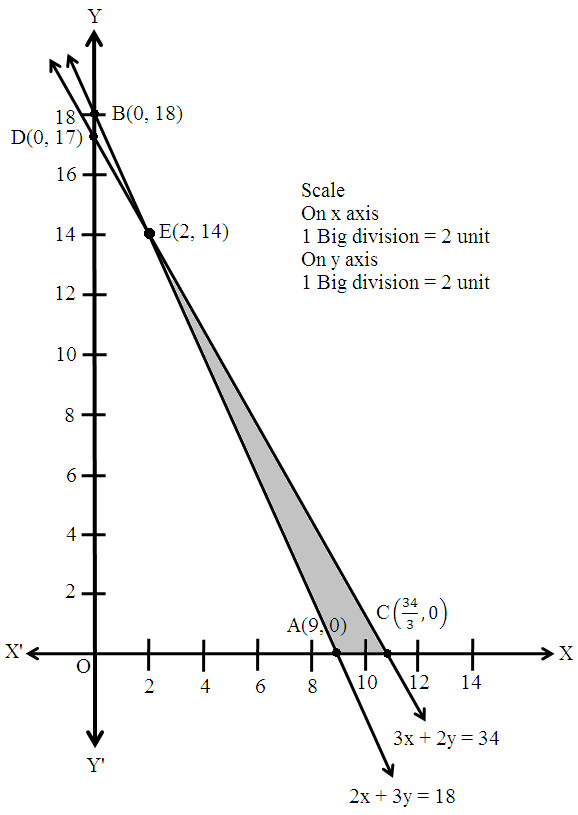
Answer

First, we will convert the given inequations into equations, we obtain the following equations:
2x + y = 18, 3x + 2y = 34
Region represented by 2x + y ≥ 18:
The line 2x + y = 18 meets the coordinate axes at A(9, 0) and B(0, 18) respectively. By joining these points we obtain the line 2x + y = 18.
Clearly (0,0) does not satisfies the inequation 2x + y ≥ 18.
So,the region in xy plane which does not contain the origin represents the solution set of the inequation 2x + y ≥ 18.
Region represented by 3x + 2y ≤ 34:
The line 3x + 2y = 34 meets the coordinate axes at $\text{C}\Big(\frac{34}{3},0\Big)$ and D(0, 17) respectively. By joining these points we abtain the line 3x + 2y = 34.
Clearly (0. 0) satisfies the inequation 3x + 2y ≤ 34. So, the region containing the origin represents the silution set of the inequation 3x + 2y ≤ 34.
The corner of the feasible region are A(9, 0), $\text{C}\Big(\frac{34}{3},0\Big)$ and E(2, 14).

The values of Z at these corner points are as follows.
$\text{Corner point}$
$\text{Z}=50\text{x}+30\text{y}$
$\text{A}(9, 0)$
$50\times9+3\times0=450$
$\text{C}\Big(\frac{34}{3},0\Big)$
$50\times\frac{34}{3}+30\times0=\frac{1700}{3}$
$\text{E}(2, 14)$
$50\times2+30\times14=520$
Therefore, the maximum value of Z $\frac{1700}{3}$ is at the point $\Big(\frac{34}{3},0\Big)$.
Hence, $\text{x}=\frac{34}{3}$ and $\text{y}=0$ is the optimal solution of the given LPP.
Thus, the optimal value of Z is $\frac{1700}{3}$.

Need a full question paper?

Generate a complete, print-ready paper with questions like this in minutes — across 16+ boards, with answer keys.

Start Generating Free

Similar questions

Evaluate : $\int_{-\pi}^\pi \frac{x(1+\sin x)}{1+\cos ^2 x} \cdot d x$
Classify the following functions as injection, surjection or bijection:
$f : N \rightarrow N $given by $f(x) = x^3$​​​​​​​
If $\vec{\text{a}}=2\hat{\text{i}}+5\hat{\text{j}}-7\hat{\text{k}},\vec{\text{b}}=-3\hat{\text{i}}+4\hat{\text{j}}+\hat{\text{k}}$ and $\vec{\text{c}}=\hat{\text{i}}-2\hat{\text{j}}-3\hat{\text{k}},$ compute $\big(\vec{\text{a}}\times\vec{\text{b}}\big)\times\vec{\text{c}}$ and $\vec{\text{a}}\times\big(\vec{\text{b}}\times\vec{\text{c}}\big)$ and verify that these are not equal.
Show the solution zone of the following inequalities on a graph paper:
$5\text{x}+\text{y}\geq10$
$\text{x}+\text{y}\geq6$
$\text{x}+4\text{y}\geq12$
$\text{x}\geq,\text{y}\geq0$
Show that the following systems of linear equations has infinite number of solutions and solve:
x + y - z = 0,
x - 2y + z = 0,
3x + 6y - 5z = 0
Differentiate the following functions with respect to x:
$(\log\text{x})^{\log\text{x}}$
Evaluate the following integrals:
$\int\sin^7\text{x}\text{ dx}$
If $A =$ diag$(a, b, c)$, show that $A^n =$ diag$(a^n, b^n, c^n)$ for all positive integer $n.$
Show that the sum of three vectors determined by the medians of a triangle directed from the vertices is zero.
A class has 15 students whose ages are 14, 17, 15, 14, 21, 17, 19, 20, 16, 18, 20, 17, 16, 19 and 20 years. One student is selected in such a manner that each has the same chance of being chosen and the age X of the student is recorded. What is the probability distribution of the random variable X? Find mean, variance, and standard deviation of X.