Question
Maximize Z = 5x + 3y
Subject to
$3\text{x}+5\text{y}\leq15$
$5\text{x}+2\text{y}\leq10$
$\text{x},\text{y}\geq0$
Answer

First, we will convert the given inequations into equations, we obtain the following equations:

3x + 5y = 15, 5x + 2 y = 10, x = 0 and y = 0

Region represented by $3\text{x}+5\text{y}\leq15:$

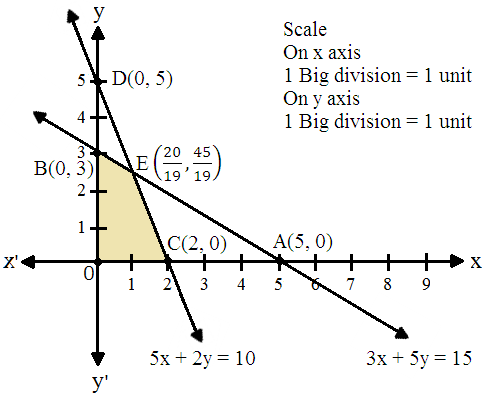
The line 3x + 5y = 15 meets the coordinate axes at A(5, 0) and B(0, 3) respectively.

By joining these points we obtain the line 3x + 5y = 15.

Clearly (0, 0) satisfies the inequation $3\text{x}+5\text{y}\leq15$.

So, the region containing the origin represents the solution set of the inequation $3\text{x}+5\text{y}\leq15$.

Region represented by $5\text{x}+2\text{y}\leq10:$

The line 5x + 2y = 10 meets the coordinate axes at C(2, 0) and D(0, 5) respectively.

By joining these points we obtain the line 5x + 2y = 10.

Clearly (0, 0) satisfies the inequation $5\text{x}+2\text{y}\leq10$.

So, the region containing the origin represents the solution set of the inequation $5\text{x}+2\text{y}\leq10$.

Region represented by $\text{x}\geq0$ and $\text{y}\geq0:$

Since, every point in the first quadrant satisfies these inequations.

So, the first quadrant is the region represented by the inequations $\text{x}\geq0$, and $\text{y}\geq0$.

The feasible region determined by the system of constraints, $3\text{x}+5\text{y}\leq15,5\text{x}+2\text{y}\leq10,\text{x}\geq0$ and $\text{y}\geq0$,are as follows.

Need a full question paper?

Generate a complete, print-ready paper with questions like this in minutes — across 16+ boards, with answer keys.

Start Generating Free

Similar questions

Let f: N $\rightarrow$ N be defined by
$ \text{f(n)} = \begin{cases} \frac{\text{n + 1}}{2}, & \text{if n is odd}\\ \frac{\text{n}}{2},& \text{if n is even}\\ \end{cases}$for all n $\in$ N.
Find whether the function f is bijective.
Solve the following differential equation:
$\frac{\text{dy}}{\text{dx}}+\text{y}\tan\text{x}=\cos\text{x}$
Find the equation of a curve passing through the point $(0, 2)$ given that the sum of the coordinates of any point on the curve exceeds the magnitude of the slope of the tangent to the curve at that point by $5.$
Find the equation of the plane through the points $(3, 4, 1)$ and $(0, 1, 0)$ and parallel to the line $\frac{\text{x}+3}{2}=\frac{\text{y}-3}{7}=\frac{\text{z}-2}{5}.$
Find the equations of the tangent and the normal to the following curves at the indicated points.
$y = x^4 - 6x^3 + 13x^2 - 10x + 5$ at $x = 1$
If $\hat{\text{a}}$ and $\hat{\text{b}}$ are unit vectors inclined at an angle $\theta$, prove that$\tan\frac{\theta}{2}=\frac{\big|\hat{\text{a}}-\hat{\text{b}}\big|}{\big|\hat{\text{a}}+\hat{\text{b}}\big|}$
Find the equation of the curve passing through the point (0, 1) if the slope of the tangent to the curve at each of its point is equal to the sum of the abscissa and the product of the abscissa and the ordinate of the point.
Show that $\text{f}(\text{x})=\tan^{-1}(\sin\text{x}+\cos\text{x})$ is a decreasing function on the interval $\Big(\frac{\pi}{4},\frac{\pi}{2}\Big).$
Prove that:
$\begin{vmatrix}\text{a}+\text{b}&\text{b}+\text{c}&\text{c}+\text{a}\\\text{b}+\text{c}&\text{c}+\text{a}&\text{a}+\text{b}\\\text{c}+\text{a}&\text{a}+\text{b}&\text{b}+\text{c}\end{vmatrix}=2\begin{vmatrix}\text{a}&\text{b}&\text{c}\\\text{b}&\text{c}&\text{a}\\\text{c}&\text{a}&\text{b} \end{vmatrix}$
The contents of three bags I, II and III are as follows:
Bag I : 1 white, 2 black and 3 red balls,
Bag II : 2 white, 1 black and 1 red ball;
Bag III : 4 white, 5 black and 3 red balls.
A bag is chosen at random and two balls are drawn. What is the probability that the balls are white and red?