Question
Maximize Z = 9x + 3y
Subject to
$2\text{x}+3\text{y}\leq13$
$3\text{x}+\text{y}\leq5$
$\text{x},\text{y}\geq0$
Answer

Coverting the given inequation into equations, we get
2x + 3y = 13, 3x + y = 5 and x = 0, y = 0

Region represented by $2\text{x}+3\text{y}\leq13:$
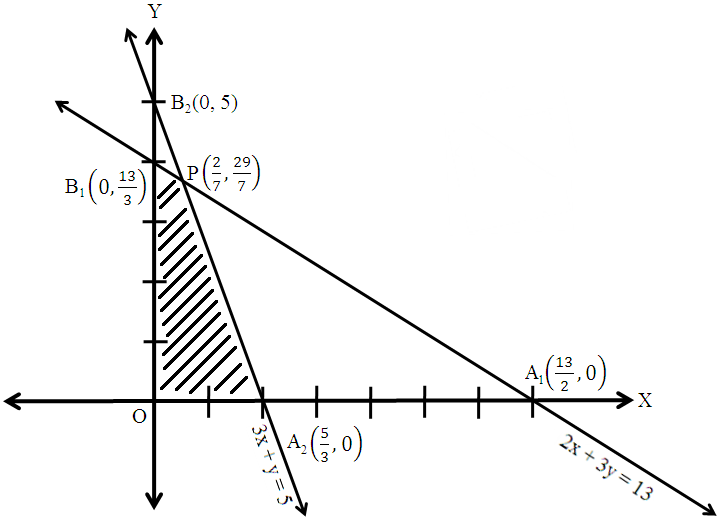
The line meets coordinate axes at $\text{A}_1\Big(\frac{13}{2},0\Big)$ and $\text{B}_1\Big(0,\frac{13}{3}\Big)$ respectively.
Join these points to obtain the line 2x + 3y = 13, clearly, (0,0) satisfies the in eqation $2\text{x}+3\text{y}\leq13$, so, the region in xy-plane that contains origin represents the solution set of $2\text{x}+3\text{y}\leq13$.
Region represented by $3\text{x}+\text{y}\leq5:$
The line meets coordinate axes at $\text{A}_2\Big(\frac{5}{3},0\Big)$ and $B_2(0, 5)$ respectively.
Join these points to obtain the line 3x + y = 5, clearly, (0, 0) satisfies the in eqation $3\text{x}+\text{y}\leq5$, so, the region in xy-plane that contains origin represents the solution set of $3\text{x}+\text{y}\leq5$.
Region represented by $\text{x},\text{y}\geq0:$
It clearly represent first quadrant of xy-plane.
The common region to regions represented by above in equalities.
The coordinates of the corner points of the shaded region are $\text{O}(0,0),\text{A}\Big(\frac{5}{3},0\Big),\text{P}\Big(\frac{2}{7},\frac{29}{7}\Big),\text{B}_2\Big(0,\frac{13}{3}\Big)$.
The value of Z = 9x + 3y at
$\text{O}(0,0)=9(0)+3(0)=0$
$\text{A}_1\Big(\frac{5}{3},0\Big)=9\Big(\frac{5}{3}\Big)+3(0)=15$
$\text{P}\Big(\frac{2}{7},\frac{29}{7}\Big)=9\Big(\frac{2}{7}\Big)+3\Big(\frac{29}{7}\Big)=15$
$\text{B}_2\Big(0,\frac{13}{3}\Big)=9(0)+3\Big(\frac{13}{3}\Big)=13$
Clearly, Z is maximum at every point on the line joining $A_1$ and P, So
$\text{x}=\frac{2}{7}$ or $\frac{2}{7}$, $\text{y}=0$ or $\frac{29}{7}$
and maximum Z = 15.

Need a full question paper?

Generate a complete, print-ready paper with questions like this in minutes — across 16+ boards, with answer keys.

Start Generating Free

Similar questions

An automobile company uses three types of steel $S_1, S_2$ and $S_3$ for producing three types of cars $C_1, C_2$ and $C_3$. Steel requirements (in tons) for each type of cars are given below:
Steel
Cars
 
$C_1$
$C_2$
$C_3$​​​​​​​
$S_1$
2
3
4
$S_2$
1
1
2
$S_3$
3
2
1
Using Cramer's rule, find the number of cars of each type which can be produced using $29, 13$ and $16$ tons of steel of three types respectively.
verify that $\text{y}=\text{ce}^{\tan^{-1}}$ is a solution of the differential equation $(1+\text{x}^2)\frac{\text{d}^2\text{y}}{\text{dx}^2}+(2\text{x}-1)\frac{\text{dy}}{\text{dx}}=0.$
If $\text{y}=\sin^{-1}\big(6\text{x}\sqrt{1-9\text{x}^2}\big), -\frac{1}{3\sqrt{2}}<\text{x}<\frac{1}{3\sqrt{2}},$ then find $\frac{\text{dy}}{\text{dx}}.$
If $\text{x}=\sin^{-1}\Big(\frac{2\text{t}}{1+\text{t}^2}\Big)$ and $\text{y}=\tan^{-1}\Big(\frac{2\text{t}}{1-\text{t}^2}\Big),-1<\text{t}<1,$ prove that $\frac{\text{dy}}{\text{dx}}=1$
Let f: N → N be defined by ${f(n)}=\begin{cases}\frac{\text{n}+1}{2},\text{ if n is odd}\\\ \ \ \ \ \ \ \ \ \ \ \ \ \ \ \ \ \ \ \ \ \ \ \ \ \ \text{for all}\text{ n }\in\text{ N}.\\\frac{\text{n}}{2}\ \ \ \ ,\text{if n is even}\end{cases}$ State whether the function f is bijective. Justify your answer.
Find the shortest distance between the lines whose vector equations are:
$\vec{\text{r}}=(1-\text{t})\hat{\text{i}}+(\text{t}-2)\hat{\text{j}}+(3-2\text{t})\hat{\text{k}}\ \text{and}$
$\vec{\text{r}}=(\text{s}+1)\hat{\text{i}}+(2\text{s}-1)\hat{\text{j}}-(2\text{s}+1)\hat{\text{k}}$
A window is in the form of a rectangle surmounted by a semicircular opening. The total perimeter of the window is $10 m.$ Find the dimensions of the window to admit maximum light through the whole opening
The area between $x = y^2$ and $x = 4$ is divided into two equal parts by the line $x = a$, find the value of $a$.
Maximize $Z = 3x_1 + 4x_2,$ if possible,
Subject to the constraints
$\text{x}_1-\text{x}_2\leq-1$
$-\text{x}_1+\text{x}_2\leq0$
$\text{x}_1,\text{x}_2\geq0$
Form the differential equation of the family of circle in the secound qudrant and touching the coordinate axes.