Question
Maximize $Z = x + y$
Subject to
$-2\text{x}+\text{y}\leq1$
$\text{x}\leq2$
$\text{x}+\text{y}\leq3$
$\text{x},\text{y}\geq0$
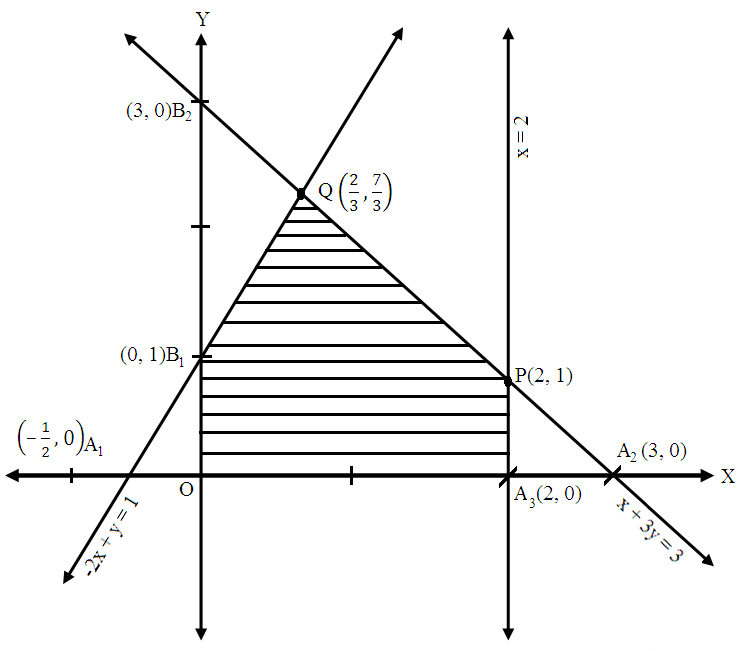
Answer

Converting the given inequations into equation,

-2x + y = 1, x = 2, x + y = 3, x= y = 0


Region represented by - 2x + y = 1:

Line - 2x + y = 1 meets coordinate axes at $\text{A}_1\Big(\frac{-1}{2},0\Big)$ and $B_1(0, 1)$, clearly, $(0, 0)$ satisfies $-2\text{x}+\text{y}\leq1$, so region containing origin represents $-2\text{x}+\text{y}\leq1$ in xy-plane.
Region represented by $\text{x}\leq2$:
Linex - 2 is parallel to y-axis and meets x-axis at $A_3(2, 0)$.
Clearly, (0, 0) satisfies $\text{x}\leq2$, so region containing origin represents $\text{x}\leq2$ in xy-plane.
Region represented by $\text{x}+\text{y}\leq3$:
Line $x + y - 3$ meets coordinate axes at $A_2(3, 0)$ and $B_2(0, 3)$.
Clearly, (0, 0) satisfies $\text{x}+\text{y}\leq3$, so region containing origin represents $\text{x}+\text{y}\leq3$ in xy-plane.
Region represented $\text{x},\text{y}\geq0$:
It represents first quadrant in xy-plane.
So, shaded region $OA_3PQ8$, represents the feasible region.
Coordinates of P(2, 1) is obtained by solving x + y = 3 and x = 2, $\text{Q}\Big(\frac{2}{3},\frac{7}{3}\Big)$ by solving -2x + y = 1 and x + y = 3.
The value of Z = x + y at
$\text{O}(0, 0) = 0 + 0 = 0$
$\text{A}_3(2, 0) = 2 + 0 = 2$
$\text{P}(2, 1) = 2 +1 = 2$
$\text{Q}\Big(\frac{2}{3},\frac{7}{3}\Big)=\frac{2}{3}+\frac{7}{3}=3$
$\text{B}_1(0, 1) = 0 + 1 = 1$
So, maximum Z = 3 is at every point on the line joining PQ.
Hence, maximum z = 3 at x = 2 and y = 1 Or $\text{x}=\frac{2}{3}$ and $\text{y}=\frac{7}{3}.$

Need a full question paper?

Generate a complete, print-ready paper with questions like this in minutes — across 16+ boards, with answer keys.

Start Generating Free

Similar questions

Prove that the relation R on Z defined by $(\text{a, b})\in\text{R}\Leftrightarrow\ \text{a}-\text{b}$ is divisible by 5 is an equivalence relation on Z.
Show that $\text{A}=\begin{bmatrix} 5 & 3 \\-1 & -2 \end{bmatrix}$ satisfies the equation $x^2 - 3x - 7 = 0$. Thus, find $A^{-1}.$
Evaluate the following definite integrals:
$\int\limits_{\frac{\pi}{2}}^{\pi}\text{e}^{\text{x}}\Big(\frac{1-\sin\text{x}}{1-\cos\text{x}}\Big)\text{dx}$
A small firm manufactures gold rings and chains. The total number of rings and chains manufactured per day is atmost $24$. It takes $1$ hour to make a ring and $30$ minutes to make a chain. The maximum number of hours available per day is $16$. If the profit on a ring is Rs. $300$ and that on a chain is Rs. $190,$ find the number of rings and chains that should be manufactured per day, so as to earn the maximum profit. Make it as an L.P.P. and solve it graphically.
Verify Rolle's Theorem for the following function:$f (x) = (x - 1) (x - 2)^{2}, [1,2]$
Solve the equation
$\cos^{-1}\frac{\text{a}}{\text{x}}-\cos^{-1}\frac{\text{b}}{\text{x}}=\cos^{-1}\frac{1}{\text{b}}-\cos^{-1}\frac{1}{\text{b}}-\cos^{-1}\frac{1}{\text{a}}$
Find the equations of the tangent and the normal to the following curves at the indicated points.
$\text{y}^2=\frac{\text{x}^3}{4-\text{x}}\text{ at }(2,-2)$
Find $\frac{\text{dy}}{\text{dx}},\text{if y = sin}^{-1}[\text{x}\sqrt{1 - x}-\sqrt{x}\sqrt{1 - x^{2}}]$.
Show that $\text{A}=\begin{bmatrix} -8 & 5 \\ 2 & 4 \end{bmatrix}$ sastisfies the equation $A^2 + 4A - 42I = 0$. Hence find $A^{-1}.$
Find the equation of the tangent to the curve $\text{x}=\sin3\text{t},\text{y}=\cos2\text{t}\text{ at }\text{t}=\frac{\pi}{4}$