MCQ
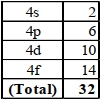
Maximum number of electrons that can be accommodated in shell with $n=4$ are:
- A$16$
- ✓$32$
- C$50$
- D$72$
Generate a complete, print-ready paper with questions like this in minutes — across 16+ boards, with answer keys.
$2MnO_4^ - + 5{C_2}O_4^{2 - } + 16{H^ + } \to 2M{n^{2 + }} + 10C{O_2} + 8{H_2}O$
Here $20\,ml$ of $0.1\,M$ $KMn{O_4}$ is equivalent to
| Experiment No. | $\begin{array}{c}{[ A ]} \\ \left( mol dm ^{-3}\right)\end{array}$ | $\begin{array}{c}{[ B ]} \\ \left( mol dm ^{-3}\right)\end{array}$ | $\begin{array}{c}{[ C]} \\ \left( mol dm ^{-3}\right)\end{array}$ | Rate of reaction $\left( mol dm ^{-3} s ^{-1}\right)$ |
| $1$ | $0.2$ | $0.1$ | $0.1$ | $6.0 \times 10^{-5}$ |
| $2$ | $0.2$ | $0.2$ | $0.1$ | $6.0 \times 10^{-5}$ |
| $3$ | $0.2$ | $0.1$ | $0.2$ | $1.2 \times 10^{-4}$ |
| $4$ | $0.3$ | $0.1$ | $0.1$ | $9.0 \times 10^{-5}$ |
The rate of the reaction for $[ A ]=0.15 mol dm ^{-3},[ B ]=0.25 mol dm ^{-3}$ and $[ C ]=0.15 mol dm ^{-3}$ is found to be $Y \times 10^{-5} mol dm d ^{-3} s ^{-1}$. The value of $Y$ i. . . . . . .