MCQ
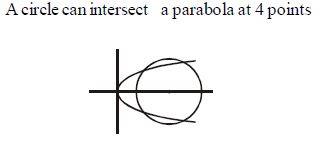
Maximum number of points on parabola $y^2 = 16x$ which are equidistant from a variable point $P$ (which lie inside the parabola), is -
  • A
    $2$
  • B
    $3$
  • $4$
  • D
    more than $4$

Answer

Correct option: C.
$4$
c

Need a full question paper?

Generate a complete, print-ready paper with questions like this in minutes — across 16+ boards, with answer keys.

Start Generating Free

Similar questions

The area between the curve ${y^2} = 4ax,$ $x -$ axis and the ordinates $x = 0$ and $x = a$ is
The distance of the point $(2,3)$ from the line $2 x-$ $3 y +28=0$, measured parallel to the line $\sqrt{3} x-y+1=0$, is equal to
In the four numbers first three are in $G.P.$ and last three are in $A.P.$ whose common difference is $6$. If the first and last numbers are same, then first will be
If $f(x)\, = {x^2} - x + 5,\,\,x > \frac{1}{2},$ and $g(x)$ is its inverse function, then $g'(7)$ equals
Four digit numbers are formed using the digits $1 , 2 , 3, 4$ (repetition is allowed). The number of such four digit numbers divisible by $11$ is
If $|\vec{a}|=2,|\vec{b}|=5$ and $|\vec{a} \times \vec{b}|=8$, then $|\vec{a} \cdot \vec{b}|$ is equal to :
Let $P$ and $Q$ be the points on the line $\frac{x+3}{8}=\frac{y-4}{2}=\frac{z+1}{2}$ which are at a distance of $6$ units from the point $R (1,2,3)$. If the centroid of the triangle $PQR$ is $(\alpha, \beta, \gamma)$, then $\alpha^2+\beta^2+\gamma^2$ is:
The difference between an integer and its cube is divisible by
Consider the cube in the first octant with sides $\text{OP, OQ}$ and $\text{OR}$ of length $1$ , along the $x-$ axis, $y-$ axis and $z-$ axis, respectively, where $O (0,0,0)$ is the origin. Let $S \left(\frac{1}{2}, \frac{1}{2}, \frac{1}{2}\right)$ be the centre of the cube and $T$ be the vertex of the cube opposite to the origin $O$ suchthat $S$ lies on the diagonal $OT.$ If $\overrightarrow{ p }=\overrightarrow{ SP }, \overrightarrow{ q }=\overrightarrow{ SQ }, \overrightarrow{ r }=\overrightarrow{ SR }$ and $\overrightarrow{ t }=\overrightarrow{ ST }$, then the value of $|(\overrightarrow{ p } \times \overrightarrow{ q }) \times(\overrightarrow{ r } \times \overrightarrow{ t })|$ is $...........$
The interval of $x$ in which the inequality ${5^{(1/4)(\log _5^2x)}}\, \geqslant \,5{x^{(1/5)(\log _5^x)}}$