Question
Maximum value of $=\left(\frac{1}{x}\right)^x$:

Answer

(A)$y=\left(\frac{1}{x}\right)^x$
$\therefore \quad \log y=\log \left(\frac{1}{x}\right)^x=-x \log x$
$\therefore \quad \frac{1}{y} \frac{d y}{d x}=-x \frac{1}{x}-\log x=-(1+\log x)$
$\Rightarrow \quad \frac{d y}{d x}=-y(1+\log x)$
now $\frac{d y}{d x}=0 \Rightarrow 1+\log x=0$
$\Rightarrow \log x=-1 \Rightarrow x=e^{-1}=\frac{1}{e}$
hence maximum value $=\left(\frac{1}{1 / e}\right)^{1 / e}=e^{1 / e}$

Need a full question paper?

Generate a complete, print-ready paper with questions like this in minutes — across 16+ boards, with answer keys.
Start Generating Free

Similar questions

If $A=\left[a_{i j}\right]$ is a scalar matrix of order $n \times n$ such that $a_{i j}=k$ for all $i$, then trace of $A$ is equal to
If $\text{f}(\text{x})=\Big(\frac{\text{x}^\text{l}}{\text{x}^\text{m}}\Big)^{\text{l}+\text{m}}\Big(\frac{\text{x}^\text{m}}{\text{x}^\text{n}}\Big)^{\text{m}+\text{n}}\Big(\frac{\text{x}^\text{n}}{\text{x}^\text{l}}\Big)^{\text{n}+1},$ the $f'(x)$ is equal to :
For which of the following values of mm, is the area of the region bounded by the curve $y = x - x^2$, and the line $y = mx$ equals $\frac{9}{2}\text{ sq. unit?}$
The value of $\int_{-\pi / 2}^{\pi / 2}\left(x^3+x \cos x+\tan 5 x+1\right) d x$ is
Four forces act on a point object. The object will be in equilibrium, if:
  1. All of them are in the same plane
  2. They are opposite to each other in pairs
  3. The sum of x, y and z-components of forces zero separately
  4. They form a closed figure of 4 sides when added as Polygon law
$\int\sqrt{\frac{\text{x}}{1-\text{x}}}\text{ dx}$ is equal to:
  1. $\sin^{-1}\sqrt{\text{x}}+\text{C}$
  2. $\sin^{-1}\Big\{\sqrt{\text{x}}-\sqrt{\text{x}(1-\text{x})}\Big\}+\text{C}$
  3. $\sin^{-1}\Big\{\sqrt{\text{x}(1-\text{x})}\Big\}+\text{C}$
  4. $\sin^{-1}\sqrt{\text{x}}-\sqrt{\text{x}(1-\text{x})}+\text{C}$
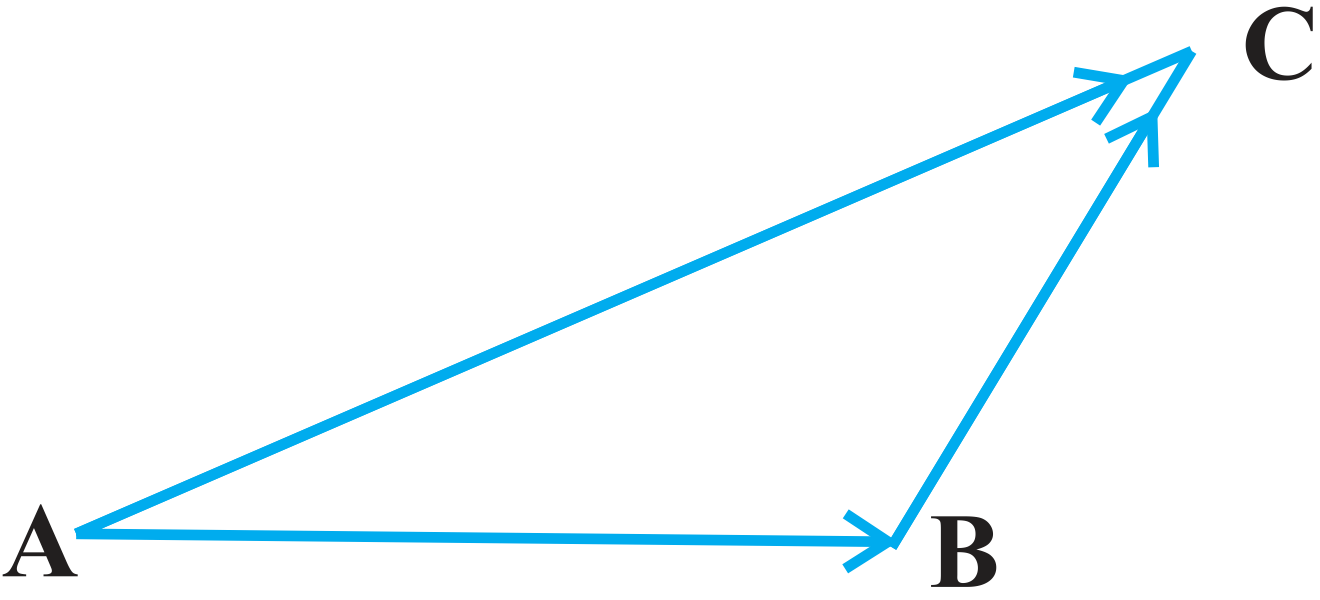
In triangle ABC (Fig 10.18), which of the following is not true:
  1. $\overrightarrow{\text{AB}}+\overrightarrow{\text{BC}}+\overrightarrow{\text{CA}}=\vec{0}$
  2. $\overrightarrow{\text{AB}}+\overrightarrow{\text{BC}}-\overrightarrow{\text{AC}}=\vec{0}$
  3. $\overrightarrow{\text{AB}}+\overrightarrow{\text{BC}}-\overrightarrow{\text{CA}}=\vec{0}$
  4. $\overrightarrow{\text{AB}}-\overrightarrow{\text{CB}}+\overrightarrow{\text{CA}}=\vec{0}$
Area of the region bounded by the curve $y=\tan x$, line $x=\frac{\pi}{4}$ and the $x$-axis is
A line with positive direction cosines passes through the point P(2, -1, 2) and makes equal angles with the coordinate axes. The line meets the plane 2x + y + z = 9 at point Q. The length of the line segment PQ equals:
The function $\text{f}(\text{x})=\log_\text{e}\Big(\text{x}^3+\sqrt{\text{x}^6+1}\Big)$ is of the following type:
  1. Even and increasing.
  2. Odd and increasing.
  3. Even and decreasing.
  4. Odd and decreasing.