MCQ
Maximum value of $x{(1 - x)^2}$ when $0 \le x \le 2$, is
  • A
    ${2 \over {27}}$
  • ${4 \over {27}}$
  • C
    $5$
  • D
    $0$

Answer

Correct option: B.
${4 \over {27}}$
b
(b) Given $f(x) = x{(1 - x)^2}$, $f(x) = {x^3} - 2{x^2} + x$

Now $f'(x) = 3{x^2} - 4x + 1$

Put $f'(x) = 0$ i.e., $3{x^2} - 4x + 1 = 0$

$3{x^2} - 3x - x + 1 = 0$ ==> $x = 1,\,\,1/3$

$f''(x) = 6x - 4$

$\therefore f''\,(1) = 2 = $ positive and $f''(1/3) = - 2 = $ $-ve$

Hence maximum value will be at $x = \frac{1}{3}$

Maximum value $f\,\left( {\frac{1}{3}} \right) = \frac{4}{{27}}$.

Need a full question paper?

Generate a complete, print-ready paper with questions like this in minutes — across 16+ boards, with answer keys.
Start Generating Free

Similar questions

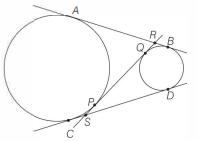
Suppose $S_1$ and $S_2$ are two unequal circles, $A B$ and $C D$ are the direct common tangents to these circles. A transverse common tangent $P Q$ cuts $A B$ in $R$ and $C D$ in $S$. If $A B=10$, then $R S$ is
Let $\alpha$ be a positive real number. Let $f: R \rightarrow R$ and $g :(\alpha, \infty) \rightarrow R$ be the functions defined by

$f(x)=\sin \left(\frac{\pi x}{12}\right) \text { and } g(x)=\frac{2 \log _{ e }(\sqrt{x}-\sqrt{\alpha})}{\log _{ e }\left( e ^{\sqrt{x}}- e ^{\sqrt{\alpha}}\right)} \text {. }$

Then the value of $\lim _{ x \rightarrow \alpha^{+}} f( g ( x ))$ is

If both the roots of the quadratic equation $x^2 - mx + 4 = 0$ are real and distinct and they lie in the interval $[1, 5],$ then $m$ lies in the interval.
If $f(x) = \frac{x}{{1 + x}}$, then ${f^{ - 1}}(x)$ is equal to
Let ${a_1},{a_2},{a_3}, \ldots $ be terms of $A.P.$  If $\frac{{{a_1} + {a_2} + \ldots + {a_p}}}{{{a_1} + {a_2} + \ldots + {a_q}}} = \frac{{{p^2}}}{{{q^2}}},p \ne q$ then $\frac{{{a_6}}}{{{a_{21}}}}$ equals
If $ x=-1 $ and $ x=2 $ are extreme point of $f\left( x \right) = \alpha \log \left| x \right| + \beta {x^2} + x$ then $\left( {\alpha ,\beta } \right)$ 
Let $y=y(x)$ be the solution curve of the differential equation $\frac{ dy }{ dx }+\left(\frac{2 x ^{2}+11 x +13}{ x ^{3}+6 x ^{2}+11 x +6}\right)$ $y=\frac{(x+3)}{x+1}, x>-1$, which passes through the point $(0,1)$. Then $y (1)$ is equal to.
If two roots of the equation ${x^3} - 3x + 2 = 0$ are same, then the roots will be
If $z_1$ and $z_2$ are two unimodular complex numbers that satisfy $z_1^2 + z_2^2 = 5,$ then ${\left( {{z_1} - {{\bar z}_1}} \right)^2} + {\left( {{z_2} - {{\bar z}_2}} \right)^2}$ is equal to -
The area of the region above the $x-$ axis bounded by the curve $y\, = tan\, x$, $0 \leq x \leq \frac{\pi }{2}$ and the tangent to the curve at $x\, = \frac{\pi}{4}$ is