Question
Maximum $Z = 10x + 6y$
Subject to
$3\text{x}+\text{y}\leq12$
$2\text{x}+5\text{y}\leq34$
$\text{x},\text{y}\geq0$
Answer

Converting the given inequations in to equations.
$3x + y = 12, 2x + 5y = 34, x = y = 0$


Region represented by $3\text{x}+\text{y}\leq12$:
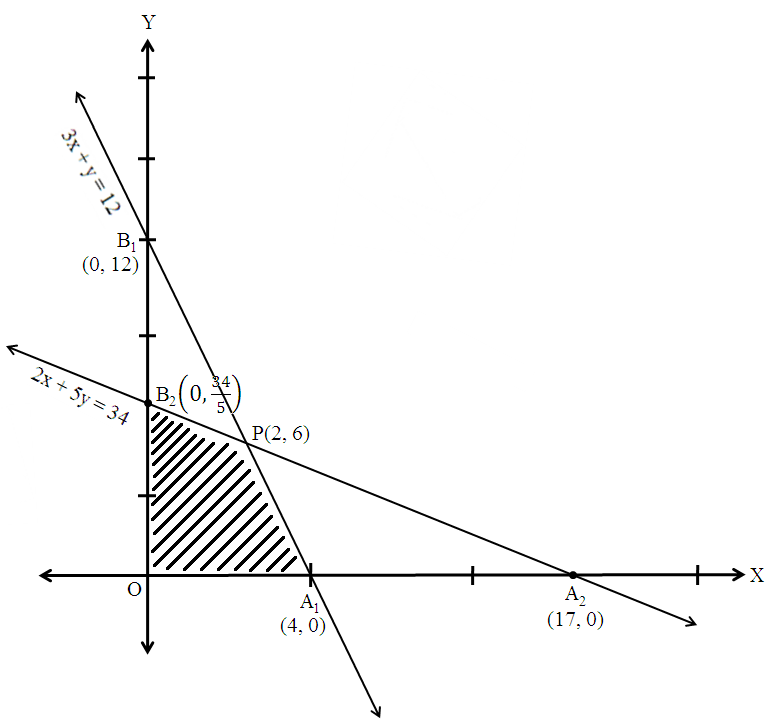
Line $3x + y = 12$ meets the coordinate axes at $A_1(4, 0)$ and $B(0, 12)$, clearly, $(0, 0)$ satisfies $3\text{x}+\text{y}\leq12$, so, region containing origin is represented by $3\text{x}+\text{y}\leq12$ in xy-plane.
Region represented by $2\text{x}+5\text{y}\leq34$:
Line $2x +y = 34$ meets coordinate axes at $A_2$_$(17, 0)$ and $\text{B}\Big(0,\frac{34}{5}\Big)$ clearly, $(0, 0)$ satisfies the $2\text{x}+5\text{y}\leq34$ so, region containing origin represents $2\text{x}+5\text{y}\leq34$ in xy-plane.
Region represented by $\text{x},\text{y}\geq0$:
It represent the first quadrant in xy-plane
Therefore, shaded area $OA_1PB_2$ is the feasible region.
The coordinate of $P(2, 6)$ is obtained by solving $2x + 5y = 34$ and $3x + y = 12$
The value of $Z = 10x + 6y at$
$\text{O}(0, 0) = 10(0) + 6(0) = 0$
$\text{A}_1(4, 0) = 10(4) + 6(0) = 40$
$\text{P}(2, 6) = 10(2) + 6(6) = 56$
$\text{B}_2\Big(0,\frac{34}{5}\Big)=10(0)+6\Big(\frac{34}{5}\Big)=\frac{204}{5}=40\frac{4}{5}$
Hence, maximum $Z = 56 at x = 2, y = 6.$

Need a full question paper?

Generate a complete, print-ready paper with questions like this in minutes — across 16+ boards, with answer keys.

Start Generating Free

Similar questions

Find the equation of the plane through the point $2\hat{\text{i}}+\hat{\text{j}}-\hat{\text{k}}$ and passing throught the line of intersection of the planes $\vec{\text{r}}\cdot(\hat{\text{i}}+3\hat{\text{j}}-\hat{\text{k}})=0$ and $\vec{\text{r}}\cdot(\hat{\text{j}}+2\hat{\text{k}})=0.$
Integrate the following integrals:
$\int\sin\text{x}\cos2\text{x}\sin3\text{x dx}$
To confirm that, Is every real number in $R$. $R =\{(a, b): a, b \in R$ and $a-b+\sqrt{3} \in S \}$ where $S$ is set of all irrational numbers, defined, $R$ is reflexive, symmetric and transitive.
Find the shortest distance between the lines
$\vec{\text{r}}=\big(\hat{\text{i}}+2\hat{\text{j}}+\hat{\text{k}}\big)+\lambda\big(\hat{\text{i}}-\hat{\text{j}}+\hat{\text{k}}\big)$ and, $\vec{\text{r}}=2\hat{\text{i}}-\hat{\text{j}}-\hat{\text{k}}+\mu\big(2\hat{\text{i}}+\hat{\text{j}}+2\hat{\text{k}}\big)$
If $\vec{\text{a}} , \vec{\text{b}} , \vec{\text{c}}$ are mutually perpendicular vectors of equal magnitudes, show that the vector $\vec{\text{a}} + \vec{\text{b}} + \vec{\text{c}}$ is equally inclined to $\vec{\text{a}} , \vec{\text{b}}$ and $\vec{\text{c}}$ Also, find the angle which $\vec{\text{a}} + \vec{\text{b}} + \vec{\text{c}}$ makes with $\vec{\text{a}} \text{ or }\vec{\text{b}} \text{ or } \vec{\text{c}}.$
Using differentials, find the approximate values of the following:
$\sqrt{0.48}$
A hospital dietician wishes to find the cheapest combination of two foods, $A$ and $B$, that contains at least $0.5$ milligram of thiamin and at least $600$ calories. Each unit of A contains $0.12$ milligram of thiamin and $100$ calories, while each unit of B contains $0.10$ milligram of thiamin and $150$ calories. If each food costs $10$ paise per unit, how many units of each should be combined at a minimum cost?
If A = $\begin{bmatrix}1&0&2\\0&2&1\\2&0&3\end{bmatrix}$, prove that $A^3 - 6A^2 + 7A + 2I = 0$.
If $\text{x}=\cos\text{t}+\log\tan\frac{\text{t}}{2},\text{y}=\sin\text{t},$ Then find the value of $\frac{\text{d}^2\text{y}}{\text{dt}^2}\ \text{and}\ \frac{\text{d}^2\text{y}}{\text{dx}^2}\ \text{at}\ \text{t}=\frac{\pi}{4}.$
Find $\frac{\text{dy}}{\text{dx}}$
$\text{y}=(\tan\text{x})^{\cot\text{x}}+(\cot\text{x})^{\tan\text{x}}$