Question
Maximum $Z = 10x + 6y$
Subject to
$3\text{x}+\text{y}\leq12$
$2\text{x}+5\text{y}\leq34$
$\text{x},\text{y}\geq0$
Answer

Converting the given inequations in to equations.
$3x + y = 12, 2x + 5y = 34, x = y = 0$


Region represented by $3\text{x}+\text{y}\leq12$:
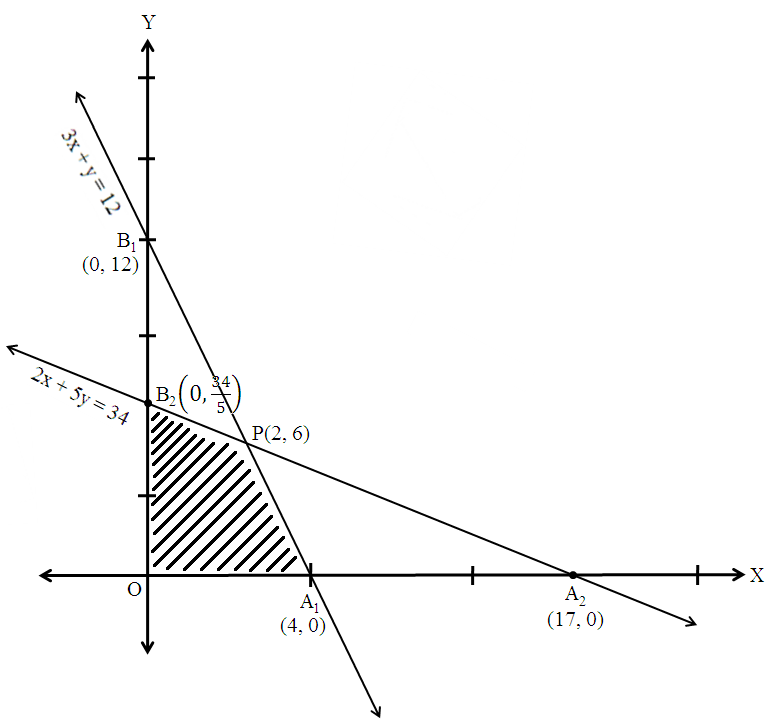
Line $3x + y = 12$ meets the coordinate axes at $A_1(4, 0)$ and $B(0, 12)$, clearly, $(0, 0)$ satisfies $3\text{x}+\text{y}\leq12$,
so, region containing origin is represented by $3\text{x}+\text{y}\leq12$ in xy-plane.
Region represented by $2\text{x}+5\text{y}\leq34$:
Line $2x +y = 34$ meets coordinate axes at $A_2(17, 0)$ and $\text{B}\Big(0,\frac{34}{5}\Big)$ clearly, $(0, 0)$ satisfies the $2\text{x}+5\text{y}\leq34$ so, region containing origin represents $2\text{x}+5\text{y}\leq34$ in xy-plane.
Region represented by $\text{x},\text{y}\geq0$:
It represent the first quadrant in xy-plane
Therefore, shaded area $OA_1PB_2​​​​​​​$​​​​​​​ is the feasible region.
The coordinate of $P(2, 6)$ is obtained by solving $2x + 5y = 34$ and $3x + y = 12$
The value of $Z = 10x + 6y$ at
$\text{O}(0, 0) = 10(0) + 6(0) = 0$
$\text{A}_1(4, 0) = 10(4) + 6(0) = 40$
$\text{P}(2, 6) = 10(2) + 6(6) = 56$
$\text{B}_2\Big(0,\frac{34}{5}\Big)=10(0)+6\Big(\frac{34}{5}\Big)=\frac{204}{5}=40\frac{4}{5}$
Hence, maximum $Z = 56$ at $x = 2, y = 6.$

Need a full question paper?

Generate a complete, print-ready paper with questions like this in minutes — across 16+ boards, with answer keys.
Start Generating Free

Similar questions

An automobile manufacturer makes automobiles and trucks in a factory that is divided into two shops. Shop A, which performs the basic assembly operation, must work 5 man-days on each truck but only 2 man-days on each automobile. Shop B, which performs finishing operations, must work 3 man-days for each automobile or truck that it produces. Because of men and machine limitations, shop A has 180 man-days per week available while shop B has 135 man-days per week. If the manufacturer makes a profit of Rs 30000 on each truck and Rs 2000 on each automobile, how many of each should he produce to maximize his profit? Formulate this as a LPP.
$\int\frac{\text{x}^2+\text{x}+5}{3\text{x}+2}\text{dx}$
Solve the following differential equation:
$(1+\text{x}^2)\frac{\text{dy}}{\text{dx}}+\text{y}=\text{e}^{\tan^{-1}\text{x}}$
A beam is supported at the two ends and is uniformly loaded. The bending moment M at a distance x from one end is given by
$\text{M}=\frac{\text{WL}}{2}\text{x}-\frac{\text{W}}{3}\frac{\text{x}^{3}}{\text{L}^{2}}$
Find the point at which M is maximum in each case.
Solve the following differential equation:$4\frac{\text{dy}}{\text{dx}}+8\text{y}=5\text{e}^{-3\text{x}}$
Evaluate the following integrals:$\int_{1}^\limits{2}\frac{1}{\text{x}\big(1+\log\text{x}\big)^2}\text{ dx}$
Find the equation of the curve such that the portion of the x-axis cut off between the origin and the tangent at a point is twice the abscissa and which passes through the point (1, 2).
Find the equation of the perpendicular drawn from the point P(-1, 3, 2) to the line $\vec{\text{r}}=\big(2\hat{\text{j}}+3\hat{\text{k}}\big)+\lambda\big(2\hat{\text{i}}+\hat{\text{j}}+3\hat{\text{k}}\big).$ Also, find the coordinates of the foot of the perpendicular from P.
If f'(x) = x + b, f'(1) = 5, f'(2) = 13, find f'(x).
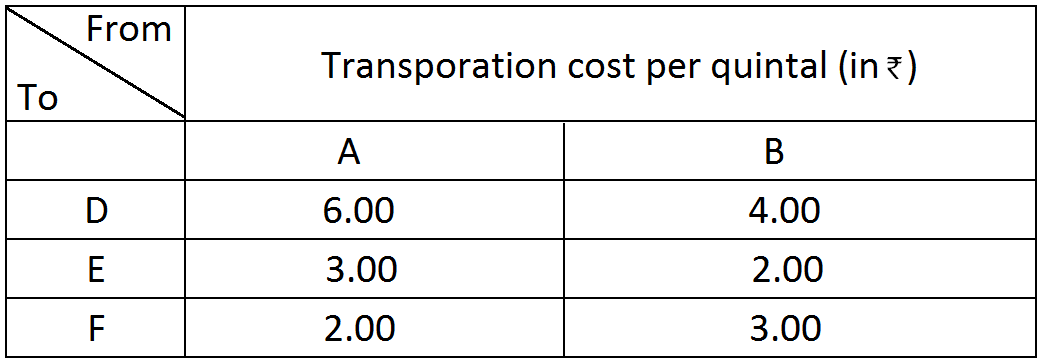
Tow godowns, $A$ and $B,$ have grain storage capacity of $100$ quintals and $50$ quintals respectively. They supply to $3$ ration shops, $D, E$ and $F$, whose requirements are $60, 50$ and $40$ quintals respectively. The cost of transportation per quintal from the godowns to the shops are given in the following table:


How should the supplies be transported in order that the transportation cost is minimum?