Question
Maximum Z = 3x + 4y
Subject to
$2\text{x}+2\text{y}\leq80$
$2\text{x}+4\text{y}\leq120$

Answer

We have to maximize Z = 3x + 4y First, we will convert the given inequations into equations, we obtain the following equations: 2x + 2y = 80, 2x + 4y = 120 Region represented by 2x + 2y ≤ 80: The line 2x + 2y = 80 meets the coordinate axes at A(40, 0) and B(0, 40) respectively. By joining these points we obtain the line 2x + 2y = 80. Clearly (0, 0) satisfies the inequation 2x + 2y ≤ 80. So,the region containing the origin represents the solution set of the inequation 2x + 2y ≤ 80. Region represented by 2x + 4y ≤ 120: The line 2x + 4y = 120 meets the coordinate axes at C(60, 0) and D(0, 30) respectively. By joining these points we obtain the line 2x + 4y ≤ 120. Clearly (0, 0) satisfies the inequation 2x + 4y ≤ 120. So,the region containing the origin represents the solution set of the inequation 2x + 4y ≤ 120. The feasible region determined by the system of constraints, 2x + 2y ≤ 80, 2x + 4y ≤ 120 are as follows:
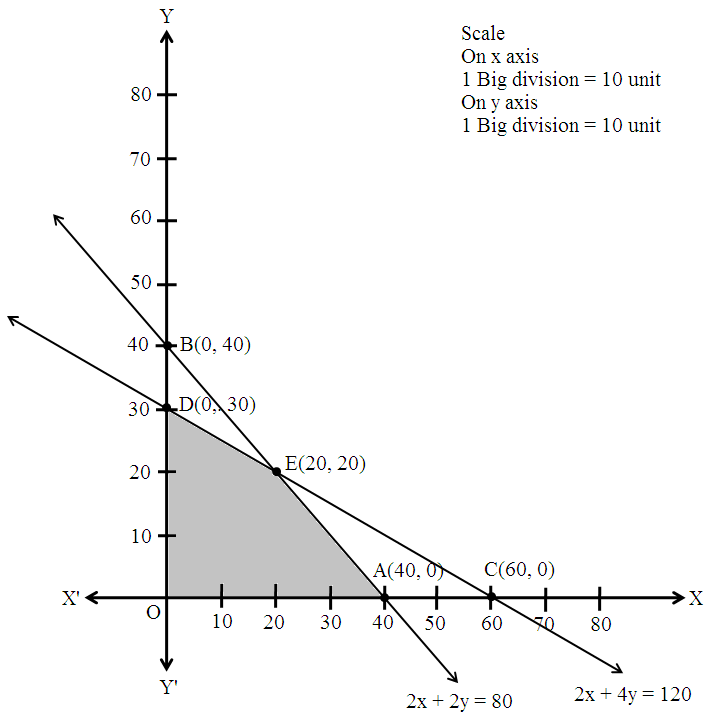
The corner points of the feasible region are O(0, 0), A(40, 0), E(20, 20) and D(0, 30). The values of Z at these corner points are as follows:
Corner point
Z = 3x +4y
O(0, 0)
3 × 0 + 4 × 0 = 0
A(40, 0)
3 × 40 + 4 × 0 = 120
E(20, 20)
3 × 20 + 4 × 20 = 140
D(0, 30)
10 × 0 + 4 × 30 = 120
We see that the maximum value of the objective function Z is 140 which is at E(20, 20) that means at x = 20 and y = 20. Thus, the optimal value of Z is 140.

Need a full question paper?

Generate a complete, print-ready paper with questions like this in minutes — across 16+ boards, with answer keys.

Start Generating Free

Similar questions

Prove that $\Big(\frac{\text{x}}{\text{a}}\Big)^\text{n}+\Big(\frac{\text{y}}{\text{b}}\Big)^\text{n}=2$ touches the straight line $\frac{\text{x}}{\text{a}}+\frac{\text{y}}{\text{b}}=2$ for all n $\in$ N, at all the point (a, b).
Of all the closed right circular cylindrical cans of volume $128\ \pi\ cm^3$ , find the dimensions of the can which has minimum surface area.
Using integration find the area of the region bounded by the curves $\text{y} = \sqrt{4 - \text{x}^{2}}, \text{x}^{2} + \text{y}^{2} \text{4x} = 0$ and the x-axis.
Evaluvate the following intregals:
$\int\frac{1}{1-\tan\text{x}}\text{ dx}$
$\text{If A} = \begin{bmatrix} 1 & 0 & 2 \\ 0 & 2 & 1 \\ 2 & 0 & 3 \end{bmatrix} \text{and A}^{3} - \text{6A}^{2} + \text{7A} + \text{kI}_{3} = \text{O find k.}$
Verify Lagrange's mean value theorem for the following function on the indicated intervals. find a point 'c' in the indicated interval as stated by the Lagrange's mean value theorem.
$f(x) = x^2 - 2x + 4$ on $[1, 5]$
Without using the concept of inverse of a matrix, find the matrix $\begin{bmatrix}\text{x}&\text{y}\\\text{z}&\text{u}\end{bmatrix}$ such that $\begin{bmatrix}5&-7\\-2&3\end{bmatrix}\begin{bmatrix}\text{x}&\text{y}\\\text{z}&\text{u}\end{bmatrix}=\begin{bmatrix}-16&-6\\7&2\end{bmatrix}$
Evaluate the following integrals:$\int\text{e}^{\text{x}}\Big(\frac{\sin4\text{x}-4}{1-\cos4\text{x}}\Big)\text{dx}$
Solve the following differential equations:
$\text{x}^2\text{dy}+\text{y}(\text{x + y})\text{dx}=0$
Find one-parameter families of solution curves of the following differential equation: (or solve the following differential equation)$\text{x}\frac{\text{dy}}{\text{dx}}-\text{y}=(\text{x}+1)\text{e}^{-\text{x}}$