MCQ
Maxwell’s equations describe the fundamental laws of
  • A
    Electricity only
  • B
    Magnetism only
  • C
    Mechanics only
  • Both $(a)$  and $(b)$

Answer

Correct option: D.
Both $(a)$  and $(b)$
d
(d) Maxwell's equation describe the fundamental laws of electricity and magnetism. His equations describe how electric and magnetic fields are generated and altered by each other and by charges and currents.

Need a full question paper?

Generate a complete, print-ready paper with questions like this in minutes — across 16+ boards, with answer keys.
Start Generating Free

Similar questions

A converging lens is used to form an image on a screen. When upper half of the lens is covered by an opaque screen
State which of the following is correct
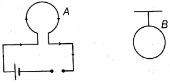
A system $S$ consists of two coils $A$ and $B$. The coil $A$ carries a steady current $I .$ While the coil $B$ is suspended nearby as shown in figure. Now, if the system is heated, so as to raise the temperature of two coils steadily, then
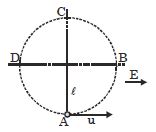
A simple pendulum with a bob of mass $m = 1\ kg$ , charge $q = 5\mu C$ and string length $l = 1\ m$ is given a horizontal velocity $u$ in a uniform electric field $E = 2 × 10^6\ V/m$ at its bottom most point $A$ , as shown in figure. It is given a speed $u$ such that the particle leave the circular path at its topmost point $C$ . Find the speed $u$ . (Take $g = 10\ m/s^2$ )
Assertion : A paramagnetic sample display greater magnetisation (for the same magnetic field) when cooled.

Reason : The magnetisation does not depend on temperature.
Choose the correct answer from the alternatives given. The conduction current is the same as displacement current when the source is.
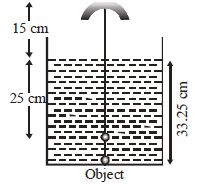
A concave mirror is placed over a beaker containing water of $\mu = 1.33$ and image of the object placed at the bottom of beaker is formed at a distance of $25\, cm$ from the top, then focal length of the mirror is nearly......$cm$
Consider the following statements:

$I$. All isotopes of an element have the same number of neutrons.

$II$. Only one isotope of an element can be stable and non-radioactive.

$III$. All elements have isotopes.

$IV$. All isotopes of carbon can form chemical compounds with oxygen-$16$.

Choose the correct option regarding an isotope.
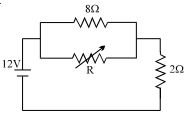
The value of the resistance $R$ in figure is adjusted such that power dissipated in the $2\,\Omega$ resistor is maximum. Under this condition
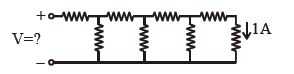
Each element in the finite chain of resistors shown in the figure is $\,1\,\Omega $ . A current of $1\, A$ flows through the final element. Then what is the potential difference $V$ across input terminals of the chain .................. $\mathrm{volt}$